Can Juniors Get Hired in the AI Job Market?
TL;DR
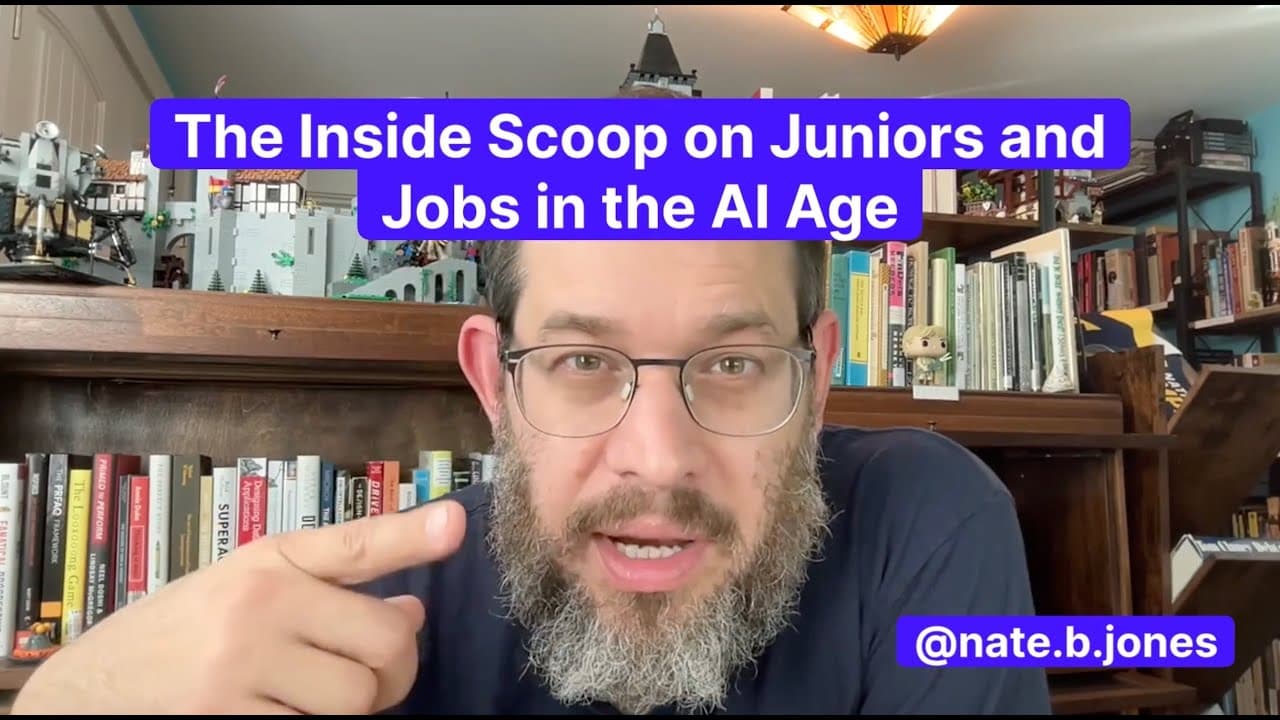
Juniors can still get hired in the AI job market, but they must overcome an AI-driven loss of reliable hiring signals by becoming known for a specific niche. Perfect resumes, automated screening, and AI interviews make high-potential candidates harder to identify, while average tech tenure remains only two to two and a half years. Read on to see why companies still need junior talent and how candidates can stand out.
Transcript
One of the biggest questions in the labor market right now is what happens to juniors? What happens to people early in their careers? Everybody's asking me this, but also we're seeing quantitative data that suggests that this is going to become a different AI story depending on where you are in your seniority when the AI curve hits your business. F... Read More
Key Insights
- The AI story for your career depends on your seniority when the AI curve hits your business, with seniors who combine domain experience and AI knowledge breaking through the ceiling on compensation and job openings.
- Domain expertise plus AI is described as the new gold standard for hiring, opening up both large compensation jumps and additional roles for people who hold that dual skill set.
- Some seniors with deep domain experience but no AI experience are choosing early retirement rather than learn AI, walking away to do woodworking, open a bookshop, or start a coffee shop instead of continuing in tech.
- It is harder now than ever to assess talent because AI has obfuscated, hidden, and camouflaged the signal that once let hiring managers tell a high-ramp junior from a low-ramp one, and that difficulty sits at the root of the job market issue.
- AI created an arms-race condition where everyone submits perfect resumes and recruiters use AI to read them and run initial interviews, none of which produces the gut-level conviction that a junior has real potential.
- Hiring only seniors who use AI agents while skipping juniors is a real but short-term strategy, because average tech tenure is still two to two and a half years and vacant senior roles will need people who know the business, the domain, and how to manage AI agents.
- Companies face a Cambrian explosion of role experimentation, and not all of those roles will survive once people figure out what actually works, but the continual need for energetic junior talent that can ramp into senior ranks persists.
- The best way for a junior to stand out is to become one of one on a specific focus area, obsessing over an online profile built around a chosen niche rather than maxing the same generic variables everyone else competes on.
Install to Summarize YouTube Videos and Get Transcripts
Explore YouTube Video Summarizer or Get YouTube Transcript Extractor
Questions & Answers
Q: Can juniors get hired in the AI job market?
Yes, companies still need energetic junior talent that can quickly develop into senior ranks. Hiring is difficult because AI has made genuine potential harder to identify, so juniors must give employers a convincing signal of their dedication, domain focus, and ability to grow.
Q: Why is the AI job market so difficult for junior candidates?
Interviews are scarce, and initial interviews may be conducted by AI in what candidates describe as a soulless process. The deeper problem is that employers now have less reliable evidence for distinguishing juniors who can rapidly become senior contributors.
Q: How has AI obscured the hiring signal for junior talent?
Candidates can use AI to submit polished resumes, while recruiters use AI to read applications and conduct initial interviews. This arms race does not create the gut-level conviction that helps an experienced hiring manager recognize a promising junior engineer, PM, or marketer.
Q: What is the new gold standard for hiring in the AI age?
The new gold standard is domain expertise combined with AI knowledge. Senior workers with both skill sets are seeing compensation jumps and additional job openings, including openings created when experienced workers without deep AI knowledge leave tech.
Q: Why is hiring AI-equipped seniors instead of juniors a short-term strategy?
Senior employees may handle current work with AI agents, but they can be promoted, change roles, or leave. Because average tech tenure is still two to two and a half years, companies may soon need replacements who understand their business, domain, and AI agents without having developed that talent internally.
Q: How can a junior stand out in a crowded AI job market?
A junior should become “one of one” by choosing a specific focus area and building an online profile around it. This creates a clearer signal than competing on generic measures such as LinkedIn connections, webinar attendance, or cover-letter polish.
Q: What examples demonstrate the “one of one” job-search strategy?
One person focused on the intersection of sales enablement and entrepreneurship, then created customized spearfishing videos for targeted employers and performed well in the job search. Another possible niche is AI automation within a specific subdomain, supported by the ability to explain tradeoffs among n8n, Zapier, Make, and other platforms.
Q: Why will companies continue to need junior employees?
People change roles too frequently for companies to stop developing new talent, and vacant positions still require knowledge of the business and domain. Although companies are experimenting with many AI-era roles and not all will survive, the need for energetic juniors who can advance into senior ranks remains.
Summary & Key Takeaways
-
AI splits the labor market by seniority. Senior workers who pair domain experience with AI knowledge see soaring compensation and expanding openings, making domain expertise plus AI the new gold standard. Seniors with domain depth but no AI skills often choose early retirement, opening roles that go to dual-skilled candidates rather than to unproven juniors.
-
Juniors face a rough market where interviews are scarce, often AI-conducted and soulless. The deeper problem is that AI has obscured the signal hiring managers once used to identify high-ramp talent. Perfect AI-written resumes and AI-run screening rounds prevent the gut-level conviction that lets an experienced hirer bet on a junior with real potential.
-
Companies skipping juniors in favor of AI-equipped seniors are betting short-term, since tech tenures average two to two and a half years and vacated senior roles will demand fresh talent. The advice: build smart redundancy in hiring, and as a junior, become one of one by obsessing over a chosen niche because people still build products for people.
Read in Other Languages (beta)
Share This Summary 📚
Summarize YouTube Videos and Get Video Transcripts with 1-Click
Try YouTube Summary with ChatGPT & Claude or YouTube Transcript Generator
Explore More Summaries from AI News & Strategy Daily | Nate B Jones 📚



Summarize YouTube Videos and Get Video Transcripts with 1-Click
Try YouTube Summary with ChatGPT & Claude or YouTube Transcript Generator