How IDPro Supports Identity Professionals
TL;DR
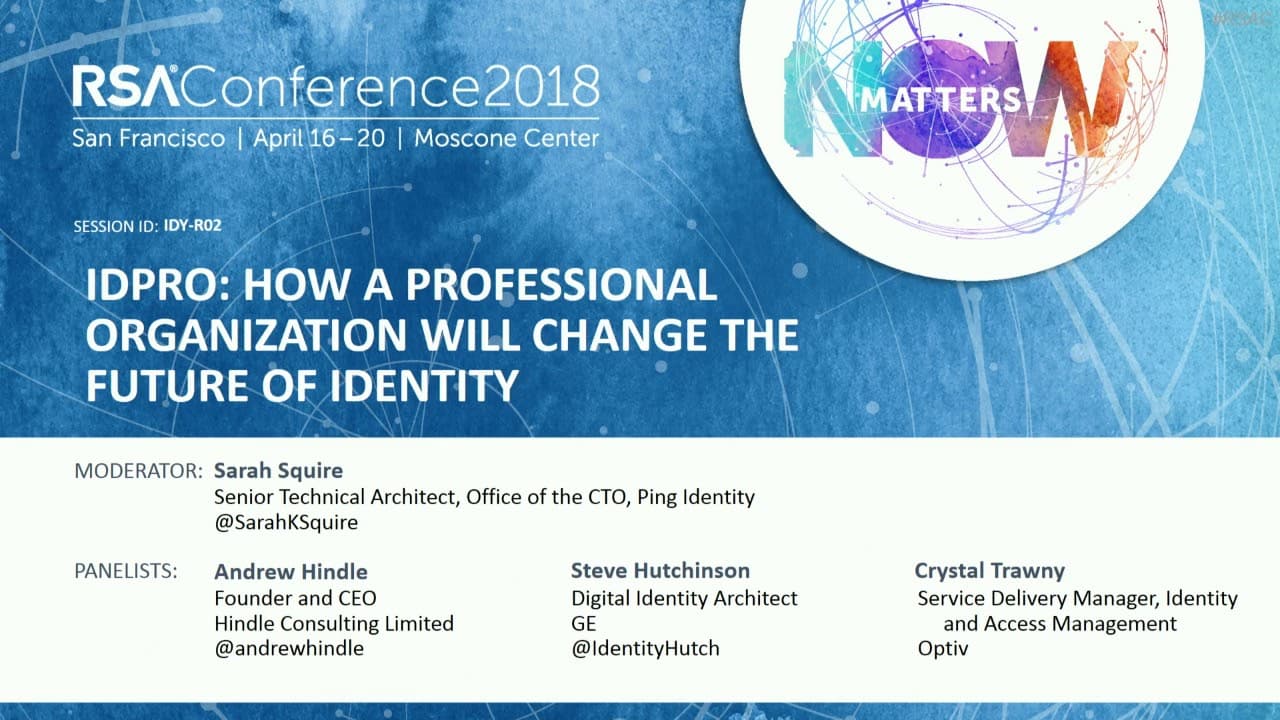
IDPro gives identity practitioners a professional community for discussing problems, sharing practices, and responding to security issues together. Its planned body of knowledge and certification could establish baseline expertise, improve training, and help employers evaluate candidates, while its Slack channel, email list, event directory, and worldwide meetups already connect practitioners across varied technical and nontechnical backgrounds.
Transcript
You are here at the IDPro panel. Thank you so much for being here bright and early on Thursday morning. Um, let me tell you a bit about how this is gonna work. Uh, I'm gonna introduce to you, um, three of my close personal friends. I have picked these people to come to you today because they not only have a huge breadth of knowledge and experience ... Read More
Key Insights
- IDPro is a professional organization created for identity practitioners to discuss their field, share best practices, and address everyday operational problems. It was founded in June 2017 and was described as the first professional organization specifically serving people who work in digital identity.
- Identity careers can begin through many different routes, including programming, networking, help-desk work, account administration, information systems, enterprise architecture, physics, history, and business roles. The panelists' backgrounds show that identity practice combines technical expertise with organizational, historical, and management perspectives.
- IDPro's member communication channels are designed to provide practical, timely support. Its Slack channel and email discussion list allow practitioners to exchange technical information, compare organizational responses, discuss identity topics, and maintain professional relationships beyond formal conferences or employer-specific teams.
- A SAML library vulnerability became an early demonstration of IDPro's real-time value. Members used the community to determine who was exposed, clarify the nature of the vulnerability, track which parties had patched it, and compare approaches for communicating the issue to customers.
- IDPro's events directory collects identity-related events occurring around the world. The organization also supports meetups in nearly every major United States city, several European locations, and Australia, giving practitioners opportunities to build regional connections alongside participation in its online channels.
- A body of knowledge is a major long-term goal for IDPro. The proposed resource would document the different ways identity work is performed, the subjects included in the field, and the practical knowledge practitioners may need, creating a shared foundation for a comparatively immature security discipline.
- An identity certification is planned to follow the development of IDPro's body of knowledge. The intended credential would indicate that a person possesses baseline knowledge about identity, responding to corporate members who want clearer and easier ways to hire and train identity practitioners.
- Identity programs include responsibilities such as user life-cycle automation, account administration, privileged access management, single sign-on, federation, security architecture, and service delivery. The panelists' careers illustrate how these functions can develop from earlier work in help desks, programming, networking, or enterprise systems.
Install to Summarize YouTube Videos and Get Transcripts
Explore YouTube Video Summarizer or Get YouTube Transcript Extractor
Questions & Answers
Q: What is IDPro and why was it created?
IDPro is a professional organization for identity practitioners, founded in June 2017. It was created so people working in identity could discuss their field, share best practices, and work through everyday problems together. The organization addresses a need for a dedicated professional community in a comparatively immature area of information security, with resources that support both practical collaboration and the future development of shared professional knowledge.
Q: How does IDPro help identity practitioners today?
IDPro currently helps practitioners through an email discussion list, a Slack channel, an online directory of identity events, and worldwide meetups. Members use these channels to discuss identity, exchange practical knowledge, build professional connections, and respond to current problems. The meetups extend the community into major United States cities, several European locations, and Australia, while the online channels support ongoing communication between events.
Q: How did IDPro respond to the SAML library vulnerability?
When a SAML library vulnerability was released, IDPro members discussed the issue through the organization's Slack channel and email list. They worked through who was vulnerable, what the vulnerability actually involved, who had issued patches, who had not patched, and how organizations were communicating with customers. The incident served as an early test of IDPro's ability to provide useful, real-time collaboration for its members.
Q: What body of knowledge does IDPro plan to create?
IDPro plans to assemble a body of knowledge covering identity as a whole. The intended resource would explain the different ways practitioners perform identity work, identify the subjects and responsibilities within the field, and gather the knowledge someone might need to understand identity practice. The organization recognizes that this will be a large project and plans to pursue it after developing stronger operational foundations.
Q: Why does IDPro want to offer an identity certification?
IDPro wants a certification that can show whether someone has baseline knowledge about identity. Corporate members have requested such a credential because it could make hiring easier and give employers a clearer basis for training staff. The organization intends to develop the certification after completing its planned body of knowledge, allowing the credential to rest on a defined and broadly organized professional foundation.
Q: What career backgrounds can lead to identity and access management?
The panel shows that identity professionals can enter the field from both technical and nontechnical backgrounds. Their experience includes Japanese, history, physics, information management, management information systems, help-desk support, programming, networking, consulting, security architecture, and account administration. Several panelists moved into identity indirectly as their responsibilities expanded into provisioning, access management, federation, privileged access, or broader enterprise security work.
Q: What work is included in an enterprise identity program?
The identity work described by the panel includes account administration, automated user life-cycle management, privileged access management, single sign-on, federation, enterprise security architecture, and service delivery. These responsibilities connect technical tools with organizational processes. For example, one panelist progressed from creating email accounts to developing a broader identity program, while another moved from programming and networking into architecture and enterprise identity leadership.
Q: How can organizations train new identity professionals?
The panel indicates that organizations may currently rely on internally created materials, employer-specific presentations, documentation, and training about particular tools. At GE, training was described as highly specific to the company and the system a new employee would manage. IDPro's proposed body of knowledge and certification aim to provide a broader shared foundation that could supplement such internal training and establish baseline identity knowledge.
Summary & Key Takeaways
-
IDPro was founded in June 2017 as a professional organization where identity practitioners could discuss their field, share best practices, and solve everyday problems. Its existing services include a Slack community, an email discussion list, a global identity-events directory, and meetups in major United States cities, Europe, and Australia.
-
A disclosed SAML library vulnerability provided an early test of IDPro's practical value. Members discussed who was vulnerable, what the flaw involved, which parties had issued patches, and how organizations were communicating with customers. The exchange demonstrated how a practitioner community can coordinate useful information during a security issue in real time.
-
IDPro plans to create a comprehensive body of knowledge describing the methods, responsibilities, and subject areas within identity. After establishing that foundation, it hopes to offer a certification representing baseline identity knowledge. Corporate members believe such a credential could make hiring easier and provide organizations with a clearer structure for employee training.
Read in Other Languages (beta)
Share This Summary 📚
Summarize YouTube Videos and Get Video Transcripts with 1-Click
Try YouTube Summary with ChatGPT & Claude or YouTube Transcript Generator
Explore More Summaries from RSAC Cybersecurity 📚



Summarize YouTube Videos and Get Video Transcripts with 1-Click
Try YouTube Summary with ChatGPT & Claude or YouTube Transcript Generator