How to Build a Browser AI Agent with LLM and Playwright
TL;DR
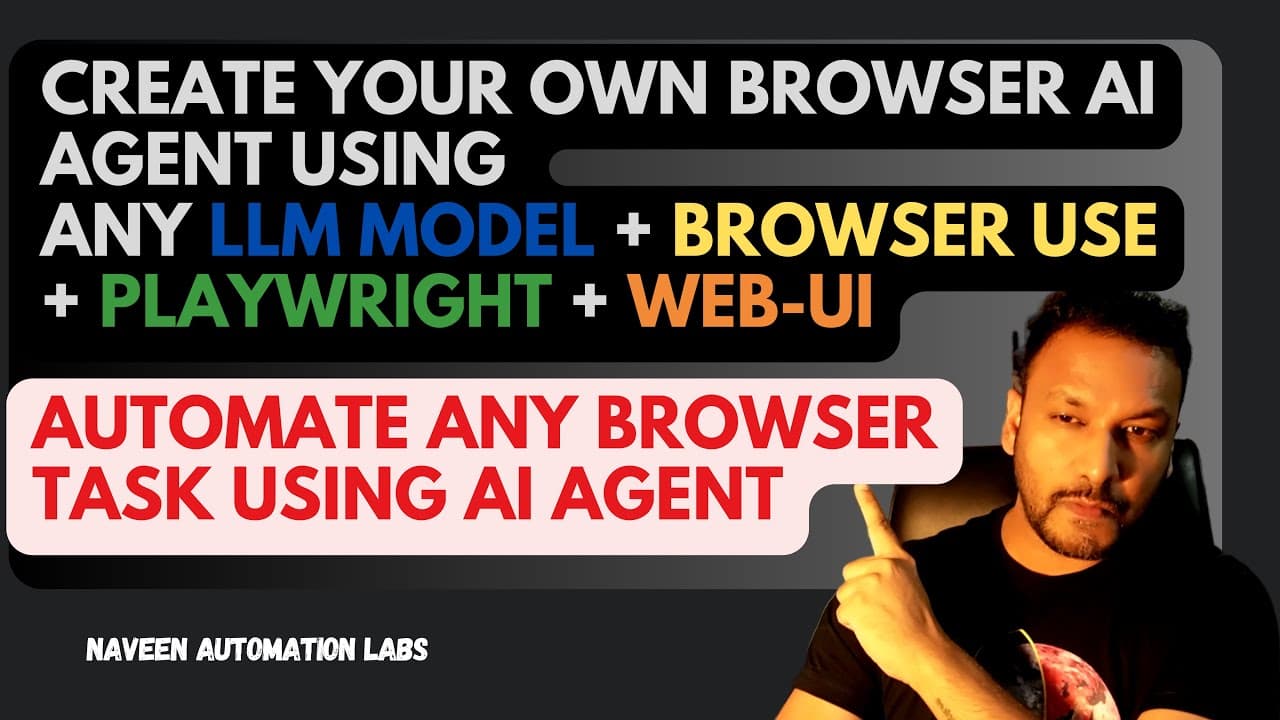
Create a powerful browser AI agent using LLM models and Playwright to automate tasks such as job applications and e-commerce orders. This guide walks you through the installation of necessary tools and provides practical examples of how to configure the AI agent to perform specific actions in the browser without needing to write code.
Transcript
hey guys this is nav welcome back to navine automation labs and back to our AI agent Series so today I'll show you how to create your own browser AI agent through which you can just execute your task on the browser whatever you want to do with respect to let's you really want to place the order on Amazon or you really want to submit... Read More
Key Insights
- The video provides a step-by-step process to create a browser AI agent that can automate tasks such as ordering on Amazon or applying for jobs without manual intervention.
- The video introduces 'browser use', an open-source project that enables AI to control browsers, making it the easiest way to connect AI agents with browsers.
- Python is essential for setting up the browser AI agent, as the models and necessary installations are compatible with Python.
- Playwright, a web automation tool by Microsoft, is used alongside 'browser use' to interact with the browser and execute tasks.
- Web UI, another open-source project, is introduced to provide an interface for configuring LLM models and running prompts.
- The video demonstrates how to set up a Python environment using 'UV', a fast Python package manager written in Rust.
- The process of configuring an LLM provider, such as OpenAI or Google Gemini, is detailed, including obtaining and using API keys.
- The video showcases practical examples like logging into websites, searching for products, and automating e-commerce workflows using simple prompts.
Install to Summarize YouTube Videos and Get Transcripts
Explore YouTube Video Summarizer or Get YouTube Transcript Extractor
Questions & Answers
Q: What is the purpose of creating a browser AI agent?
The purpose of creating a browser AI agent is to automate repetitive tasks on the browser, such as placing orders, applying for jobs, or any other web-based activity that requires manual intervention. This automation can save time and effort, allowing users to focus on more critical tasks. The agent can execute these tasks by interpreting prompts and interacting with browser elements, making it a powerful tool for personal and professional use.
Q: What tools are necessary to set up the browser AI agent?
To set up the browser AI agent, several tools are necessary: Python, as the base programming language; 'browser use', an open-source project that connects AI agents with browsers; Playwright, a web automation tool by Microsoft; and Web UI, which provides an interface for configuring LLM models and running prompts. Additionally, a Python environment manager like 'UV' is used to manage packages and dependencies efficiently.
Q: How does 'browser use' facilitate AI control over browsers?
'Browser use' is an open-source project that enables AI to control browsers by providing a straightforward way to connect AI agents with browser interfaces. It interprets prompts given by users and performs corresponding actions on the browser, such as clicking links, filling forms, and navigating pages. This tool abstracts the complexity of direct browser manipulation, allowing users to focus on specifying tasks rather than coding interactions.
Q: What role does Playwright play in the AI agent setup?
Playwright plays a crucial role in the AI agent setup as it is a web automation tool that facilitates interaction with browser elements. Developed by Microsoft, Playwright allows the AI agent to execute web-based tasks such as navigating pages, filling forms, and clicking buttons. It works in conjunction with 'browser use' to provide a seamless automation experience, enabling the AI agent to perform tasks without manual coding.
Q: How is the Python environment set up for this project?
The Python environment for this project is set up using 'UV', a fast Python package manager written in Rust. Users need to install UV and use it to create a virtual environment where all necessary dependencies and packages for the browser AI agent can be managed. This setup ensures that the Python environment is isolated and optimized for running the AI agent, preventing conflicts with other projects.
Q: How are LLM providers configured in the Web UI?
LLM providers, such as OpenAI or Google Gemini, are configured in the Web UI by selecting the preferred provider and entering the required API key. Users can choose from various LLM providers, each offering different capabilities and pricing models. The configuration process involves obtaining an API key from the provider's platform and inputting it into the Web UI, allowing the AI agent to leverage the provider's language models for task execution.
Q: What are some practical examples demonstrated in the video?
The video demonstrates practical examples of using the browser AI agent, such as logging into websites, searching for products, and automating e-commerce workflows. It shows how to write prompts in plain English to instruct the AI agent on tasks like placing orders, filling forms, and navigating pages. These examples highlight the agent's ability to perform complex web-based activities without manual coding, showcasing its potential for various applications.
Q: What are the benefits of using a browser AI agent?
The benefits of using a browser AI agent include increased efficiency and productivity by automating repetitive web-based tasks. It reduces the need for manual intervention, allowing users to focus on more critical activities. The agent's ability to interpret prompts and execute tasks without coding knowledge makes it accessible to a broader audience. Additionally, it can be customized with different LLM providers and configurations to suit specific needs and preferences.
Summary & Key Takeaways
-
This video tutorial guides viewers through creating a browser AI agent using LLM models, Playwright, and Web-UI. It details the installation and configuration process, including setting up Python, browser use, Playwright, and Web UI, to automate tasks like job applications and e-commerce orders.
-
The tutorial emphasizes the simplicity of using browser use and Playwright to connect AI agents with browsers, eliminating the need for manual coding. It also highlights the importance of configuring LLM providers, such as OpenAI or Google Gemini, to enhance the AI agent's capabilities.
-
Practical examples demonstrate the agent's ability to perform tasks like logging into websites, searching for products, and placing orders. The video encourages viewers to explore various prompts and configurations to maximize the potential of their browser AI agents.
Read in Other Languages (beta)
Share This Summary 📚
Summarize YouTube Videos and Get Video Transcripts with 1-Click
Try YouTube Summary with ChatGPT & Claude or YouTube Transcript Generator
Explore More Summaries from Naveen AutomationLabs 📚
Summarize YouTube Videos and Get Video Transcripts with 1-Click
Try YouTube Summary with ChatGPT & Claude or YouTube Transcript Generator