What Interview Questions Should Junior React Developers Expect?
TL;DR
Junior React developers should prepare for a variety of interview questions covering JavaScript fundamentals, such as hoisting, closures, and promises, as well as React-specific topics like state management and lifecycle methods. Understanding the differences between class and functional components, along with key concepts like async/await, is essential for success in interviews.
Transcript
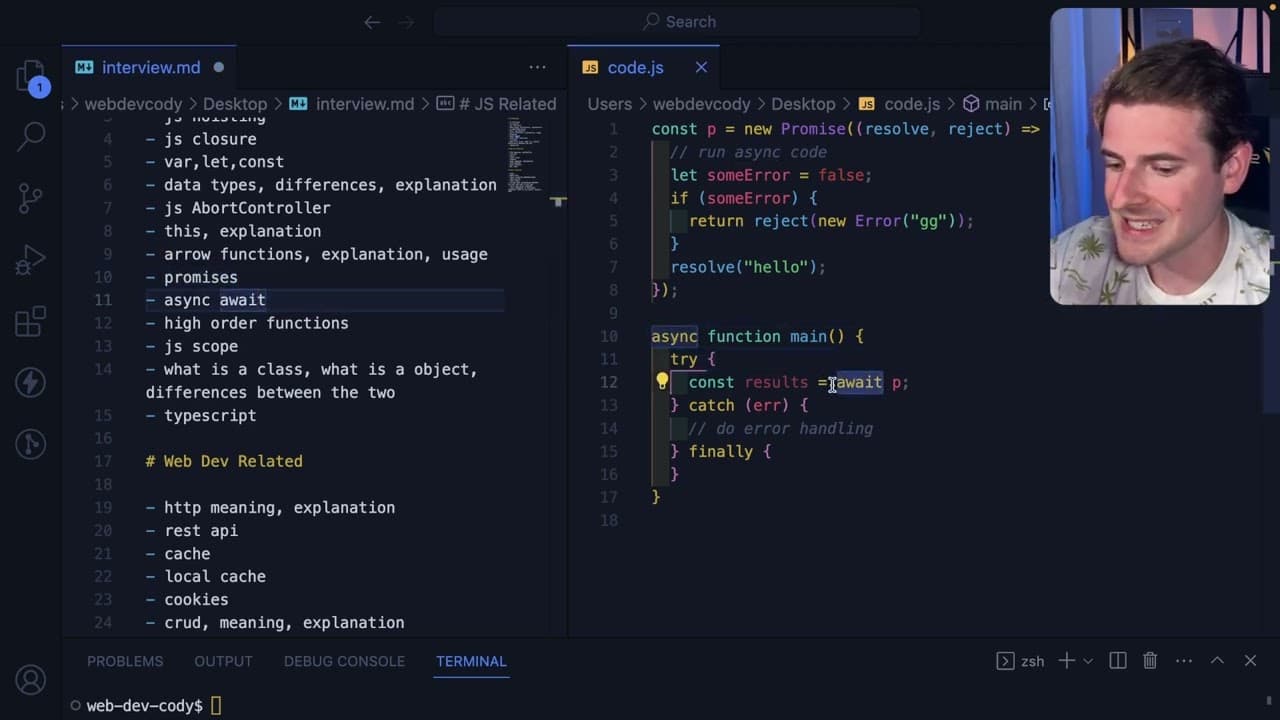
so one of my subscribers reached out to me and said I just did an interview for a junior react front-end developer position and he actually shared with me all the questions that he was asked so I'm gonna try to go through these as fast as possible and just kind of tell you the things that I know about the topics some of these things I'd probably ha... Read More
Key Insights
- 🤙 Understanding JavaScript hoisting is critical for managing function calls and variable access within different scopes.
- 🔒 Closures are important in JavaScript for creating private data but may require deeper explanation during interviews.
- 💌 The var, let, and const keywords serve different purposes, influencing variable scope and mutability critical for clean coding practices.
- 🤝 Async/await is considered syntactic sugar for promises, enhancing code clarity and error handling when dealing with asynchronous tasks.
- 👻 React's state management system, using hooks like useState, allows components to respond to user inputs efficiently.
- 👨💻 React's lifecycle methods enable developers to execute specific code at various stages of a component's existence and manage cleanup effectively.
- 🏛️ The choice between class and functional components has shifted towards functional components due to their simplicity and better support for hooks.
Install to Summarize YouTube Videos and Get Transcripts
Explore YouTube Video Summarizer or Get YouTube Transcript Extractor
Questions & Answers
Q: What are some key JavaScript concepts junior developers should understand?
Junior developers should be well-versed in concepts such as hoisting, closures, and the differences between var, let, and const. They must understand how JavaScript manages variable scope and the implications of function declarations versus expressions. Familiarity with promises and asynchronous programming using async/await is also vital for handling asynchronous tasks effectively in web applications.
Q: Can you explain what closures are in JavaScript?
Closures in JavaScript are functions that maintain access to their lexical scope, even when the outer function has finished executing. They allow the inner function to access variables of the outer function, enabling the creation of private variables. This concept is widely used for data encapsulation, making closures essential for understanding JavaScript's functional programming capabilities.
Q: How does state management work in React?
In React, state is a built-in feature that allows developers to maintain and track data associated with components. The useState hook is generally used for functional components to create state variables. When the state updates, React re-renders the component, reflecting the changes to the user interface, making state management fundamental to interactive applications built with React.
Q: What are React lifecycle methods?
React lifecycle methods are functions that allow developers to hook into different phases of a component's life: mounting, updating, and unmounting. For functional components, the useEffect hook can mimic these lifecycle phases, allowing code to run when a component mounts, updates, or unmounts. Understanding these lifecycle methods is crucial for managing side effects in React applications.
Summary & Key Takeaways
-
A subscriber shared interview questions he faced for a junior React front-end developer role, covering topics from JavaScript to React.
-
The video provides explanations of crucial JavaScript concepts such as hoisting, closures, promises, async/await, and differences among var, let, and const.
-
It also discusses React-specific topics, including state management, lifecycle methods, and the distinction between class and functional components.
Read in Other Languages (beta)
Share This Summary 📚
Summarize YouTube Videos and Get Video Transcripts with 1-Click
Try YouTube Summary with ChatGPT & Claude or YouTube Transcript Generator
Explore More Summaries from Web Dev Cody 📚

Summarize YouTube Videos and Get Video Transcripts with 1-Click
Try YouTube Summary with ChatGPT & Claude or YouTube Transcript Generator