What Challenges Did Shūji Nakamura Overcome to Create the Blue LED?
TL;DR
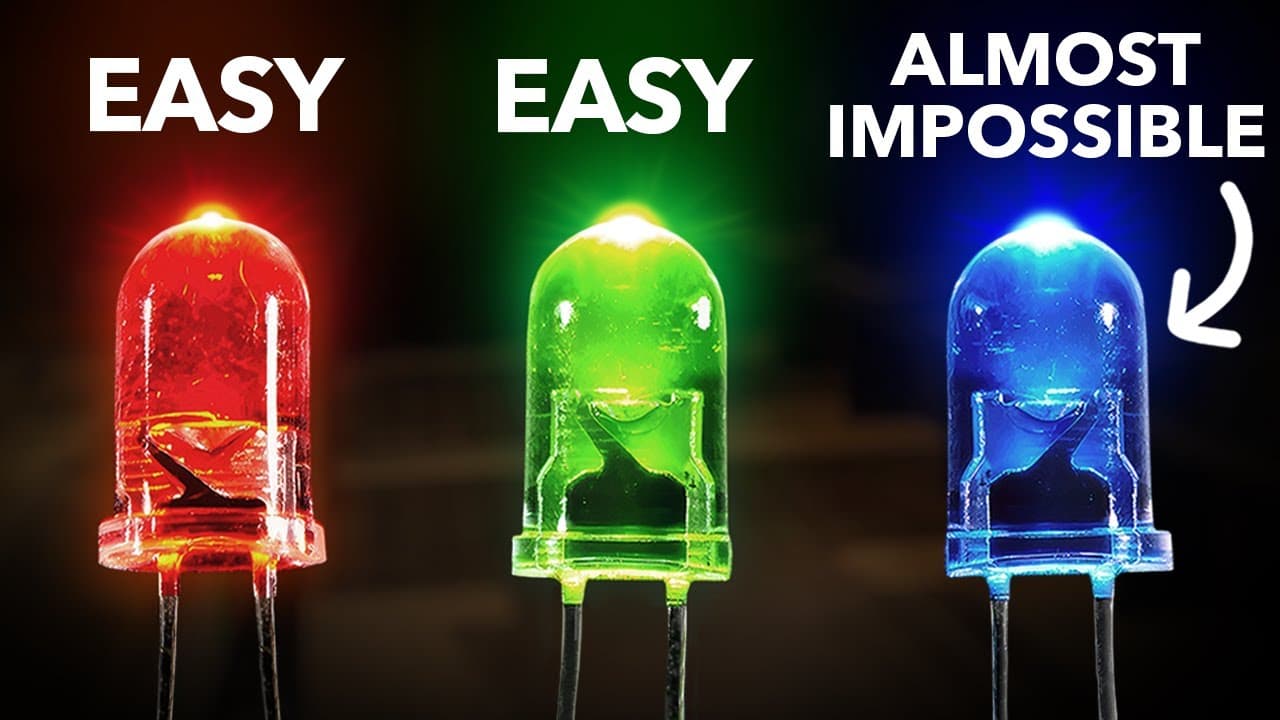
The blue LED was almost impossible because for roughly 30 years every major electronics company, from IBM to GE to Bell Labs, raced to build one and failed. Engineer Shūji Nakamura at the small Japanese firm Nichia finally cracked it with three radical breakthroughs, backed by a 500 million yen (about $3 million) gamble from president Nobuo Ogawa. Read on for how blue completed red and green to unlock white light.
Transcript
- LEDs don't get their color from their plastic covers. And you can see that because here is a transparent LED that also glows the same red color. The color of the light comes from the electronics themselves. The casing just helps us tell different LEDs apart. In 1962, general Electric engineer Nick Holonyak created the first visible LED. It glowed... Read More
Key Insights
- 👫 The color of an LED comes from the electronics, not the plastic cover.
- 🩵 The creation of the blue LED was a significant breakthrough that enabled the production of white light and expanded the use of LEDs in various applications.
- 🤔 Nakamura's perseverance and critical thinking skills were instrumental in overcoming challenges and pioneering advancements in LED technology.
Install to Summarize YouTube Videos and Get Transcripts
Explore YouTube Video Summarizer or Get YouTube Transcript Extractor
Questions & Answers
Q: Why was the blue LED almost impossible to make?
Throughout the 1960s and beyond, every big electronics company in the world, from IBM to GE to Bell Labs, raced to create the blue LED because they knew it would be worth billions. Despite the efforts of thousands of researchers, nothing worked for roughly 30 years. Making blue required breakthroughs in crystal formation and materials that no established lab had solved.
Q: Who created the first blue LED?
Shūji Nakamura, a researcher at a small Japanese chemical company named Nichia, made the world's first blue LED. He defied the entire industry and achieved three radical breakthroughs to do it, after larger companies like Sony, Toshiba, and Panasonic had all failed.
Q: Why is a blue LED so important for lighting?
Before it, engineers only had red and green LEDs, so LEDs could only be used in indicators, calculators, and watches. With blue, you can mix red, green, and blue to make white and every other color. This unlocked LEDs for every type of lighting, from light bulbs to phones, computers, TVs, and billboards.
Q: Who made the first visible LED, and what colors existed before blue?
In 1962, General Electric engineer Nick Holonyak created the first visible LED, which glowed a faint red. A few years later, engineers at Monsanto created a green LED. For decades those were the only two colors available.
Q: How much did Nichia invest in Nakamura's blue LED project?
After more than a decade of losses on semiconductors, Nichia's founder and president Nobuo Ogawa took a gamble and devoted 500 million yen, or about $3 million, to Nakamura's moonshot. That was likely around 15% of the company's annual profit at the time.
Q: What conditions did Nakamura work under at Nichia?
Nichia was short on money, so Nakamura's lab mainly consisted of machinery he had scavenged and welded together himself. Phosphorus leaks caused so many explosions that his coworkers stopped checking in on him. Senior workers called his research a waste of money, and by 1988 his supervisors told him to quit.
Q: Where does an LED's color actually come from?
The color comes from the electronics themselves, not the plastic cover. A transparent LED still glows the same red, which shows the casing only helps us tell different LEDs apart. The light's color is set by the semiconductor materials and their energy band gap.
Q: Why are LEDs more efficient than traditional light bulbs?
Light bulbs run current through a tungsten filament until it glows, but most of the energy comes out as infrared heat and only a negligible fraction as visible light. LED stands for light emitting diode, and LEDs primarily create light rather than heat, so they are far more efficient.
Summary & Key Takeaways
-
LEDs were limited to indicators, calculators, and watches until the creation of the blue LED, which allowed for the production of white light and opened the doors for LED lighting in various applications.
-
Shūji Nakamura, a researcher at Nichia, faced a lack of support and resources but persevered to create breakthroughs in crystal formation, p-type gallium nitride, and efficient LED structures.
-
The blue LED developed by Nakamura became a significant success for Nichia, leading to the company's rapid expansion and dominance in the LED market.
Read in Other Languages (beta)
Share This Summary 📚
Summarize YouTube Videos and Get Video Transcripts with 1-Click
Try YouTube Summary with ChatGPT & Claude or YouTube Transcript Generator
Explore More Summaries from Veritasium 📚






Summarize YouTube Videos and Get Video Transcripts with 1-Click
Try YouTube Summary with ChatGPT & Claude or YouTube Transcript Generator