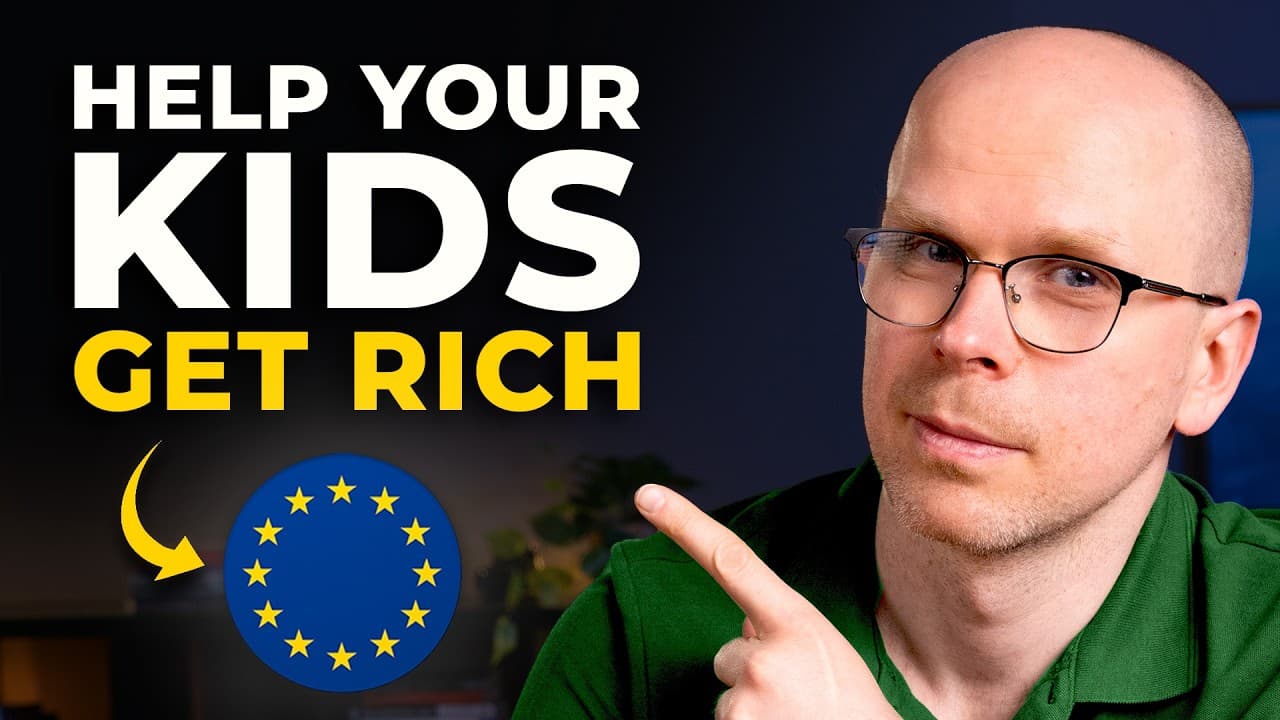
How to Invest for Your Children's Future in Europe
TL;DR
Invest consistently in broadly diversified stock ETFs and automate contributions as soon as your salary arrives. Because European account, tax, and brokerage rules differ by country, compare local requirements carefully and usually retain control through an account in your own name, unless asset protection, inheritance, or gift-tax considerations make a child-owned account more suitable.
Transcript
If you're thinking about investing for your kids' future, I've got good news and bad news. The good news is this really is a tremendous opportunity for you, your kids, and your family. I've been a professional investor for 18 years, but I only started investing my own money, seriously, 9 years ago, and that's when my son was born. That was the happ... Read More
Key Insights
- Long-term compounding is the central advantage of investing early for children. In the example, investing €200 each month for 18 years at an assumed 9% annual return creates €104,000, even though the account begins with no initial capital.
- Continued investment can multiply an early financial head start without further contributions. The illustrated €104,000 grows to €291,000 by age 30, €690,000 by age 40, and almost €6 million by retirement if it remains invested at the assumed return.
- A realistic contribution should balance a child's future with the parent's retirement. Parents can test monthly amounts such as €50, €100, or €200 and annual returns such as 7%, 8%, or 9%, but should avoid neglecting their own financial security.
- Cash savings may be too conservative for an 18-year objective. The transcript argues that a high-yield account paying 2% annually may not cover inflation, causing purchasing power to decline instead of allowing the child's assets to compound through long-term market growth.
- Concentrated investments can expose a child's fund to permanent losses. The transcript states that historically as many as 11% of stocks have gone to zero and as many as 40% have suffered losses of 70% without recovering, making a small stock portfolio risky.
- Broad ETFs provide diversification with limited ongoing effort. They can distribute contributions among hundreds of companies across countries and industries, reducing dependence on any single business or sector while giving amateur investors a straightforward way to participate in long-term stock-market growth.
- Account ownership determines control, access, and the eventual transfer of money. Assets placed in a child's name belong to the child, may face legal restrictions, might be unavailable during a family emergency, and can become fully controlled by the child at age 18.
- Automatic contributions support investing discipline over many years. The recommended approach is to pay the child first by scheduling a transfer from the checking account to investments as soon as salary arrives, instead of hoping that money remains available at the end of each month.
Install to Summarize YouTube Videos and Get Transcripts
Explore YouTube Video Summarizer or Get YouTube Transcript Extractor
Questions & Answers
Q: How much should parents invest for a child each month?
Parents should choose a contribution that is sustainable alongside their own retirement saving. The transcript suggests testing scenarios such as €50, €100, or €200 per month and comparing possible annual returns of 7%, 8%, or 9%. The goal is to establish a realistic amount that can be maintained consistently without creating a future situation in which the parents become financially dependent on their children.
Q: How can €200 monthly grow over an 18-year period?
The video's example begins with zero, invests €200 every month for 18 years, and assumes a 9% annual return based on the stated average of the global stock market over the previous 50 years. Under those assumptions, the account reaches €104,000. The example is presented as enough for a college fund or a down payment on a desirable apartment, although investing always involves risk.
Q: Why are diversified ETFs suitable for a child's investment fund?
Diversified ETFs can place money into hundreds of companies across different countries and industries, so the child's future does not depend on a few individual businesses. If one company or industry encounters serious problems, the wider portfolio offers protection through diversification. ETFs are also described as passive investments because parents can contribute money with relatively little ongoing work while participating in long-term stock-market growth.
Q: Why can individual stocks be risky when investing for children?
A portfolio containing only a few individual stocks can suffer permanent damage if one selection collapses. The transcript states that as many as 11% of stocks historically have gone to zero, while as many as 40% have experienced catastrophic losses, defined there as losing 70% of their value and never recovering. Diversifying across hundreds of companies reduces exposure to these company-specific outcomes.
Q: Should a child's investments be held in the parent's name?
The video's general preference is to keep the investments in the parent's own account because that preserves control and flexibility. Money placed in a child's account legally belongs to the child, may be difficult to access during a family emergency, and can be subject to decisions by a court or government agency. At age 18, the child may automatically receive control regardless of financial maturity.
Q: When can investing through an account in the child's name make sense?
A child-owned account can be useful when the parent's assets may be threatened by debt or tax trouble, because it may shield money already belonging to the child. It can also help when inheritance rules might otherwise direct assets to an ex-partner or unwanted relatives. In countries with high gift taxes above certain amounts, making smaller ongoing gifts may also be preferable to transferring one large sum later.
Q: How should European parents choose a brokerage for child investing?
The main priorities are licensing, reputation, and low costs, with careful attention to the brokerage's fee list. A child-owned account may require a local bank or brokerage, which the transcript notes can be expensive. For parent-owned accounts, it mentions DEGIRO, Trading 212, and Trade Republic for beginners, plus Interactive Brokers and Saxo for advanced investors or larger sums, while noting that the latter choices are harder to use.
Q: How can parents maintain investing discipline for 18 years?
Parents can automate contributions so investing happens immediately after income arrives. The recommended method is to pay the child first by arranging an automatic transfer from the checking account to the investment account as soon as salary is deposited. Waiting until the end of the month makes contributions vulnerable to surprises and unexpected expenses, which can undermine consistency across a long investment period.
Summary & Key Takeaways
-
A long investment horizon gives parents an opportunity to build substantial assets through regular contributions and compounding. The example invests €200 monthly for 18 years at an assumed 9% annual return, producing €104,000. If the child leaves that money invested, the illustration reaches €291,000 by age 30 and nearly €6 million by retirement.
-
Broad stock ETFs offer a middle path between overly conservative savings accounts and concentrated speculation. A savings account paying 2% may fail to cover inflation, while crypto or a few individual stocks can expose the entire fund to severe losses. ETFs spread money across hundreds of companies, countries, industries, and businesses with little ongoing work.
-
Parents must decide who legally owns the investments, choose a suitable brokerage, understand country-specific tax rules, and create a reliable contribution system. Keeping assets in a parent's account usually preserves flexibility and control. Child-owned accounts can make sense for debt protection, inheritance planning, or gift-tax reasons, but may impose restrictions and transfer control at adulthood.
Read in Other Languages (beta)
Share This Summary 📚
Summarize YouTube Videos and Get Video Transcripts with 1-Click
Try YouTube Summary with ChatGPT & Claude or YouTube Transcript Generator
Explore More Summaries from Tom Crosshill 📚




Summarize YouTube Videos and Get Video Transcripts with 1-Click
Try YouTube Summary with ChatGPT & Claude or YouTube Transcript Generator