Stacking of Peltier units - Part 3
TL;DR
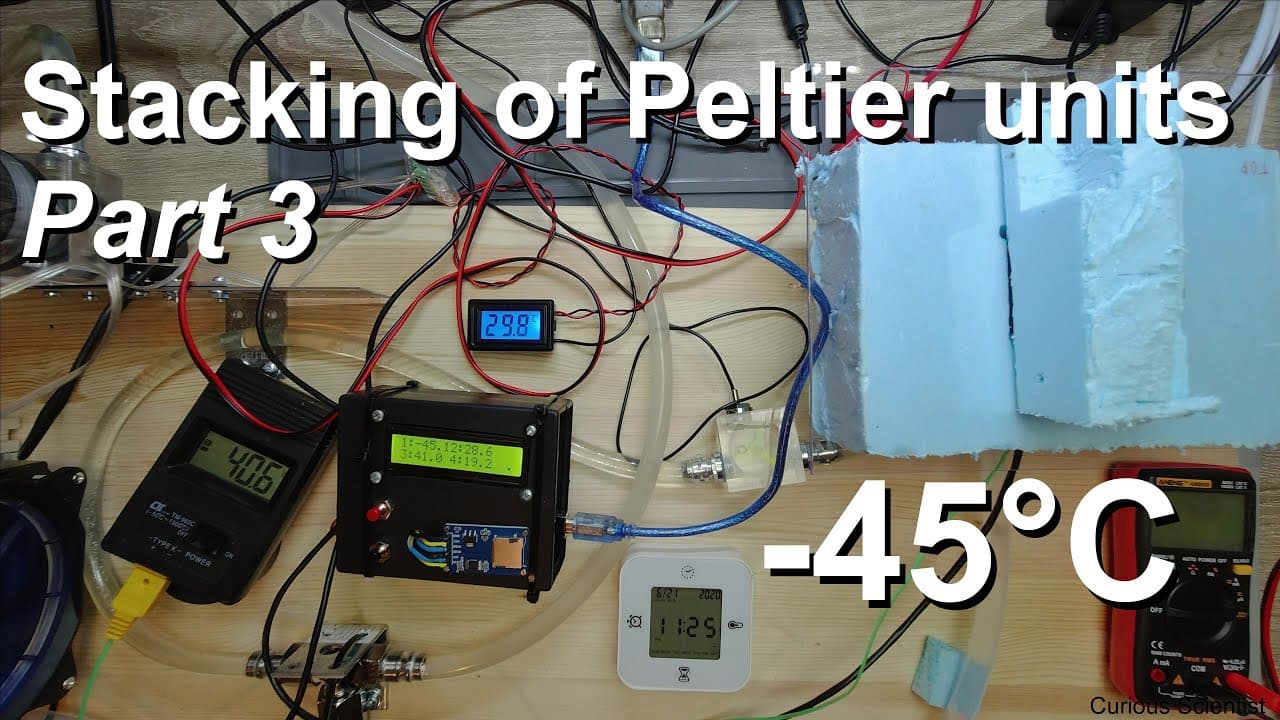
The video showcases an experiment to improve temperature performance of stacked patient coolers.
Transcript
welcome everyone in this video i will try something different with the stacked patient coolers i was not really satisfied with the previous experiment where i could only reach minus 40 degrees on the cold side of the top party device and i strongly believe that that should be different and the reason i think the reason why i reached such a bad temp... Read More
Key Insights
- 😎 The experiment aimed to achieve better cooling performance from the stacked patient coolers by accurately managing power supply and cooling techniques.
- 🥵 Measuring temperature accurately is crucial to understand the heat transfer efficiency in the cooling system.
- 😎 Continuous adjustments to current and voltage can lead to significant improvements in temperature management within thermoelectric cooler setups.
- 🥵 The successful operation of the experiment relies on maintaining optimal water temperatures and ensuring effective heat removal from both the hot and cold sides.
- ❓ System equilibrium must be established for reliable temperature readings, which demonstrates the importance of patience and strategy when conducting experiments.
- 🖐️ Thermal contact quality with temperature sensors plays a pivotal role in measurement accuracy and can result in discrepancies in temperature readings.
- 😎 Continuous monitoring during adjustments is essential for detecting trends in temperature changes and ensuring the cooling system’s performance remains stable.
Install to Summarize YouTube Videos and Get Transcripts
Explore YouTube Video Summarizer or Get YouTube Transcript Extractor
Questions & Answers
Q: What was the issue with the previous experiment using stacked patient coolers?
The earlier setup achieved a maximum temperature of minus 40 degrees on the cold side, which was deemed unsatisfactory. The host believed this was due to not accurately determining the hot side temperatures and possibly overfeeding power, resulting in overheating rather than efficient cooling.
Q: How did the host measure temperatures within the cooling system?
The host utilized a thermometer box containing four different thermometers, combined with a K-type thermocouple, to measure ambient temperature, cold side temperature, water temperature, and air exiting the radiator. This setup allowed for accurate tracking of the system's heat dynamic throughout the experiment.
Q: What current and voltage values were monitored during the experiment?
Current and voltage values were constantly monitored and measured throughout the experiment. For example, at one stage, the bottom unit had a current of approximately 10.5 amps and a voltage of around 12 volts, while the top unit was set to 2.5 amps to manage the heat load effectively.
Q: What changes were made to optimize cooling performance in the experiment?
To improve cooling, the host adjusted the current and voltage to get an optimal temperature difference (dt) between the hot and cold sides of the coolers. They also complemented their findings with new water that was more effective in maintaining a lower temperature in the system.
Summary & Key Takeaways
-
The video explores the inefficiencies encountered in an earlier experiment with stacked patient coolers, achieving only minus 40 degrees on the cold side.
-
The host discusses the setup involving thermometers and a water cooling system to monitor the temperature differences across different components of the cooling system.
-
Adjustments to current and voltage are made to optimize heat transfer and cooling power, leading to varying temperature measurements throughout the experiment.
Read in Other Languages (beta)
Share This Summary 📚
Summarize YouTube Videos and Get Video Transcripts with 1-Click
Try YouTube Summary with ChatGPT & Claude or YouTube Transcript Generator
Explore More Summaries from Curious Scientist 📚
![Building a coil winder [Part 6] - A few improvements thumbnail](/_next/image?url=https%3A%2F%2Fi.ytimg.com%2Fvi%2F3eyxG_g2iUA%2Fhqdefault.jpg&w=750&q=75)


Summarize YouTube Videos and Get Video Transcripts with 1-Click
Try YouTube Summary with ChatGPT & Claude or YouTube Transcript Generator