What Are Limits and How Do You Evaluate Them?
TL;DR
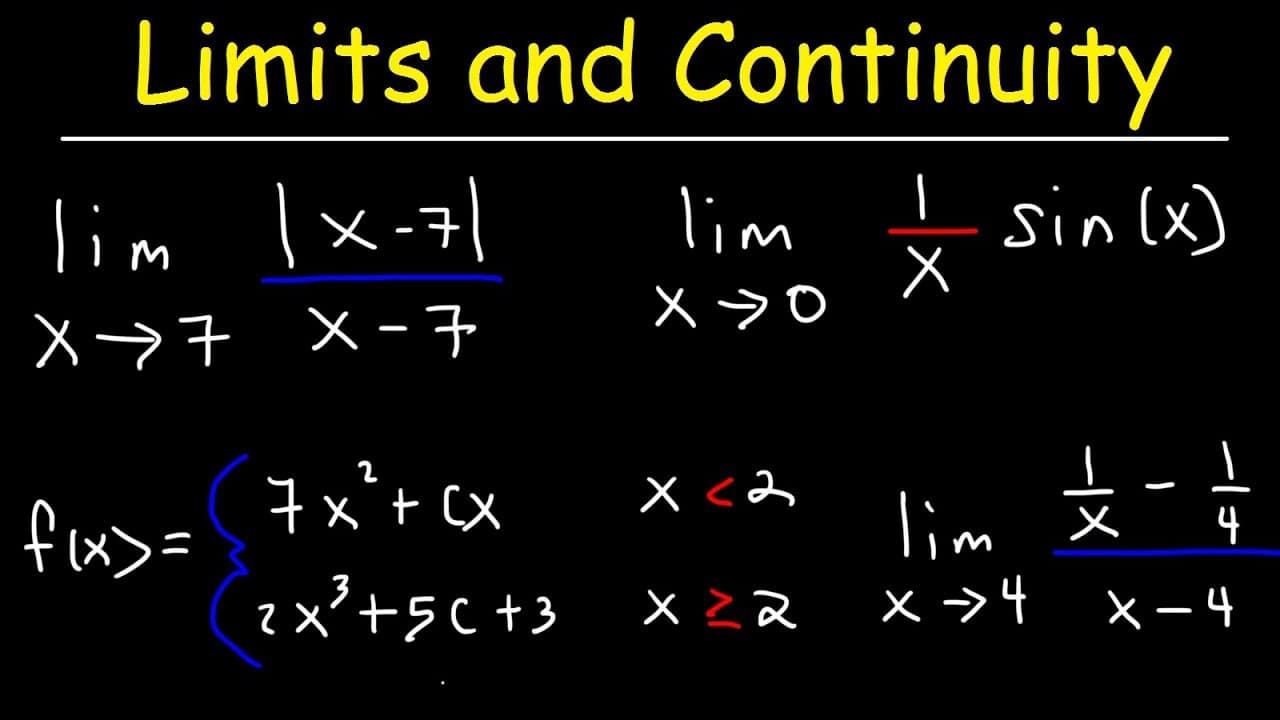
Limits help determine the value that a function approaches as the input approaches a certain point. Techniques for evaluating limits include direct substitution, factoring, the squeeze theorem, and the use of trigonometric properties. The Intermediate Value Theorem is also useful for finding specific values that guarantee continuity within a given interval.
Transcript
now let's start the video quiz for each of these problems pause the video and work on it once you have your answer unpause it to see the solution so let's go ahead and begin for number one if we plug in 2 notice that we will get 4 in the bottom we won't get a 0 in the denominator of the fraction so therefore we can use direct substitution to get th... Read More
Key Insights
- 😑 Direct substitution can be used when there are no undefined forms in the expression.
- 😑 Factoring helps simplify complex expressions and allows for simplification and cancellation.
- ❓ The intermediate value theorem guarantees the existence of a specific value within a given interval.
- 👻 The squeeze theorem allows for conclusions about the limit of a function based on the bounds of two other functions.
- 😑 The values of c can be determined by setting two expressions equal to each other and solving for the unknown variable.
- 🧡 Trigonometric functions have defined oscillation patterns and amplitude ranges, making their limits predictable.
- ♾️ The horizontal asymptote of a function can be found by evaluating the limit as x approaches infinity or negative infinity.
- 😑 The continuity of a function at a specific point can be achieved by finding the value of c that satisfies the equation of the two expressions being equal.
Install to Summarize YouTube Videos and Get Transcripts
Explore YouTube Video Summarizer or Get YouTube Transcript Extractor
Questions & Answers
Q: How do you solve a limit problem using direct substitution?
Direct substitution involves replacing the variable (x) with a specific value in the expression. This can be done when there are no undefined or indeterminate forms in the expression. By substituting the value and simplifying, you can find the limit.
Q: How do you factor a numerator in a limit problem?
To factor a numerator, you need to identify two numbers that multiply to give the coefficient of x^2 (if present) and add up to the coefficient of x. By factoring the numerator, you can cancel common factors and simplify the expression to find the limit.
Q: How do you solve a limit problem with a complex fraction?
To solve a complex fraction, multiply the numerator and denominator by the common denominator of all fractions involved. This helps eliminate the complex fraction and simplify the expression, making it easier to evaluate the limit.
Q: How do you use the intermediate value theorem?
The intermediate value theorem states that if a function is continuous on a closed interval [a, b] and there is a number k between f(a) and f(b), then there must exist a number c in the interval [a, b] where f(c) is equal to k. You can use this theorem to prove the existence of a specific value within a given interval.
Q: How do you find the value of c to make a function continuous at a specific point?
To make a function continuous at a specific point, set the expressions for the function equal to each other and substitute the x-value of the specific point. Then, solve for the unknown variable (c) by performing algebraic manipulations.
Summary & Key Takeaways
-
The video covers several limit problems and provides step-by-step solutions for each problem.
-
It explains concepts such as direct substitution, factoring, complex fractions, and trigonometric function limits.
-
The intermediate value theorem is discussed, and the video demonstrates how to find the value of c using the theorem.
-
It also explains how to make a function continuous at a specific point by solving for the value of c.
Read in Other Languages (beta)
Share This Summary 📚
Summarize YouTube Videos and Get Video Transcripts with 1-Click
Try YouTube Summary with ChatGPT & Claude or YouTube Transcript Generator
Explore More Summaries from The Organic Chemistry Tutor 📚


Summarize YouTube Videos and Get Video Transcripts with 1-Click
Try YouTube Summary with ChatGPT & Claude or YouTube Transcript Generator