Why Most Enterprise Data Stacks Aren't Ready for AI
TL;DR
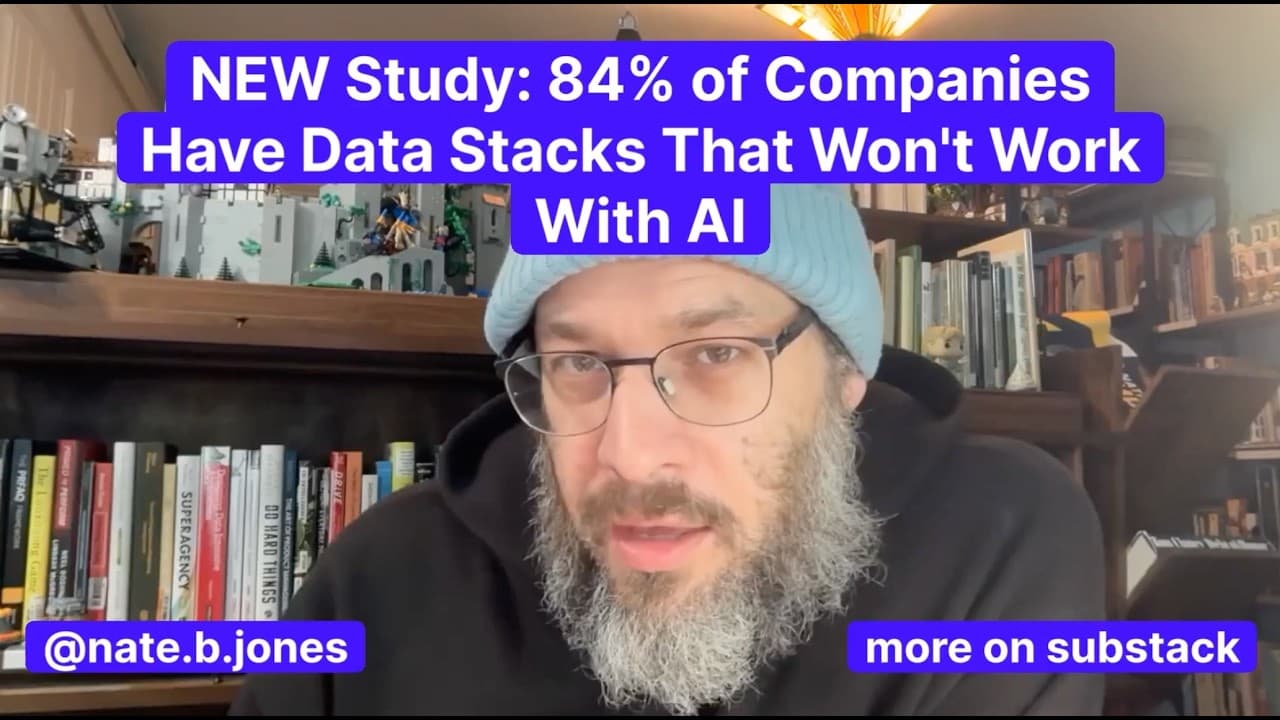
84% of enterprise data leaders say their data strategy needs a complete overhaul before AI works, yet 63% of executives believe they are already data-driven. That perception gap is why most AI initiatives fail. Seven principles separate the 16% successfully scaling AI, starting with diagnosing your data before deploying agents.
Transcript
This week's executive briefing is all about the glamorous subject of AI ready data architectures. Why? You might be thinking, are we going to do that? The reason is simple. Salesforce published data this week from 6,000 plus enterprise data leaders. 84% said their data strategies needed a complete overhaul before AI works. And at the same time, 63%... Read More
Key Insights
- The AI perception gap is the core problem: 84% of 6,000+ enterprise data leaders said their data strategies needed a complete overhaul before AI works, while 63% of executives believe their companies are already data-driven.
- Diagnosing before deploying means running two tests: your system should answer a simple factual data question in under 5 seconds without human intervention, and assemble a complete customer view across sales, support, billing, and shipping.
- Zero-copy architecture is a philosophy, not tooling: instead of copying data to a central location cleaned overnight, agents query authoritative source systems where the data lives, enabling real-time conversations with your data.
- Companies using a zero-copy approach were 34% more likely to succeed, partly because they could architect the entire system themselves rather than cobbling together tools from different vendors, which requires internal building capacity.
- Context matters more than volume: 49% of organizations draw incorrect conclusions because their data lacks business context, meaning more data without context just produces more confidently wrong answers.
- A semantic layer encodes business definitions, relationships, and logic so agents understand the difference between booking and revenue, gross and net, or active and churned customers from a single source of truth.
- Governance enables speed rather than slowing it down when framed as accountability and encoded as automated quality monitoring, routing data issues through the same severity model used for production software outages.
- The honest transformation timeline is 18 to 36 months in phases, not the six-month transformations vendors promise, because those vendor timelines assume infrastructure is already ready when for most organizations it is not.
Install to Summarize YouTube Videos and Get Transcripts
Explore YouTube Video Summarizer or Get YouTube Transcript Extractor
Questions & Answers
Q: Why do most enterprise AI initiatives fail?
Most AI initiatives fail because of a perception gap between belief and reality. According to Salesforce data from over 6,000 enterprise data leaders, 84% said their data strategies needed a complete overhaul before AI works, yet 63% of executives believe their companies are already data-driven. Leaders walk into AI conversations assuming they are ready, but their data is not designed for the demands of AI, so the initiatives fall short.
Q: How do you diagnose whether your data is ready for AI?
Diagnose before you deploy by running two tests. First, confirm your system can answer a simple factual question about your data, such as current inventory for a product, in under 5 seconds without human intervention. Second, check whether you can assemble a complete customer view across sales, support, billing, and shipping with no missing data in a similar time envelope. If these tests fail, you need infrastructure work because your data sets are designed for slow retrieval, not fast agentic retrieval.
Q: What is zero-copy architecture in AI data systems?
Zero-copy architecture is a philosophy, not a tool. Traditional data warehouses copy data to a central location, clean it overnight, then make it available for reporting. Zero-copy instead has the AI query data where it lives across your different source systems in real time, rather than copying it centrally. Agentic AI cannot wait for overnight batch jobs, so agents need real-time access to authoritative source systems if you want real-time conversations with your data.
Q: Why does data context matter more than data volume for AI?
Context matters more than volume because 49% of organizations draw incorrect conclusions when their data lacks business context. For example, a row showing $2 million in Q3 revenue for a customer may not specify it was a one-time contract rather than recurring revenue, causing agents to wrongly add it to ARR. Without a semantic layer that encodes definitions and relationships, adding more data just produces more confidently wrong answers.
Q: What is a semantic layer and why is it needed?
A semantic layer encodes business definitions, relationships, and logic across the top of your data at a high level. It lets agents understand distinctions like the difference between booking and revenue, between gross and net, and between active and churned customers, all from a single universal source of truth. Without it, data queries lack the executive context needed to interpret sophisticated questions correctly. Vendors like Cube offer semantic layers, which can make sense when you lack internal capacity to build one.
Q: How does governance enable speed rather than slow AI down?
Governance enables speed when framed as accountability rather than process. Rather than pushing things through slow human processes, encode governance as automated quality monitoring so you can route data issues through the same severity model used for production software outages. The 16% successfully scaling AI in the Salesforce survey do so with strong governance. Someone must own data quality, but that owner needs an automation mindset, otherwise governance becomes bureaucracy that slows everything down.
Q: How long does it realistically take to build AI-ready data architecture?
The honest timeline for most enterprises is 18 to 36 months, showing progress in phases. In year one you might fix critical pipelines, implement zero-copy architecture for top domains, and pilot agents where data is trustworthy. Year two expands toward real-time capabilities and automates governance. Year three scales agents. This feels slow against vendors promising six-month transformations, but those timelines wrongly assume your infrastructure is already ready.
Q: Why should companies start their AI data work sooner rather than later?
The strategic choice is time-bound because data runs on a clock. If fixing infrastructure and scaling AI will take 18 to 36 months regardless, it is better to start sooner than later, because you fall exponentially farther behind the longer you wait. The disciplined approach is to be honest about shortcomings, fix infrastructure while running AI pilots that prove concepts, then scale once the foundations are solid.
Summary & Key Takeaways
-
Salesforce published data from over 6,000 enterprise data leaders showing 84% said their data strategies needed a complete overhaul before AI works, while 63% of executives believe they are already data-driven. This perception gap is why most AI initiatives fail, as leaders assume readiness they do not actually have.
-
Seven principles separate the 16% successfully scaling AI: diagnose before you deploy, treat zero-copy architecture as a philosophy, prioritize context over volume, use governance to enable speed, accept an honest timeline, close the business-technical perception gap, and recognize that strategy is time-bound.
-
Success depends on investing in internal capacity to architect systems, adding semantic layers that encode business context, assigning ownership of data quality with an automation mindset, and having technical leaders honestly educate executives. Data runs on a clock, so starting the 18-to-36-month infrastructure work sooner avoids falling exponentially further behind.
Read in Other Languages (beta)
Share This Summary 📚
Summarize YouTube Videos and Get Video Transcripts with 1-Click
Try YouTube Summary with ChatGPT & Claude or YouTube Transcript Generator
Explore More Summaries from AI News & Strategy Daily | Nate B Jones 📚






Summarize YouTube Videos and Get Video Transcripts with 1-Click
Try YouTube Summary with ChatGPT & Claude or YouTube Transcript Generator