What Drove Tesla's Second-Quarter Performance?
TL;DR
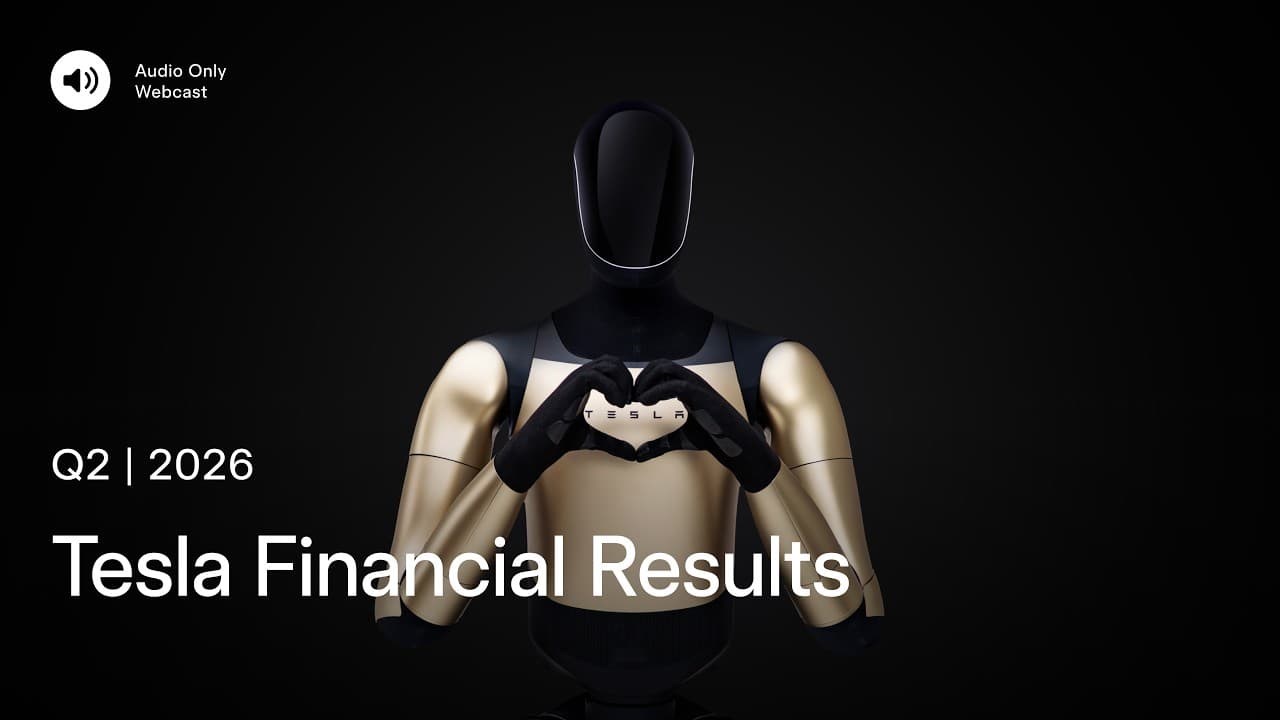
Record quarterly deliveries, rising Model Y popularity, and strong demand for Full Self-Driving supported Tesla's performance. Management is directing heavy capital spending toward robotaxis, Optimus, energy storage, batteries, solar manufacturing, refining, and chip development, while emphasizing that safety, manufacturing complexity, supply constraints, and regulatory approval will determine how quickly these initiatives can scale.
Transcript
Heat. Heat. Heat. Heat. Heat. Heat. Heat. Heat. Hey, hey, hey, hey, hey, hey, hey, hey. Heat. Heat. Heat. Heat. Heat. Heat. Heat. Heat. N. Heat. Heat. Heat up here. Heat. Heat. N. Heat. Heat. Heat. Hey, heat. Hey, heat. Heat. Heat. N. Heat. Heat. Heat. Heat. Heat. Heat. Good afternoon everyone and welcome to Tesla's second quarter 2026 Q&A webcast.... Read More
Key Insights
- Tesla's automotive performance was supported by record quarterly deliveries and increasing Model Y popularity. Management described Model Y as the best-selling car of any kind worldwide and said its popularity continues to grow, positioning the vehicle as an important foundation for the company's core business.
- Full Self-Driving is becoming a meaningful vehicle demand driver in approved locations. Management said some customers enter stores primarily seeking the autonomous-driving capability and treat the particular Tesla vehicle as secondary, suggesting that software availability can influence both product interest and purchasing decisions.
- Tesla's energy business is growing rapidly and is expected to support artificial intelligence infrastructure. Management connected energy storage and future electricity supply with the expanding power requirements of data centers, transportation electrification, and other forms of rising electrical demand.
- Tesla's capital spending is funding a broad manufacturing buildout across vehicles, robots, batteries, refining, energy storage, and solar production. Management expects these investments to produce substantial returns, although the projects require major spending before their intended capacity and economic benefits can be realized.
- Robotaxi growth is constrained primarily by safety considerations and regulatory sensitivity. Tesla wants to expand quickly while avoiding harm to people and animals, because even a single incident involving its autonomous service could receive extensive attention and prompt regulators to restrict further operations.
- Optimus is intended to perform general tasks from verbal instructions or video demonstrations without task-specific programming. Management distinguished that goal from demonstrations involving pre-programmed or remotely controlled robots and emphasized that useful autonomy, reliability, durability, and human-level dexterity remain difficult engineering challenges.
- Optimus manufacturing will begin with a slow production ramp because nearly every component is new. Unlike electric vehicles, the humanoid robot cannot rely extensively on an established supply chain, requiring Tesla to develop suppliers or bring significant component production inside the company.
- Tesla's proposed chip initiative is considered necessary for scaling Optimus because external chip availability could become a constraint. The planned development facility in Austin is intended to combine mask production, logic, memory, packaging, and testing, enabling faster experimentation with new artificial intelligence chip designs.
Install to Summarize YouTube Videos and Get Transcripts
Explore YouTube Video Summarizer or Get YouTube Transcript Extractor
Questions & Answers
Q: What drove Tesla's quarterly automotive performance?
Tesla attributed its automotive momentum to record quarterly deliveries, the growing popularity of Model Y, and strong customer interest in Full Self-Driving where the system has approval. Management said some buyers now approach Tesla primarily for the autonomous-driving capability rather than for a specific vehicle, making software availability an important contributor to vehicle demand.
Q: How does Full Self-Driving affect demand for Tesla vehicles?
Full Self-Driving appears to strengthen demand in places where regulators have approved it. Management described customers who enter Tesla stores asking first for the autonomous-driving capability and only secondarily considering which vehicle provides it. Tesla therefore expects approval in additional countries to encourage similar purchasing behavior and support broader demand for its vehicles.
Q: Why is Tesla investing heavily in energy and manufacturing?
Tesla is investing to expand its core operations and prepare for expected growth in electricity consumption, transportation electrification, artificial intelligence infrastructure, and new products. The manufacturing program includes vehicles, energy storage, batteries, refining, solar components, and robotics. Management believes these capital-intensive projects can generate substantial returns once production capacity is established and scaled.
Q: How is Tesla approaching robotaxi expansion?
Tesla is expanding robotaxi service as quickly as it believes safety permits. Management said the central constraint is avoiding injuries, accidents, and even harm to pets, both because safety matters directly and because an incident could attract worldwide attention and trigger regulatory restrictions. New city launches and service updates are communicated through Tesla's account on X.
Q: Why will Optimus be difficult to manufacture at scale?
Optimus will be difficult to scale because nearly every part of the humanoid robot is new and lacks the established supplier base available to conventional vehicles. Tesla must create much of the supply chain or manufacture components internally. Reliability, durability, dexterity, and safe operation also require careful development before production can accelerate along a normal manufacturing curve.
Q: What capabilities is Tesla designing Optimus to have?
Tesla is designing Optimus to complete general tasks after receiving a simple request or seeing a video, without requiring specific programming for each activity. The robot is also intended to achieve human-level and eventually superhuman hand dexterity. Management emphasized that genuine autonomous usefulness differs from online demonstrations that depend on pre-programmed movements or remote control.
Q: Why does Tesla consider internal chip development necessary?
Tesla believes chip supply could limit its ability to scale Optimus, making internal development strategically important. Its plans cover logic, memory, packaging, testing, and lithography mask production. By placing these functions together in an Austin development facility, Tesla expects to shorten the cycle for designing, producing, testing, and revising experimental artificial intelligence chips.
Q: What is digital Optimus and how would it work?
Digital Optimus is Tesla's concept for applying its autonomous-driving technology to computer use. Instead of interpreting road imagery and producing vehicle controls, the system would interpret a computer screen as real-time video and generate corresponding controls. Management said the same general photons-in and controls-out approach could support both physical Optimus robots and autonomous interaction with computers.
Summary & Key Takeaways
-
Tesla reported record quarterly deliveries and described Model Y as the world's best-selling car of any kind. Management said Full Self-Driving adoption is particularly strong where the system has approval, with some customers prioritizing the software when selecting a vehicle. Additional regulatory approvals could therefore support demand in more markets.
-
Tesla is undertaking a broad manufacturing expansion covering Semi, Megapack, batteries, lithium and cathode refining, solar cells, solar panels, and Optimus. Management characterized the period as capital intensive but expects strong returns from infrastructure intended to support transportation electrification, artificial intelligence data centers, energy demand, and future product growth.
-
Robotaxi expansion is proceeding cautiously because Tesla wants to avoid injuries and regulatory setbacks while entering additional cities. Optimus faces an unusually difficult production ramp because its components and supply chain are largely new. Tesla also views internal chip development, including logic, memory, packaging, and testing, as essential for scaling robotics.
Read in Other Languages (beta)
Share This Summary 📚
Summarize YouTube Videos and Get Video Transcripts with 1-Click
Try YouTube Summary with ChatGPT & Claude or YouTube Transcript Generator
Explore More Summaries from Tesla 📚

Summarize YouTube Videos and Get Video Transcripts with 1-Click
Try YouTube Summary with ChatGPT & Claude or YouTube Transcript Generator