What Did Tesla Reveal About the Model 3?
TL;DR
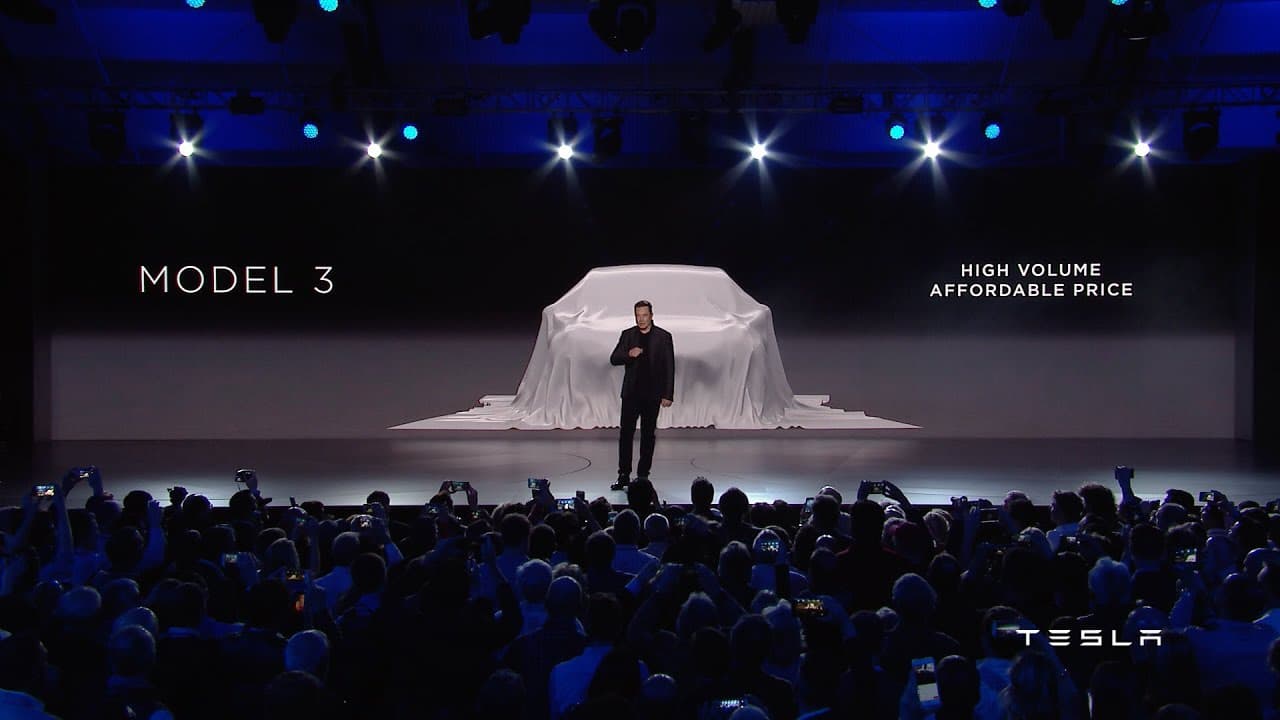
Tesla presented the Model 3 as an affordable, high-volume electric car with at least 215 miles of EPA-rated range, five-star safety targets in every category, and acceleration from zero to 60 mph in under six seconds for the base model. Every car was also planned to include Autopilot hardware, Autopilot safety features, five-adult seating, front and rear trunks, and Supercharging as standard.
Transcript
good evening everyone here and out there on the internet my name is France Von Hol Housen I lead the design team here at Tesla and I'm excited to welcome you to the Tesla Design Studio here in Hawthorne California we are here tonight to talk about model 3 but we wouldn't be here without years of intense drive and passion from the Tesla team and Lea... Read More
Key Insights
- The Model 3 is positioned as Tesla's affordable, high-volume vehicle and the final step of a strategy that began with expensive, low-volume cars. Tesla said the earlier Roadster, Model S, and Model X supplied proof, experience, and revenue needed to develop it.
- Tesla's stated mission is to accelerate the transition to sustainable transport because atmospheric carbon dioxide levels and temperatures are rising. Musk also cited an MIT study attributing 53,000 annual deaths in the United States to automobile emissions as another reason to replace combustion vehicles.
- The Roadster was designed to disprove the belief that electric cars had to be slow, unattractive, short-ranged, or poor-performing. Although Tesla produced only 500 units per year, Musk argued that the vehicle had an outsized influence on established automakers and subsequent electric vehicle programs.
- The Model S demonstrated that an electric sedan could compete with leading combustion vehicles in performance, handling, technology, and practicality. Tesla presented its awards and strong evaluations as evidence for the broader automotive industry that an electric car could be considered the best car in its category.
- The Model 3's announced minimum performance includes at least 215 miles of EPA-rated range and zero-to-60-mph acceleration in under six seconds for the base version. Musk emphasized that these figures were minimum targets and said faster versions would also be available.
- The Model 3's safety target is a five-star rating in every category, rather than merely achieving five stars on average. Tesla also said every vehicle would contain Autopilot hardware and that all Autopilot safety features would be included without requiring an additional option.
- The Model 3's five-adult interior works by exploiting the absence of a large combustion engine, moving the front seats forward, and compressing the instrument panel. A continuous pane of glass over the rear roof adds headroom and creates a greater feeling of openness.
- The Model 3's practicality includes front and rear trunks, enough interior length for a seven-foot surfboard, and Supercharging as standard. Tesla also planned to double its 3,600-plus Superchargers, quadruple destination chargers, and expand from 215 sales and service locations to 441 by the end of the following year.
Install to Summarize YouTube Videos and Get Transcripts
Explore YouTube Video Summarizer or Get YouTube Transcript Extractor
Questions & Answers
Q: Why did Tesla develop the Model 3?
Tesla developed the Model 3 as an affordable, high-volume electric car intended to accelerate the transition to sustainable transport. Musk connected that mission to rising atmospheric carbon dioxide, increasing temperatures, and toxic emissions from combustion vehicles. The company also wanted to extend the appeal of electric transportation beyond expensive, low-volume products and make its technology accessible to a much larger market.
Q: How did Tesla's earlier vehicles support the Model 3?
Tesla followed a staged strategy because new technology requires multiple iterations and economies of scale before it can become both capable and affordable. The Roadster established that an electric car could be fast, attractive, and desirable. The Model S and Model X then generated the revenue needed to finance the billions of dollars in engineering, cost reductions, and capabilities required for Model 3 development.
Q: What range and acceleration did Tesla announce for the Model 3?
Tesla announced that the Model 3 would have an EPA-rated range of at least 215 miles. The base version was expected to accelerate from zero to 60 miles per hour, or zero to 100 kilometers per hour, in less than six seconds. Musk described both figures as minimum numbers, expressed hope that Tesla would exceed them, and said quicker versions would also be offered.
Q: What safety features did Tesla promise for the Model 3?
Tesla said safety was its highest priority and targeted a five-star rating for the Model 3 in every safety category, not simply a five-star average. The company also announced that every Model 3 would include Autopilot hardware as standard. Musk further stated that all Autopilot safety features would be present in every car and would not require buyers to purchase an optional package.
Q: How does the Model 3 fit five adults comfortably?
The Model 3 creates passenger space by taking advantage of its electric architecture. Without a large combustion engine at the front, Tesla could move the front seats forward and compress the instrument panel, increasing legroom for both seating rows. A continuous pane of glass over the rear roof adds headroom and openness, helping the smaller vehicle accommodate five adults comfortably.
Q: How much cargo space does the Model 3 provide?
The Model 3 includes both a front trunk and a rear trunk, using space that a gasoline vehicle would devote to its combustion engine and related components. Musk said this arrangement gives it more cargo capacity than a gasoline car with the same external dimensions. He also confirmed that a seven-foot-long surfboard could fit inside the vehicle when the interior was configured appropriately.
Q: Why is Supercharging important for the Model 3?
Supercharging is important because Tesla viewed convenient long-distance travel as a central part of the freedom provided by car ownership. Musk said Supercharging would come standard on every Model 3. At the unveiling, Tesla had built more than 3,600 Superchargers worldwide and approximately the same number of destination chargers, with plans to double Superchargers and quadruple destination chargers by the end of the following year.
Q: How did Tesla plan to expand sales and service access?
Tesla reported having 215 sales and service locations across Asia, North America, and Europe at the time of the presentation. The company expected to more than double that network to 441 locations by the end of the following year. The stated goal was to make purchasing and servicing a Tesla practical for customers near almost any midsize metropolitan area in those regions.
Summary & Key Takeaways
-
Tesla framed the Model 3 as the final step in a strategy for accelerating sustainable transport. The company began with the low-volume, high-priced Roadster, expanded into the Model S and Model X, and used revenue from those vehicles to fund the engineering and cost reductions required for an affordable, high-volume electric car.
-
The announced minimum specifications included at least 215 miles of EPA-rated range and acceleration from zero to 60 mph in under six seconds for the base model. Tesla targeted five-star safety performance in every category and said every Model 3 would include Autopilot hardware, Autopilot safety features, and Supercharging as standard equipment.
-
The Model 3 was designed to seat five adults comfortably by moving the front seats forward and compressing the instrument panel. A continuous rear glass roof increased headroom and openness, while front and rear trunks expanded cargo capacity. Tesla also planned major growth in charging infrastructure, stores, and service locations across several regions.
Read in Other Languages (beta)
Share This Summary 📚
Summarize YouTube Videos and Get Video Transcripts with 1-Click
Try YouTube Summary with ChatGPT & Claude or YouTube Transcript Generator
Explore More Summaries from Tesla 📚

Summarize YouTube Videos and Get Video Transcripts with 1-Click
Try YouTube Summary with ChatGPT & Claude or YouTube Transcript Generator