How to Solve Density Practice Problems Step by Step
TL;DR
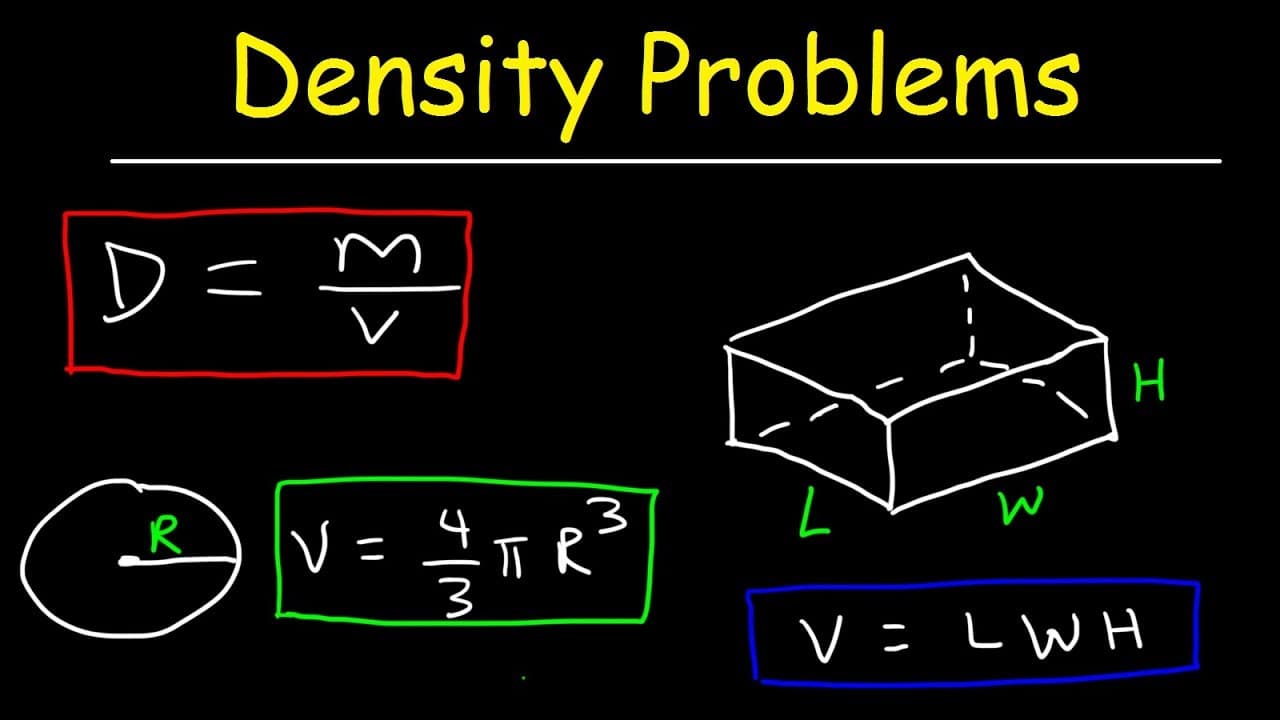
To solve density problems, use the formula density = mass/volume. For example, to find the density of a rock with a mass of 50g and a volume of 8.5ml, divide 50 by 8.5 to get 5.88g/ml. This method applies to various shapes and conversions as demonstrated in the problems.
Transcript
in this video we're going to go over density problems so let's start with the first one a 50 gram rock has a volume of 8.5 milliliters what is the density of the rock feel free to pause the video if you want to work on these problems density is equal to mass divided by volume so the mass of the rock is 50 grams the volume is 8.5 milliliters so we j... Read More
Key Insights
- 💆 Density can be calculated by dividing mass by volume.
- ❓ The density of an object determines whether it will sink or float in a given fluid.
- 🔇 Mass can be found by multiplying density and volume.
- 🔇 The volume of a rectangular object can be calculated by multiplying its dimensions.
Install to Summarize YouTube Videos and Get Transcripts
Explore YouTube Video Summarizer or Get YouTube Transcript Extractor
Questions & Answers
Q: How do you calculate the density of a rock?
The density of a rock can be found by dividing its mass by its volume. In the example given, the rock has a mass of 50 grams and a volume of 8.5 milliliters, resulting in a density of 5.88 grams per milliliter.
Q: How do you convert grams per milliliter to kilograms per cubic meter?
To convert from grams per milliliter to kilograms per cubic meter, multiply the density by 1000. In the example, the density of 9.26 grams per milliliter converts to 9260 kilograms per cubic meter.
Q: How do you calculate the volume of a rectangular metal bar?
To find the volume of a rectangular metal bar, multiply its length, width, and height. In the example, the dimensions are given as 6 cm by 8 cm by 9 cm, resulting in a volume of 432 cubic centimeters.
Q: Will a 25 gram rock sink or float in water?
To determine whether the rock will sink or float, compare its density to the density of water. If the rock's density is greater than 1 gram per milliliter, it will sink. If it is less than 1 gram per milliliter, it will float. In this case, the rock has a density of 8.06 grams per milliliter, so it will sink.
Summary & Key Takeaways
-
The video explains how to find the density of a rock by dividing its mass by its volume.
-
It shows how to calculate the mass of a metal bar using its density and volume.
-
The video teaches how to determine the density of a rectangular metal bar and convert it to different units.
Read in Other Languages (beta)
Share This Summary 📚
Summarize YouTube Videos and Get Video Transcripts with 1-Click
Try YouTube Summary with ChatGPT & Claude or YouTube Transcript Generator
Explore More Summaries from The Organic Chemistry Tutor 📚


Summarize YouTube Videos and Get Video Transcripts with 1-Click
Try YouTube Summary with ChatGPT & Claude or YouTube Transcript Generator