Why Is Apple So Dependent on Manufacturing in China?
TL;DR
Apple remains dependent on China because no other country currently matches the combination of manufacturing skill, scale, cost, infrastructure, and tightly clustered suppliers required for its complex products. Over 25 years, Apple helped Chinese factories acquire advanced capabilities, but those investments also strengthened local competitors and gave Beijing greater commercial and political leverage.
Transcript
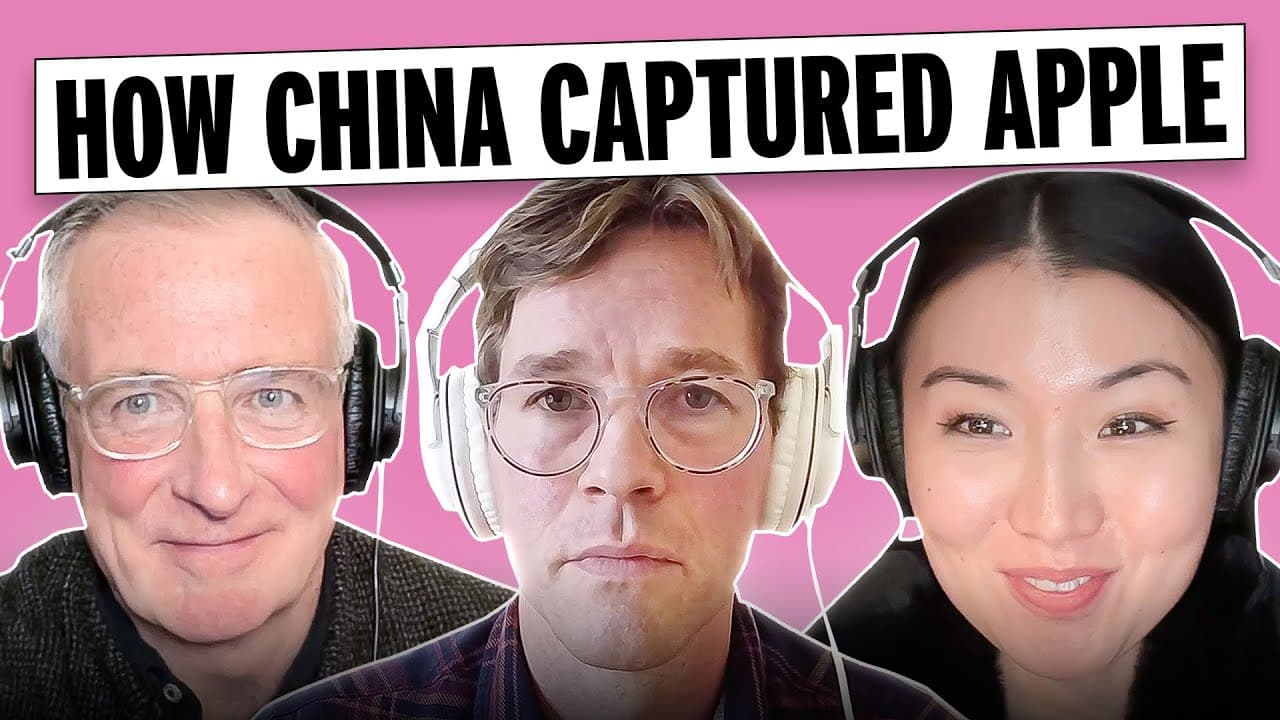
We're joined now by journalist Patrick McGee. He is the author of the fascinating book Apple and China, the capture of the world's greatest company, which was published earlier this year to widespread acclaim. Patrick, thanks so much for joining us. It seems quite fitting having we met just in Sicily earlier in the uh winter that you are our first ... Read More
Key Insights
- Apple’s dependence on China rests on a unique combination of quality, quantity, and cost. After 25 years of investment across hundreds of factories, the company cannot easily reproduce the same manufacturing returns or capabilities in another country.
- The iPhone supply chain operates at extraordinary scale. Production rose from about 5 million units in 2007 to 230 million annually by 2015, while peak output could reach one million phones and require roughly one billion components per day.
- China’s next-door manufacturing model concentrated suppliers and assembly operations within short distances. This replaced a fragmented Asian network that required teams to cross borders and bodies of water between Taiwan, Singapore, Thailand, Malaysia, China, Japan, and Korea.
- China’s infrastructure made Apple’s manufacturing system more efficient. World-leading ports, eight-lane highways, and high-speed rail supported the rapid movement of engineers, materials, components, and finished products at a scale not matched elsewhere in the interview’s account.
- Apple built manufacturing competence rather than simply purchasing it. Apple engineers taught fundamental production methods, acquired machinery, installed equipment on factory lines, and co-created facilities and processes with Chinese suppliers.
- Apple’s 50% rule required suppliers to expand with other customers as quickly as they expanded with Apple. The policy protected suppliers from excessive dependence and allowed Apple to change designs without bankrupting companies whose components were no longer needed.
- Apple-developed capabilities spread to domestic smartphone companies through shared suppliers. Manufacturers such as Lens Technology could apply processes created with Apple to work for Huawei, OPPO, Vivo, and Xiaomi, indirectly strengthening Apple’s own competitors.
- China’s manufacturing position creates political and commercial leverage. The threatened licensing of rare earth minerals was treated as a serious crisis in Washington, while initiatives such as Belt and Road and Made in China 2015 prepared China for pressure from Western markets.
Install to Summarize YouTube Videos and Get Transcripts
Explore YouTube Video Summarizer or Get YouTube Transcript Extractor
Questions & Answers
Q: Why is Apple so dependent on manufacturing in China?
Apple depends on China because its products require a combination of manufacturing quality, enormous production volume, and acceptable cost that the interview says no other country can currently provide. Apple has invested across hundreds of Chinese factories for 25 years. China also offers tightly clustered suppliers, advanced transport infrastructure, and the capacity to absorb and deploy Apple’s manufacturing knowledge.
Q: Why is moving Apple production out of China so difficult?
Moving production is difficult because an iPhone contains about a thousand components and must be manufactured in immense quantities. By 2015, Apple was producing 230 million iPhones annually, with peak output approaching one million devices per day. Replicating that system requires factories for components, skilled workers, equipment, transportation networks, and suppliers that can coordinate at roughly one billion components per day.
Q: How did China’s next-door manufacturing model help Apple?
Next-door manufacturing placed component makers, production facilities, and assembly operations close together. Before this concentration, Apple’s teams relied on a network spanning Taiwan, Singapore, Thailand, Malaysia, China, Japan, and Korea. Prototyping required crossing borders, navigating customs, and returning to California. China transformed many of those journeys into short trips, accelerating product development and large-scale manufacturing.
Q: How did Apple build manufacturing capabilities in China?
Apple did more than hire factories with existing expertise. Its engineers helped Chinese suppliers learn fundamental production methods, purchased machinery, installed equipment on production lines, and co-created facilities and processes. Apple’s travel demand became so substantial that United began serving distant Chinese cities three times a week with the expectation that Apple would purchase many first-class tickets.
Q: What was Apple’s 50% supplier rule?
Apple’s 50% rule told suppliers that, however quickly they grew their Apple business, they needed to grow equally quickly with another customer. The rule served Apple’s interests by reducing suppliers’ dependence on a single buyer. It also allowed Apple to change designs or discontinue components without causing suppliers that had invested in workers, property, and machinery to collapse immediately.
Q: How did Apple help create stronger Chinese smartphone competitors?
Apple helped suppliers acquire advanced production skills, equipment, and processes, then encouraged them to serve other customers through its 50% rule. Those suppliers could apply the knowledge developed with Apple when working for Huawei, OPPO, Vivo, and Xiaomi. Lens Technology, for example, gained capabilities involving cutting, tempering, and etching Corning glass for multi-touch applications, which could then support domestic manufacturers.
Q: How does China’s hold over Apple create political leverage?
China’s importance to Apple forms part of its wider leverage over Washington and Western companies. The interview cites Beijing’s threatened licensing requirements for rare earth minerals as a moment treated like a serious emergency, even before the policy took effect. It also argues that Belt and Road developed export markets beyond Europe and America, while Made in China 2015 strengthened ten targeted industries.
Q: Can Apple reproduce its Chinese manufacturing system in India or the United States?
Patrick McGee argues that copying Apple’s China strategy in India is unlikely to work for several reasons, although those reasons are not fully detailed in the excerpt. He also calls large-scale relocation to the United States fanciful because America lacks factories for many iPhone components. China’s accumulated supplier expertise, infrastructure, production scale, and 25 years of Apple investment are not easily duplicated.
Summary & Key Takeaways
-
Apple’s reliance on China developed through 25 years of investment across hundreds of factories. China uniquely combined production quality, enormous capacity, competitive costs, modern transport infrastructure, and closely located suppliers. These advantages allowed Apple to expand iPhone output from about 5 million units in 2007 to 230 million units annually by 2015.
-
Apple did not merely assign production to factories that already possessed the required expertise. Its engineers helped suppliers develop capabilities, purchased machinery, installed equipment, and co-created manufacturing processes. This extensive transfer of knowledge built an ecosystem capable of producing complicated Apple devices at a scale that the United States and other countries could not match.
-
Apple’s 50% rule encouraged suppliers to grow their business with other customers as quickly as they grew with Apple. Although designed to give Apple flexibility and prevent supplier collapse, the policy spread Apple-developed manufacturing knowledge to Huawei, OPPO, Vivo, Xiaomi, and other domestic companies, helping create stronger competitors within China’s technology ecosystem.
Read in Other Languages (beta)
Share This Summary 📚
Summarize YouTube Videos and Get Video Transcripts with 1-Click
Try YouTube Summary with ChatGPT & Claude or YouTube Transcript Generator
Explore More Summaries from The Prof G Pod – Scott Galloway 📚





Summarize YouTube Videos and Get Video Transcripts with 1-Click
Try YouTube Summary with ChatGPT & Claude or YouTube Transcript Generator