What Is the Origin of Money and Its Historical Role?
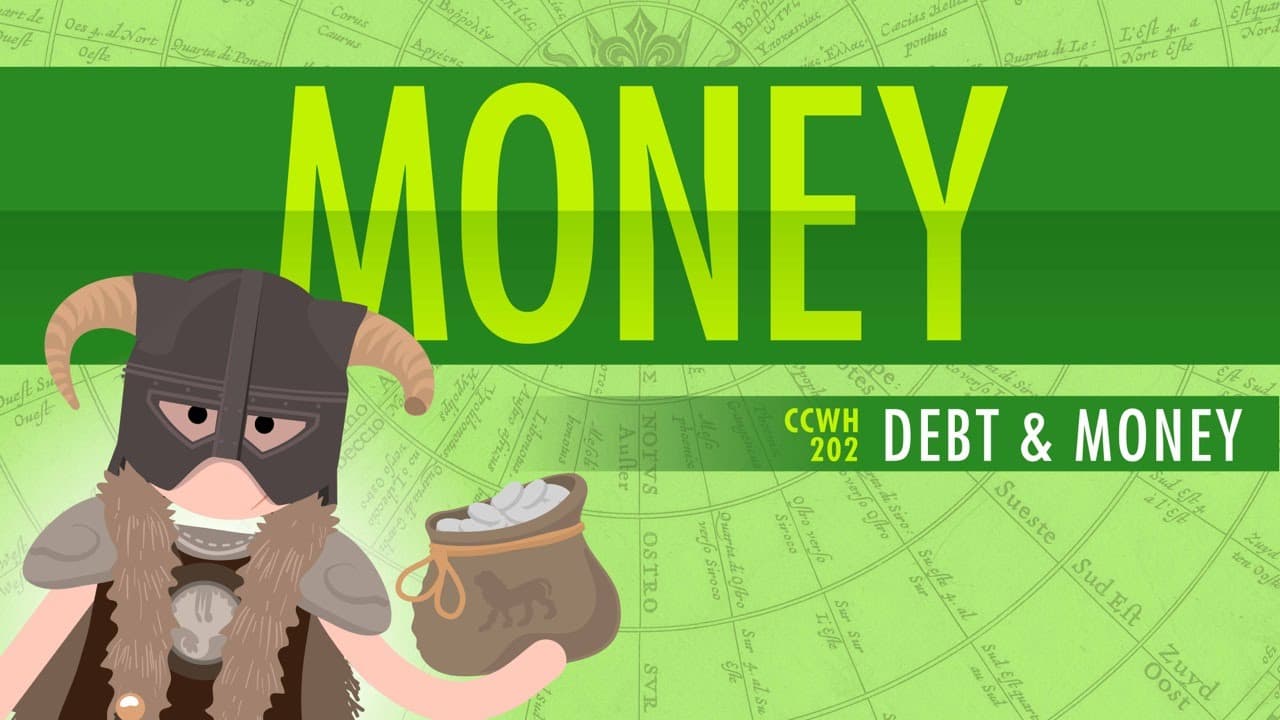
TL;DR
Money originated not from barter systems but as a tool for facilitating trade, linked to credit and social obligations within communities. David Graeber argues that the rise of coinage correlated with the need to fund military and state activities, fundamentally transforming social structures and contributing to systems of debt and slavery. Contrary to Adam Smith's theories, anthropological evidence shows that money is a product of human actions, not nature.
Transcript
Hi, I'm John Green. This is Crash Course World History and today we're going to make it rain. We're going to talk about money, the stuff that makes the world go 'round. I'm not very good at making it rain. Mr. Green! Mr. Green. I'm sorry, but money doesn't make the world go round. It's actually conservation of angular momentum. It's the same thing ... Read More
Key Insights
- Money serves as a medium of exchange, unit of account, and store of value, with the first being the most crucial function.
- Adam Smith's view that money evolved from barter systems is challenged by anthropological evidence suggesting barter was rare.
- David Graeber argues that credit, not barter, was the precursor to money, emphasizing mutual obligations in small communities.
- Coins were introduced as a convenient way to pay soldiers and facilitate state-building, not as a natural economic evolution.
- The rise of coinage is linked to the development of professional armies and the need for states to fund warfare.
- Money's introduction by Europeans in West Africa transformed social orders from relationship-based to debt-based systems.
- Graeber suggests that money, especially coinage, facilitated slavery by quantifying and transferring debt.
- The fall of the Western Roman Empire saw a decline in coinage, with societies reverting to credit systems based on trust.
Install to Summarize YouTube Videos and Get Transcripts
Explore YouTube Video Summarizer or Get YouTube Transcript Extractor
Questions & Answers
Q: What are the three functions of money according to economics textbooks?
Money serves three primary functions: as a medium of exchange, a unit of account, and a store of value. The medium of exchange is considered the most important, as it allows for the facilitation of trade and economic transactions by providing a common ground for valuing goods and services.
Q: How does David Graeber challenge Adam Smith's view on the origin of money?
David Graeber challenges Adam Smith's view by arguing that barter was not a common precursor to money. Instead, Graeber presents evidence that early societies relied on credit systems based on mutual obligations and trust, rather than direct barter, to facilitate exchange. This challenges the traditional narrative of money evolving from barter systems.
Q: Why were coins introduced according to Graeber's theory?
According to Graeber, coins were introduced primarily to pay professional armies and facilitate state-building. The rise of coinage was linked to the need for states to fund warfare and manage resources efficiently, rather than as a natural evolution from barter systems. Coins provided a convenient method for states to maintain and expand their power through military conquests.
Q: What role did money play in West African societies before and after European arrival?
Before European arrival, money in West African societies was used mainly for symbolic purposes in ceremonies like weddings and funerals, reinforcing social bonds. However, Europeans introduced monetized trade, transforming these societies by shifting focus from relationship-based exchanges to systems centered on quantifiable debt, altering traditional social structures and enabling practices like slavery.
Q: How does Graeber link money to slavery and war?
Graeber links money to slavery and war by arguing that coinage facilitated the quantification and transferability of debt, which in turn supported the rise of state-based warfare and slavery. Coins allowed states to efficiently pay soldiers and manage resources, while also enabling the commodification of human lives through practices like chattel slavery.
Q: What happened to coinage after the fall of the Western Roman Empire?
After the fall of the Western Roman Empire, coinage largely disappeared as the centralized state structures that supported it collapsed. Societies reverted to credit systems based on personal trust and mutual obligations, rather than relying on physical money. This shift highlights the dependence of coinage on stable state systems for its existence and utility.
Q: Why does John Green mention the concept of 'honor-based warfare'?
John Green discusses 'honor-based warfare' to critique the narratives that societies use to justify war. He suggests that while historical accounts, like the Iliad, frame wars as fought for honor, modern justifications often similarly obscure resource-driven motives. This critique questions the authenticity of honor as a primary motivation for warfare throughout history.
Q: What is the significance of credit systems in early societies according to the video?
Credit systems in early societies were significant as they facilitated exchange without the need for physical money. These systems relied on mutual trust and obligations, allowing communities to function economically by tracking debts and repayments over time. This challenges the notion that money is a natural economic necessity, highlighting the role of social relationships in early economic interactions.
Summary & Key Takeaways
-
John Green explores the history of money, challenging the idea that it naturally evolved from barter systems. Anthropological evidence suggests barter was rare, and credit systems based on mutual obligation were more common in early societies.
-
David Graeber's theories link the rise of coinage to state-building and professional armies, arguing that money was introduced to facilitate warfare and fund state needs, rather than as a natural economic development.
-
The introduction of money by Europeans in West Africa transformed social structures, shifting from relationship-based exchanges to systems centered on quantifiable debt, with money facilitating slavery and altering traditional social orders.
Read in Other Languages (beta)
Share This Summary 📚
Summarize YouTube Videos and Get Video Transcripts with 1-Click
Try YouTube Summary with ChatGPT & Claude or YouTube Transcript Generator
Explore More Summaries from CrashCourse 📚






Summarize YouTube Videos and Get Video Transcripts with 1-Click
Try YouTube Summary with ChatGPT & Claude or YouTube Transcript Generator