How to Determine Slope and Concavity of Parametric Curves
TL;DR
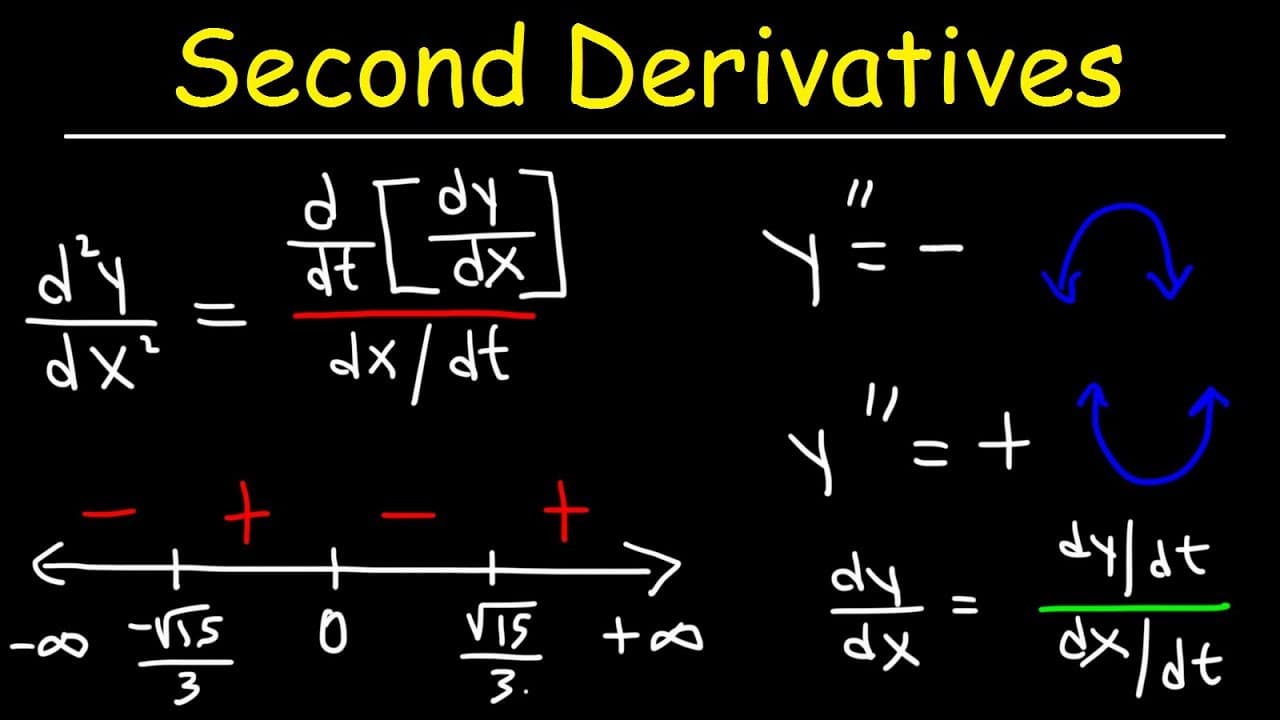
To determine the slope and concavity of parametric curves, calculate the first derivative by differentiating y with respect to t divided by x with respect to t. The second derivative, derived from the first, reveals concavity: positive indicates concave up, while negative indicates concave down. Intervals of concavity are determined by analyzing the sign of the second derivative.
Transcript
let's say that x is equal to four t plus five and let's say that y is equal to t squared minus eight t plus three find the slope and concavity at the given parameter and that is when t is equal to two so how can we do this in order to find the slope we need to calculate d y d x when t is two so let's find d x dt first the derivative of four t plus ... Read More
Key Insights
- 🫡 The slope of a parametric curve can be found by differentiating the components of the curve with respect to the parameter.
- ❎ The second derivative of a parametric curve reveals its concavity, with a positive value indicating concave up and a negative value indicating concave down.
- 🪈 The quotient rule is used to differentiate the first derivative of a parametric curve in order to find the second derivative.
- 🤘 Intervals of concavity are determined by analyzing the sign chart and identifying where the second derivative changes signs.
- 💠 Understanding the concavity of a parametric curve is essential for visualizing its behavior and understanding its shape.
- 👻 Parametric equations allow for the representation of curves in terms of a parameter, enabling more complex shapes to be described.
- ❓ Calculating slope and concavity for parametric curves involves applying calculus concepts to parametric equations.
Install to Summarize YouTube Videos and Get Transcripts
Explore YouTube Video Summarizer or Get YouTube Transcript Extractor
Questions & Answers
Q: How do you calculate the slope of a parametric curve?
To calculate the slope, you need to find the derivative by differentiating each component of the parametric equations with respect to the parameter. Then substitute the parameter value to find the slope at a specific point.
Q: What does the sign of the second derivative indicate for concavity?
If the second derivative is positive, the curve is concave up. If it is negative, the curve is concave down. The sign of the second derivative helps determine the intervals of concavity.
Q: How do you find the concavity of a parametric curve?
To find concavity, you first calculate the second derivative using the quotient rule. Then, substitute the parameter value into the second derivative expression to determine whether the curve is concave up or down at that point.
Q: What are the intervals of concavity?
The intervals of concavity can be found by examining the sign chart, which shows where the second derivative is positive (concave up) and where it is negative (concave down). These intervals indicate where the curve changes concavity.
Summary & Key Takeaways
-
The video demonstrates how to calculate the slope of a parametric curve by finding the derivative and plugging in a specific parameter value.
-
It also explains how to find the second derivative to determine concavity at a given parameter and differentiate a parametric curve using the quotient rule.
-
The video provides step-by-step instructions and examples for finding slope and concavity for different parametric curves.
Read in Other Languages (beta)
Share This Summary 📚
Summarize YouTube Videos and Get Video Transcripts with 1-Click
Try YouTube Summary with ChatGPT & Claude or YouTube Transcript Generator
Explore More Summaries from The Organic Chemistry Tutor 📚




Summarize YouTube Videos and Get Video Transcripts with 1-Click
Try YouTube Summary with ChatGPT & Claude or YouTube Transcript Generator