How Can You Use Your Value Prop to Pivot? LIVE Marketing Optimization Amid Coronavirus, Pt 2

TL;DR
Use your value proposition to improve conversions by making the perceived value of an action outweigh its perceived cost. Drawing on patterns from more than 20,000 treatment experiments, the review recommends clarifying each form’s benefit, expected effort, required information, and next step while reducing friction and anxiety. Read on for practical ways to strengthen forms, buttons, and calls to action.
Transcript
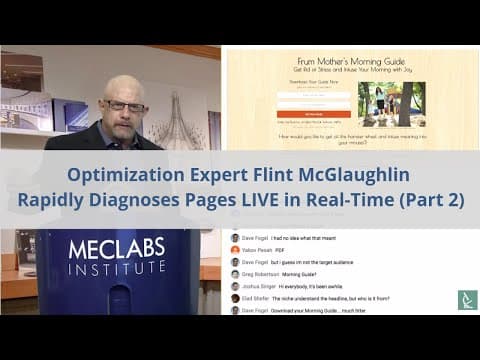
welcome everyone I see Steve bigger from our team Steve actually runs a lot of IT and development for us he's on board is going to test some new ideas in the coming events Dave good to see you back to from Denmark Michael Thomas berry I just wrote you a letter this morning watch your inbox for it shine welcome here already we've got people from Tor... Read More
Key Insights
- Conversion improves when perceived value outweighs perceived cost. The page should tilt the visitor's decision toward saying yes by strengthening the benefits associated with an action and reducing the effort, uncertainty, or concern that might discourage participation.
- A decision can be influenced in only two basic ways within the presented framework: add weight to perceived value or remove weight from perceived cost. Every improvement to a form, button, headline, or instruction should support one or both of these purposes.
- A form has a process-level value proposition because it asks the visitor to take a specific action deeper in the funnel. Its message must justify that action independently instead of relying entirely on the broader value proposition of the product or service.
- A page needs a focused objective, expressed as a 70/30 balance between the product proposition and the process proposition. It can emphasize either one, but dividing attention without a clear priority can create conversion leakage.
- The phrase "get started" implies an undefined commitment. It can make visitors wonder what they are beginning, how much time it will require, and whether additional steps will follow, even when the visible form requests only basic contact information.
- Friction is psychological resistance to something a visitor does not want to do. A call to action increases friction when it suggests effort, time, or a lengthy process without showing why that effort is worthwhile or how manageable it will be.
- Anxiety is psychological concern about something a visitor fears may happen. Requesting a phone number without explaining the next step can raise concern about an unwanted call, particularly when the stated promise cannot be fulfilled using the requested information alone.
- Unanswered questions create both friction and anxiety. Effective calls to action clarify how long the process takes, what information or documents may be needed, whether contact happens by email or phone, and what the visitor receives after completing the form.
Install to Summarize YouTube Videos and Get Transcripts
Explore YouTube Video Summarizer or Get YouTube Transcript Extractor
Questions & Answers
Q: How can you use a value proposition to improve conversions?
Make the perceived value of an action outweigh its perceived cost. Strengthen the reasons to proceed while reducing effort, uncertainty, and concern around the form, button, or call to action.
Q: What is a process-level value proposition?
A process-level value proposition explains why a visitor should take a specific action deeper in the funnel, such as submitting a form or requesting a quote. It must justify that immediate action rather than relying entirely on the broader product proposition.
Q: Why can "get started" reduce conversions?
The phrase can imply an undefined commitment without explaining what the visitor is starting. It may create friction and anxiety because the visitor does not know the required time, subsequent steps, or eventual outcome.
Q: How can marketers reduce friction on a lead form?
Define the requested task, show that it is manageable, and explain the effort or time involved. Ask for information connected to the next step and clarify whether the visitor will face additional questions or requirements.
Q: How can marketers reduce anxiety around a quote request?
Explain what happens after submission and why each contact detail is required. Clarify whether the next step involves an email, phone call, another form, or an immediate result so visitors do not fill the uncertainty with negative assumptions.
Q: What does the 70/30 rule mean for a landing page?
The page should deliberately prioritize either the product proposition or the process proposition using a 70/30 balance. Splitting attention without a clear priority can weaken motivation and create conversion leakage.
Q: What questions should call-to-action copy answer?
It should explain what the visitor is being asked to do, how long it will take, what information is required, and what happens next. It should also clarify how the promised result will be delivered and whether additional steps or documents are necessary.
Q: How should marketers evaluate a form or button?
Treat it as an independent decision point and identify both its perceived value and perceived cost. Add meaningful benefits, remove unnecessary effort or uncertainty, and connect the action clearly to its expected outcome.
Summary & Key Takeaways
-
Number: The research library includes more than 20,000 treatment experiments focused on understanding why people say yes.
-
Definition: Conversion improves when the perceived value of an action outweighs its perceived cost.
-
Definition: A process-level value proposition justifies a specific action that moves a visitor deeper into the funnel.
-
Compare: Product propositions explain the broader offer, while process propositions explain why an immediate form or button action is worthwhile.
-
Number: A 70/30 balance gives clear priority to either the product proposition or the process proposition.
-
Definition: Friction is psychological resistance associated with effort, time, or an unwanted task.
-
Definition: Anxiety is concern about uncertain consequences, such as unwanted contact after sharing a phone number.
-
Step 1: Identify the benefit visitors perceive from clicking a button or submitting a form.
-
Step 2: Identify perceived costs, including effort, time, uncertainty, and concern.
-
Step 3: Clarify the expected time, required information, next step, and method used to deliver the result.
-
Tool: Replace vague calls to action such as "get started" with copy that defines the process and outcome.
Read in Other Languages (beta)
Share This Summary 📚
Summarize YouTube Videos and Get Video Transcripts with 1-Click
Try YouTube Summary with ChatGPT & Claude or YouTube Transcript Generator
Explore More Summaries from Flint McGlaughlin 📚
Summarize YouTube Videos and Get Video Transcripts with 1-Click
Try YouTube Summary with ChatGPT & Claude or YouTube Transcript Generator