How Does Vectra Detect Cyberattacks in Real Time?
TL;DR
Vectra detects cyberattacks by analyzing network traffic for cumulative patterns of attacker behavior after a machine becomes infected. Its network-based system monitors perimeter and lateral traffic, builds a behavioral narrative for each host, and ranks machines by threat and certainty, giving incident responders real-time context without relying on perfect judgments about individual files, transactions, or flows.
Transcript
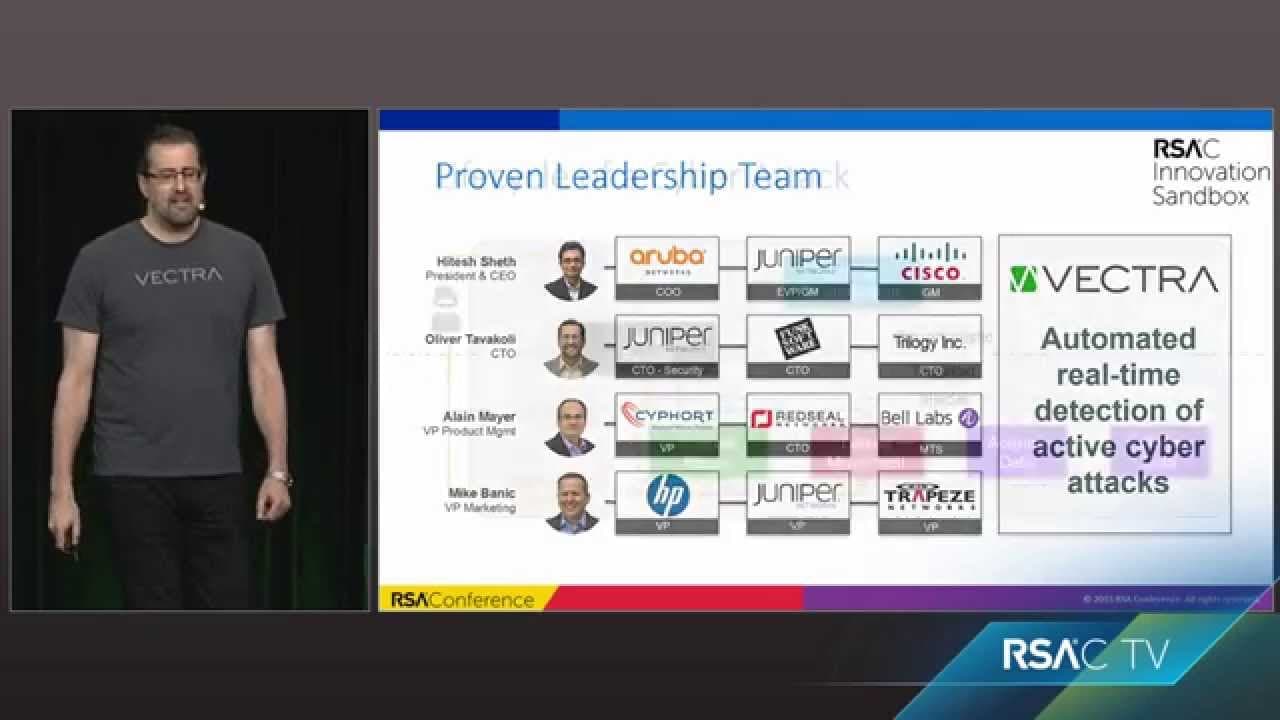
Go. Hi, I'm Oliver Tavakoli, and I'm here to talk to you about automating the detection of cyber attacks in real time. So first, a quick thumbnail sketch of our company. We're seventy-five strong. Uh, leadership team is your usual collection of Silicon Valley grizzled veterans, um, most of whom have had some overlap in prior lives, some who have no... Read More
Key Insights
- Vectra is a network-based detection system that observes traffic from strategically useful junction points. Multiple junction points can be covered to provide perspectives from different parts of an enterprise network without requiring agent-based deployment on every monitored machine.
- Cyberattacks commonly progress from an initial exploit into either botnet monetization or targeted activity. The described outcomes include search engine optimization abuse, spam, ad click fraud, internal reconnaissance, lateral movement, data acquisition, data exfiltration, and sometimes deliberate data destruction.
- The detection gap exists between preventive controls and post-incident investigation. Firewalls, intrusion prevention systems, proxies, and sandboxes cannot provide perfect prevention, while SIEM, analytics, and forensics may enter the process only after evidence of compromise has already emerged.
- Vectra analyzes post-infection machine behavior instead of carving files from data streams. This approach focuses detection on the actions an attacker attempts to accomplish, avoiding a constant race to recognize every newly disclosed exploit or vulnerability.
- Each suspicious machine receives a behavioral narrative and a position on a threat certainty matrix. Customers can review a concise behavioral sketch, inspect activity across time, open individual detections, examine supporting details, and access underlying packet capture files for context.
- Traditional intrusion prevention systems generally inspect perimeter traffic and attempt to decide whether an individual flow is malicious. Vectra also examines lateral traffic inside the enterprise, where traditional IPS deployments are generally absent, and evaluates aggregate host behavior rather than isolated flows.
- Behavioral memory is central to Vectra's detection method. The system accumulates evidence over minutes, hours, or weeks, creates a learned behavioral baseline, and avoids the effective amnesia of systems that evaluate only one flow at one instant.
- Machine learning is presented as a technique rather than Vectra's defining advantage. The stated differentiator is using relatively inexpensive network data to identify coarse-grained patterns of actual attacker behavior, with deployment described as taking fifteen minutes rather than three weeks.
Install to Summarize YouTube Videos and Get Transcripts
Explore YouTube Video Summarizer or Get YouTube Transcript Extractor
Questions & Answers
Q: How does Vectra detect cyberattacks in real time?
Vectra mines network traffic for patterns of activity performed by machines after they become infected. Rather than trying to recognize every exploit or make a perfect judgment about one flow, it aggregates behaviors over time. It then constructs a narrative for each affected host, evaluates threat and certainty of infection, and exposes timelines, detection details, and packet captures.
Q: What stages of a cyberattack can Vectra identify?
Vectra looks for active post-infection states described in the presentation, including command and control, internal reconnaissance, lateral movement, data acquisition, data exfiltration, and possible data destruction. It can also detect behavior associated with botnet monetization, such as search engine optimization abuse, spam, and ad click fraud. These behaviors are evaluated collectively as a developing attack narrative.
Q: How is Vectra different from a traditional IPS or IDS?
Traditional IPS and IDS technologies are described as judging an individual network flow at a particular moment, often with little retained context. Vectra instead aggregates host behavior over minutes, hours, or weeks and maintains memory of earlier activity. It also analyzes lateral traffic inside the enterprise, while traditional intrusion prevention systems are generally deployed at the network perimeter.
Q: Does Vectra use endpoint agents to monitor machines?
Vectra is described as entirely network-based rather than agent-based. It typically sits at an important junction point in the network and mines the traffic available there. An organization can cover multiple junction points to gain views from different angles. The approach relies on the amount of behavioral information contained in network traffic when that data is mined thoroughly.
Q: What information does Vectra provide about a suspicious host?
Vectra creates a narrative for every machine on which it observes relevant behaviors. It places the machine on a threat certainty matrix based on its threat level and certainty of infection, presents a thumbnail sketch of detected behaviors, and lets investigators examine activity across time. Users can also inspect individual behaviors, supporting details, and underlying packet capture files.
Q: Does Vectra prevent attacks or only detect them?
Vectra is presented primarily as a detection product rather than an enforcement system. Its role is to identify active attack behavior and give security teams sufficient context to understand what a compromised machine is doing. The system complements preventive technologies by covering the middle stage between imperfect prevention and later activities such as incident response, SIEM analysis, and forensics.
Q: Why does Vectra analyze behavior over extended periods?
A single network flow can be too limited to reveal whether activity is malicious. Vectra therefore combines observations across minutes, hours, or weeks to establish a behavioral baseline and recognize cumulative attacker behavior. The presentation compares this distinction to judging a robbery from a video rather than from one still photograph, where the sequence provides the necessary context.
Q: How quickly can Vectra be deployed and detect targeted attacks?
The presentation states that Vectra can be up and running in fifteen minutes because it uses data obtained relatively cheaply from the network, rather than requiring a three-week deployment project. Detection does not need to occur on the first suspicious flow. Finding a targeted attack eight hours or twenty-four hours into its activity is described as sufficiently useful.
Summary & Key Takeaways
-
Vectra addresses the detection gap between preventive security controls and post-incident analysis. Instead of extracting files or identifying every new exploit, its network-based technology analyzes what compromised machines do after infection, including command and control, reconnaissance, lateral movement, data acquisition, exfiltration, monetization activities, and destructive behavior across the enterprise.
-
The system observes network traffic from strategically selected junction points and can combine coverage from multiple locations. For each machine displaying suspicious behavior, it constructs a narrative, positions the host on a threat certainty matrix, summarizes observed activities, and provides access to behavioral timelines, detailed evidence, and underlying packet capture files for investigation.
-
Vectra differs from traditional IPS and IDS approaches by retaining and aggregating behavioral evidence across minutes, hours, days, or weeks. It monitors both perimeter and internal lateral traffic, prioritizes coarse-grained patterns of attacker activity, and accepts that detecting a targeted attack eight or twenty-four hours after it begins can still be operationally valuable.
Read in Other Languages (beta)
Share This Summary 📚
Summarize YouTube Videos and Get Video Transcripts with 1-Click
Try YouTube Summary with ChatGPT & Claude or YouTube Transcript Generator
Explore More Summaries from RSAC Cybersecurity 📚




Summarize YouTube Videos and Get Video Transcripts with 1-Click
Try YouTube Summary with ChatGPT & Claude or YouTube Transcript Generator