How Can Drones Protect Privacy and Security?
TL;DR
Privacy and security must be designed into drones and autonomous vehicles from the beginning, not added after lawsuits, breaches, or public pressure. These systems can collect passenger identities, communications, preferences, geolocation, and sensor data at enormous scale, creating risks around consent, ownership, cybersecurity, monetization, and surveillance unless companies establish clear technical and ethical boundaries.
Transcript
Well, good morning. As he said, I'm Justin Daniels. I'm an attorney at the law firm Baker Donelson, and I am a corporate M&A and transactional lawyer, but I deal with cybersecurity all the time. One day it could be a ransomware event. Another day it can be helping to create a cybersecurity and privacy program for some of the stuff we're gonna talk ... Read More
Key Insights
- Privacy and security are routinely treated as afterthoughts because safeguards can be inconvenient when companies prioritize rapid innovation, adoption, and monetization. The history of social platforms, videoconferencing, and blockchain projects illustrates the consequences of delaying these protections until problems become visible.
- Innovation is accelerating, while regulation and organizational safeguards often arrive later. The automobile took decades to become embedded in American life and another 50 years before airbags and habitual seatbelt use, but modern digital technologies can reach enormous audiences much more quickly.
- Data collection and monetization are central to many modern companies and industries. Facebook, other large technology companies, and their broader ecosystems collected data for more than a decade while privacy laws attempted to catch up with the resulting commercial and societal effects.
- Security design flaws can turn a focus on speed and adoption into substantial losses. Axie Infinity built an additional blockchain over Ethereum to increase performance, but the presenters say the system contained a fatal security design flaw associated with a $625 million hack.
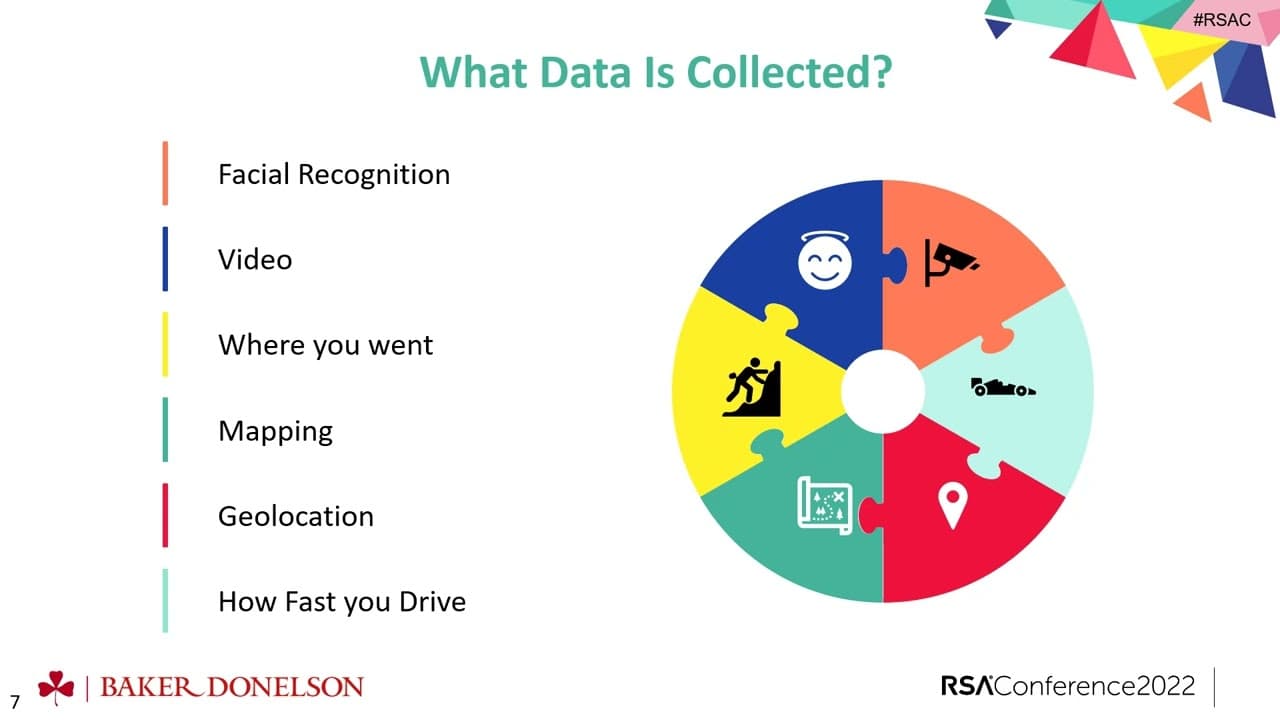
- Autonomous vehicles can collect more than four terabytes of data per vehicle each day. The information may include passenger details, facial recognition data, synchronized phone content, contacts, text messages, entertainment preferences, continuous geolocation, and readings from numerous external sensors.
- Facial recognition creates questions beyond simple identification. Organizations must determine whether a system stores an actual picture or a facial map, how long that information is retained, and whether travelers knowingly consented to its collection and use.
- Connected transportation depends on communication among vehicles and surrounding infrastructure. In the imagined journey, traffic and weather systems automatically exchange information with autonomous cars and aircraft to change routes, demonstrating both the operational value and the extensive data flows involved.
- Privacy and security by design provide a framework for balancing innovation with public trust. Developers should address what information is collected, who owns it, where it travels, whether consent exists, what regulations apply, and which ethical limits prevent transportation technology from becoming surveillance infrastructure.
Install to Summarize YouTube Videos and Get Transcripts
Explore YouTube Video Summarizer or Get YouTube Transcript Extractor
Questions & Answers
Q: How should drones and autonomous vehicles protect privacy?
Drones and autonomous vehicles should integrate privacy and security into their design from the beginning. Organizations need to identify every type of information collected, why it is needed, who owns it, where it goes, how long it remains available, and whether users consented. They should also consider current regulations and establish ethical boundaries so connected transportation does not gradually become a surveillance system.
Q: What data can an autonomous vehicle collect?
An autonomous vehicle can collect more than four terabytes of data per day per vehicle. The identified categories include passenger information, facial recognition data, synchronized meeting information, contacts, text messages, music preferences, possible movie preferences, continuous geolocation, and sensor readings about obstacles and people nearby. These categories create questions about necessity, access, retention, consent, ownership, and downstream use.
Q: Why is facial recognition a privacy concern in autonomous transportation?
Facial recognition may allow a traveler to enter a vehicle or pass through a gate, verify flight clearance, and trigger an automatic fare payment. The privacy concern is that users may not know whether the system keeps an actual image or a facial map, how long it retains that information, where the data travels, or whether meaningful consent was obtained.
Q: What can transportation developers learn from Facebook and Zoom?
Facebook demonstrates how extensive data collection and monetization can develop for more than a decade while privacy laws struggle to catch up. Zoom shows how a platform built for a smaller audience can face privacy and security problems when hundreds of millions of people rapidly adopt it. Both examples support implementing safeguards before scale, lawsuits, and public exposure force corrective action.
Q: How did the Axie Infinity hack illustrate security-by-design risks?
Axie Infinity was a play-to-earn game involving NFTs and cryptocurrency. Because its Ethereum foundation was considered slow, an additional blockchain was built over it to increase speed and user adoption. The presenters describe that added system as having a fatal security design flaw and connect it to the year's largest blockchain hack, valued at $625 million.
Q: Why does geolocation matter for autonomous vehicles?
Geolocation is operationally important because connected systems need to know where vehicles are. It can support traffic management, route changes, and coordination with surrounding infrastructure. However, continuous location collection can also reveal a passenger's movements. That makes location data part of the broader questions about ownership, destination, consent, retention, cybersecurity, and potential surveillance.
Q: How do connected vehicles use data to change routes?
Connected vehicles can communicate with traffic and transportation management systems. In the presenters' near-future scenario, a traffic drone tells an autonomous car about a highway collision and directs it to another route. Later, an autonomous traffic management system warns an aerial vehicle about a fast-moving weather front, allowing another route adjustment that avoids the affected area.
Q: Why must privacy and security be built into new technology early?
Early integration helps prevent safeguards from becoming reactions to breaches, lawsuits, or public criticism. The presenters argue that technology companies frequently prioritize profit, speed, adoption, and data monetization because privacy and security can seem inconvenient. With drones and autonomous vehicles collecting extensive personal, location, communication, and sensor data, delayed protection could create serious cybersecurity failures and a slippery slope toward surveillance.
Summary & Key Takeaways
-
Drones and autonomous vehicles promise convenient transportation through connected systems that can reroute travelers, recognize passengers, process fares, and respond to traffic or weather. Their operation also depends on extensive data collection and communication, raising fundamental questions about security, privacy, consent, ownership, retention, and the parties receiving the information.
-
Past technologies show that innovation often advances faster than safeguards. Facebook and other companies built businesses around collecting and monetizing data, Zoom strengthened protections after rapid growth exposed problems, and Axie Infinity suffered a $625 million blockchain hack linked to a security design flaw created while prioritizing speed and user adoption.
-
A responsible path requires privacy and security by design, supported by regulatory awareness and explicit ethical boundaries. Companies developing or using drones and autonomous vehicles should understand every category of collected data, determine why it is necessary, control how it is shared and retained, and avoid allowing useful innovation to become pervasive surveillance.
Read in Other Languages (beta)
Share This Summary 📚
Summarize YouTube Videos and Get Video Transcripts with 1-Click
Try YouTube Summary with ChatGPT & Claude or YouTube Transcript Generator
Explore More Summaries from RSAC Cybersecurity 📚






Summarize YouTube Videos and Get Video Transcripts with 1-Click
Try YouTube Summary with ChatGPT & Claude or YouTube Transcript Generator