How to Build and Grow an AI App Without Coding
TL;DR
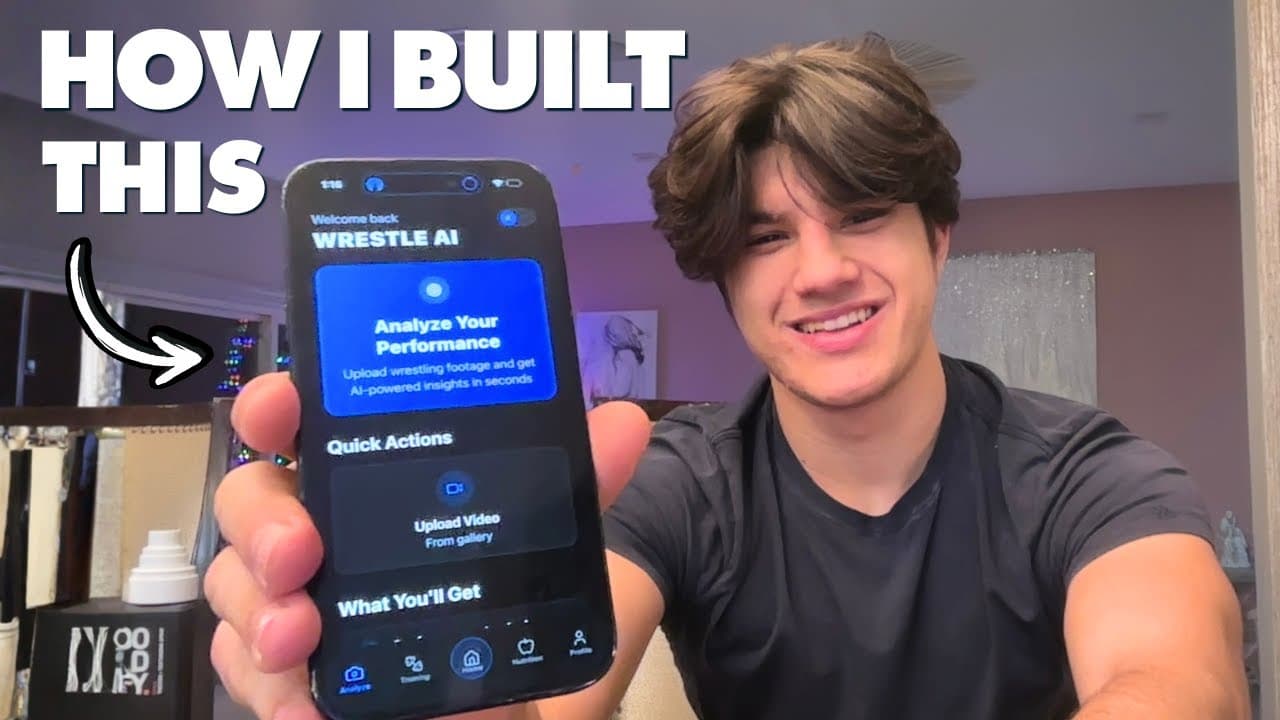
George Lampropolis, an 18-year-old college freshman who cannot code, built Wrestle AI with the vibe coding platform Rork and reached over $17,000 per month within about six months of launch. The app took one month from idea to App Store, priced at $9.99 monthly or $59.99 yearly, and has around 17,000 downloads from over 2 million social media impressions.
Transcript
Yeah, I literally don't know how to code at all. Meet George, a college student who had never written a single line of code in his life. That was until he discovered coding with AI. I truly believe that anyone can build a mobile app these days. In just a couple months, he came up with an idea, he built it, and then he launched it to the App Store. ... Read More
Key Insights
- Vibe coding platforms let non-programmers ship to the App Store. George says he does not know how to code at all, yet he used Rork plus public APIs to go from idea to live on the App Store in about one month, launching July 1st after starting in June.
- A viral idea matters more than distribution, in George's view. He pushes back on the popular claim that distribution is most important, arguing that if the idea is not viral by nature, distribution does not matter because the creatives will not convert.
- Three pillars define a good app idea: uniqueness so it catches eyes, helpfulness so it has stickiness, and a gotcha moment built into the app that conveys what it does in roughly 5 seconds and stops someone from scrolling.
- Impressions do not equal downloads without a novel concept. George's second app, Green, launched with a million-follower influencer and got close to 1.8 million impressions but only about 100 downloads, while Wrestle AI converted on similar reach.
- Onboarding is the second most important part of an app because a great product still fails if it cannot convert the user. George studied high converting apps such as Opel and Cali for hours and copied their onboarding elements into his own.
- His onboarding formula runs in three moves: educate the user about what the app does, personalize the experience with guiding questions that both configure the app and show why it is needed, then enact FOMO about not having the app.
- Outsourcing narrow technical tasks is cheaper than outsourcing the build. George hired one developer on Fiverr for about $250 to add a paywall and authentication in a week, after earlier agency attempts on a previous app failed for a year and a half.
- Revenue splits between subscription terms: MRR is $8,000 from monthly subscriptions and the rest comes from yearly plans, which accrue because the free trial is attached to the yearly option at $59.99 versus $9.99 monthly.
Install to Summarize YouTube Videos and Get Transcripts
Explore YouTube Video Summarizer or Get YouTube Transcript Extractor
Questions & Answers
Q: What is Wrestle AI and how does it make money?
Wrestle AI is an AI wrestling coach app built by George Lampropolis. Users submit videos of their matches, and the app uses video analysis to break down what they did right, what they did wrong, and how they can improve, then gives drills and actionable plans for improvement. Pricing is $9.99 for the month and $59.99 for the year. It launched September 26th and now generates over $17,000 per month, with MRR of $8,000 coming from monthly subscriptions and the remainder from yearly plans.
Q: How long did it take to build the app with no coding experience?
It took George around one month from idea to being live on the App Store. He started in June after seeing an ad for a vibe coding platform, and launched July 1st. He spent the first week of June prompting Rork non-stop until he got something he liked, then passed the project to a developer. The final two weeks were spent dealing with Apple's rejections and review issues, which he describes as the most time-consuming part of the launch.
Q: What tools did George use to vibe code his app?
George used Rork, a vibe coding platform he discovered through a social media ad claiming someone built seven apps in a week. He combined it with a number of public APIs to build functionality. He also used ChatGPT as an adviser: whenever there was an issue porting the app from Rork to TestFlight, such as an Expo error, he copied the logs into ChatGPT and let it guide him through fixing the problem.
Q: How much did George pay a developer, and for what?
George paid someone on Fiverr about $250 to integrate payments and authentication, and that work took roughly a week. He describes integrating a paywall as a simple task worth outsourcing rather than fighting through himself. This contrasts sharply with his earlier venture at age 15, where he and a friend hired three development agencies, none of which got the app right, and it took a year and a half to release.
Q: What makes an app idea go viral according to George?
George names three pillars for a good idea: uniqueness, helpfulness, and the gotcha moment. Uniqueness makes the app catch eyes, helpfulness gives it stickiness so people keep using it, and the gotcha moment is a built-in element that conveys what the app does in about 5 seconds. He designs with the gotcha moment in mind, asking what he can seamlessly integrate into a TikTok or YouTube Short that will stop someone from scrolling.
Q: Why did George's second app fail despite millions of impressions?
George launched a second app called Green in collaboration with an influencer with a million followers. It reached close to 1.8 million impressions, similar to Wrestle AI, but got only about 100 downloads. He attributes the failure to the idea itself: Green was a concept similar to existing apps rather than a novel one, so it did not follow what he calls the purple cow philosophy. Without an abstract, eye-catching concept, the creatives did not convert.
Q: How should you design an app's onboarding to convert users?
George calls onboarding the second most important part of an app, because a great app that cannot convert the user means no one will know about it. His approach is to copy what already works: he spent hours studying the onboarding flows of high converting apps such as Opel and Cali and applied those elements to his own. His formula is to first educate the user about what the app does, second personalize the experience with guiding questions that set up the app and show why the user needs it, then enact FOMO about not having it.
Q: What are the first steps in George's app building process?
Step one is the idea, judged against uniqueness, helpfulness, and the gotcha moment. Step two is designing the app by answering who it is for and what type of UI would fit the prospective buyer, then building the framework before the functionality, while also considering how users could organically share the app. Step three is building out the core functionality, which for George meant setting aside a week to prompt Rork from morning until night, figuring out Supabase, and looking for external APIs that are inexpensive but improve the app substantially.
Summary & Key Takeaways
-
George Lampropolis is 18 and a college freshman who says he does not know how to code at all. He built Wrestle AI, an AI wrestling coach that analyzes submitted match videos, breaks down what the user did right and wrong, and returns drills and actionable improvement plans. It launched September 26th and now makes over $17,000 per month.
-
The build took about a month, starting in June after George saw an ad for a vibe coding platform called Rork claiming seven apps in a week. He prompted Rork non-stop for the first week, pasted Expo error logs into ChatGPT as an adviser, and paid a Fiverr developer roughly $250 to integrate payments and authentication.
-
His six-step process starts with the idea, which he judges on three pillars: uniqueness, helpfulness, and a gotcha moment that conveys the app in about 5 seconds. Later steps cover designing the UI around a specific buyer, prompting out core functionality with APIs, and building an onboarding that educates, personalizes, then creates FOMO.
Read in Other Languages (beta)
Share This Summary 📚
Summarize YouTube Videos and Get Video Transcripts with 1-Click
Try YouTube Summary with ChatGPT & Claude or YouTube Transcript Generator
Explore More Summaries from Starter Story 📚

Summarize YouTube Videos and Get Video Transcripts with 1-Click
Try YouTube Summary with ChatGPT & Claude or YouTube Transcript Generator