How to use test time compute to improve graph models
TL;DR
The video shows that test time compute can help refine outputs in graph neural networks, but recurrence alone often does not match larger models trained with more time. Adding graph structure and deep equilibrium approaches can boost performance, though stability and training issues may arise that require careful handling.
Transcript
uh hi um my talk is going to be about characterizing test time compute on graph structured problems um most of my scholars project has been spent thinking about uh this question of whether we can uh create models that continuously improve their outputs the more compute that we give them at test time this is something that i'll call the test time co... Read More
Key Insights
- Test time compute aims to let models improve answers with more run-time iterations to reduce ambiguity.
- Graph neural networks operate by iteratively refining node representations via message passing across a graph.
- Short answer: extra recurrence alone does not reliably match larger models trained without recurrence.
- Evaluating predictions at multiple steps during training helps robustness when test time refinement differs from training time.
- Deep equilibrium models turn iterative graphs into implicit fixed point problems, enabling backprop through equilibrium points.
- Using a fixed flop budget allows fair comparison between recurrent and non recurrent models while testing test time compute.
- Graph refinement equations resemble fixed point equations, enabling application of deep equilibrium methods.
- Learning adjacencies on the fly, for sudoku or similar tasks, can be guided by a transformer to select relevant edges.
Install to Summarize YouTube Videos and Get Transcripts
Explore YouTube Video Summarizer or Get YouTube Transcript Extractor
Questions & Answers
Q: What is the test time compute dream and why is it considered anthropomorphic?
The test time compute dream refers to creating models that improve their outputs the more time they are given to think at test time, similar to how humans answer more accurately when allowed more time. It is anthropomorphic because it draws a parallel between human thinking time and machine reasoning, suggesting extended computation could yield better generalization and refined answers.
Q: How do graph neural networks refine node representations?
Graph neural networks refine node representations by performing message passing between nodes and aggregating neighbor information through a graph refinement equation. Each node updates its hidden state based on its own embedding and the embeddings of its neighbors, processed through a function and aggregated, enabling the model to encode relational structure.
Q: Why did the researchers test multiple time steps during training and evaluation?
Testing multiple time steps during training and evaluation helps assess whether extended computation at test time can improve accuracy beyond what is seen during training. It also examines if increasing iterations helps the model solve harder instances or approach the performance of larger models trained without recurrence, providing insight into the usefulness of test time computation.
Q: What is a deep equilibrium model and how is it applied here?
A deep equilibrium model is an implicit representation where a network is treated as converging to a fixed point, rather than computing layered intermediate states. In this work, the graph refinement phase is treated as a fixed point problem, allowing evaluation at convergence and backpropagation through the equilibrium point to achieve infinite depth behavior with efficiency gains.
Q: What stability caveat is mentioned with deep equilibrium GNNs?
The presentation notes a stability caveat where training sometimes collapses or degenerates during optimization, potentially due to the spectral norm growth of operators in the GNN under fixed point iteration. Early stopping when this degeneracy appears is suggested as a practical workaround pending further investigation.
Q: How can adjacencies in a graph be learned rather than predefined?
Adjacencies can be learned by using a transformer to estimate relevance between nodes, sampling top k indices per node to form a learned adjacency matrix. This learned structure is then fed into the GNN, allowing the model to discover which nodes should influence each other rather than relying on fixed, manually defined connections.
Q: What was the role of the Sudoku example in the talk?
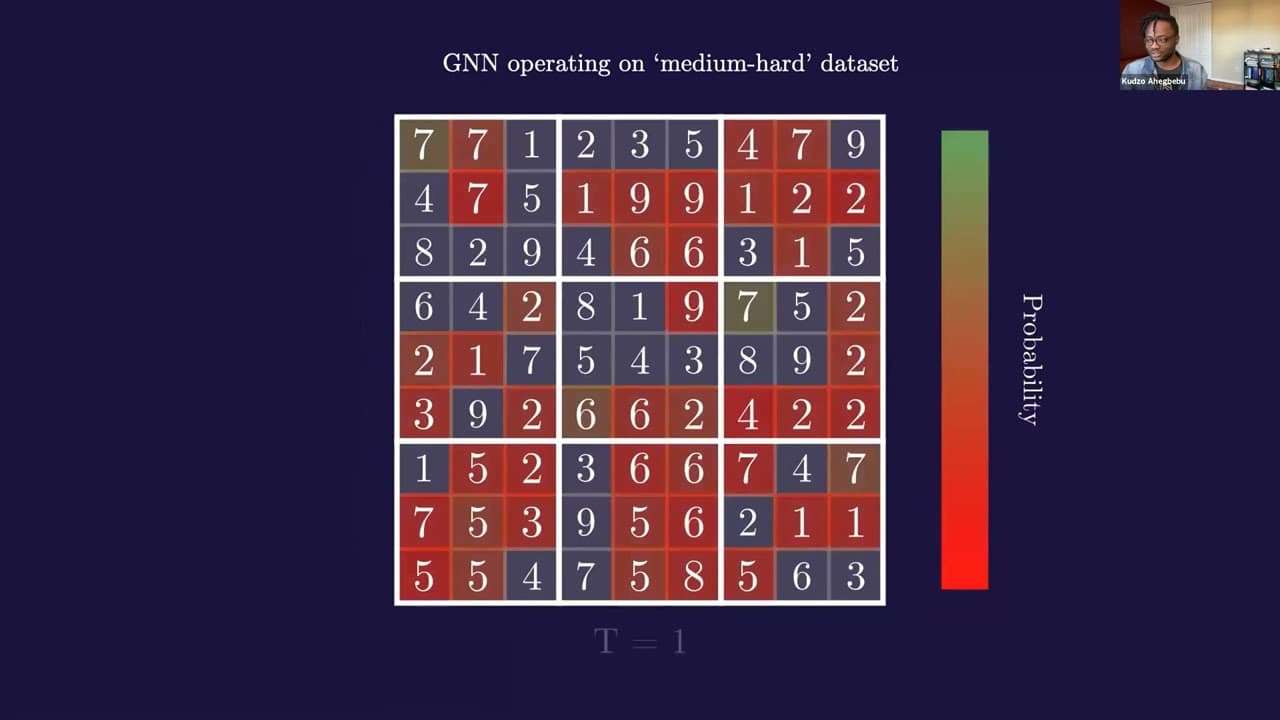
The Sudoku example serves to illustrate how a graph model can solve a structured relational problem by treating each cell as a node and applying the graph refinement process. It demonstrates how attention to uncertain elements and iterative refinement can guide the model to complete the puzzle, showing the practical application of test time compute and GNNs.
Q: How does the proposed approach relate test time compute to efficiency and parameterization?
The approach separates the amount of parameters from inference time by using recurrent or fixed point methods to reuse computations, potentially allowing larger models to run with similar or lower inference time. This aims to decouple parameter growth from test time cost, improving efficiency while exploring whether extra compute yields better generalization.
Summary & Key Takeaways
-
The talk investigates test time compute and how extra iterations can improve a model’s answers on graph tasks, particularly shortest path in graphs and Sudoku. It also compares recurrence with larger, longer trained models and introduces graph neural networks as a way to leverage relational structure for better generalization.
-
Graph neural networks refine node representations through message passing, and the presentation emphasizes evaluating predictions at multiple time steps to improve robustness and performance on hard instances.
-
A key theme is balancing compute and efficiency, using fixed flop budgets and exploring deep equilibrium models to achieve faster training and lower memory usage while maintaining accuracy, with caveats related to potential training instability and the need for structural guidance in the network.
Read in Other Languages (beta)
Share This Summary 📚
Summarize YouTube Videos and Get Video Transcripts with 1-Click
Try YouTube Summary with ChatGPT & Claude or YouTube Transcript Generator
Explore More Summaries from OpenAI 📚




Summarize YouTube Videos and Get Video Transcripts with 1-Click
Try YouTube Summary with ChatGPT & Claude or YouTube Transcript Generator