How to Calculate Projectile Max Height and Range
TL;DR
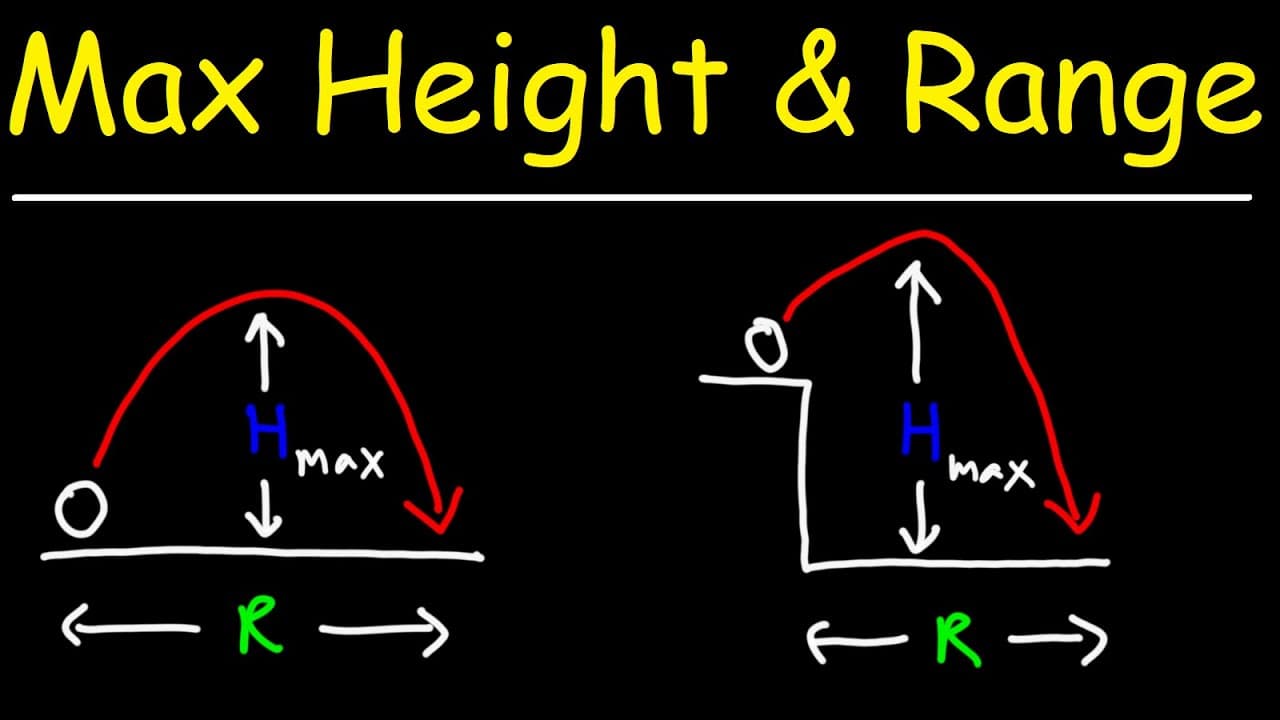
To find the maximum height and range of a projectile, use specific kinematic equations. For maximum height, apply the formula involving initial velocity and angle, while for range, use the equation incorporating initial velocity, angle, and time. These calculations are essential for understanding projectile motion in physics.
Transcript
in today's lesson we're going to work on projectile motion problems that will help us to calculate the maximum height and the range of a projectile so let's begin with this problem A ball rolls off a cliff at 15 m/ second and hits the ground 6 seconds later what is the height of the cliff and how far from the base of the cliff will the ball hit the... Read More
Key Insights
- Projectile motion involves both horizontal and vertical components that can be analyzed separately.
- The maximum height of a projectile is determined using the formula: (V_initial^2 * sin^2(Theta)) / (2 * g).
- The range of a projectile is calculated using: (V_initial^2 * sin(2 * Theta)) / g.
- Time of flight can be found using the formula: (2 * V_initial * sin(Theta)) / g.
- Horizontal velocity remains constant throughout the projectile's flight.
- Vertical velocity changes due to gravitational acceleration, affecting the projectile's height and time of flight.
- The final velocity of a projectile can be calculated using kinematic equations that account for both horizontal and vertical components.
- Understanding these formulas is crucial for solving complex projectile motion problems in physics.
Install to Summarize YouTube Videos and Get Transcripts
Explore YouTube Video Summarizer or Get YouTube Transcript Extractor
Questions & Answers
Q: How to calculate the maximum height of a projectile?
The maximum height of a projectile is calculated using the formula: (V_initial^2 * sin^2(Theta)) / (2 * g), where V_initial is the initial velocity, Theta is the launch angle, and g is the acceleration due to gravity (9.8 m/s^2). This formula accounts for the vertical component of the projectile's motion.
Q: What is the formula for finding the range of a projectile?
The range of a projectile is determined using the formula: (V_initial^2 * sin(2 * Theta)) / g. Here, V_initial is the initial velocity, Theta is the launch angle, and g is the acceleration due to gravity. This equation calculates the horizontal distance traveled by the projectile.
Q: How do you find the time of flight for a projectile?
The time of flight for a projectile can be found using the formula: (2 * V_initial * sin(Theta)) / g, where V_initial is the initial velocity, Theta is the launch angle, and g is the gravitational acceleration. This formula calculates the total time the projectile remains in the air.
Q: Why does horizontal velocity remain constant in projectile motion?
In projectile motion, horizontal velocity remains constant because there are no horizontal forces acting on the projectile once it is in motion. Gravity only affects the vertical component, causing vertical acceleration, while the absence of horizontal forces means no change in horizontal velocity.
Q: How does gravity affect a projectile's vertical velocity?
Gravity affects a projectile's vertical velocity by causing it to decrease as the projectile ascends and increase as it descends. This is due to gravitational acceleration, which is a constant force pulling the projectile downward at 9.8 m/s^2, impacting the vertical component of motion.
Q: What is the significance of the launch angle in projectile motion?
The launch angle in projectile motion is significant because it determines the initial vertical and horizontal velocity components. A higher angle increases the vertical component, affecting maximum height and time of flight, while influencing the range. The angle critically impacts the projectile's trajectory.
Q: How do you calculate the final velocity of a projectile?
The final velocity of a projectile is calculated using kinematic equations that combine both horizontal and vertical components. The magnitude is found using the Pythagorean theorem, combining horizontal and vertical velocities, while the direction is determined using trigonometric functions like arctan or arccos.
Q: What are the key equations for solving projectile motion problems?
Key equations for solving projectile motion problems include: maximum height = (V_initial^2 * sin^2(Theta)) / (2 * g), range = (V_initial^2 * sin(2 * Theta)) / g, and time of flight = (2 * V_initial * sin(Theta)) / g. These equations are essential for analyzing projectile trajectories.
Summary & Key Takeaways
-
Projectile motion problems can be solved by separating horizontal and vertical components. Maximum height is found using initial velocity and angle, while range is calculated with initial velocity, angle, and time. These formulas are fundamental for physics students learning about projectile motion.
-
The video provides formulas to calculate projectile motion parameters like maximum height and range. It emphasizes the importance of understanding horizontal and vertical components separately, as horizontal velocity remains constant and vertical velocity is affected by gravity.
-
Key formulas include: maximum height = (V_initial^2 * sin^2(Theta)) / (2 * g) and range = (V_initial^2 * sin(2 * Theta)) / g. These equations help determine the projectile's trajectory, essential for physics problem-solving.
Read in Other Languages (beta)
Share This Summary 📚
Summarize YouTube Videos and Get Video Transcripts with 1-Click
Try YouTube Summary with ChatGPT & Claude or YouTube Transcript Generator
Explore More Summaries from The Organic Chemistry Tutor 📚



Summarize YouTube Videos and Get Video Transcripts with 1-Click
Try YouTube Summary with ChatGPT & Claude or YouTube Transcript Generator