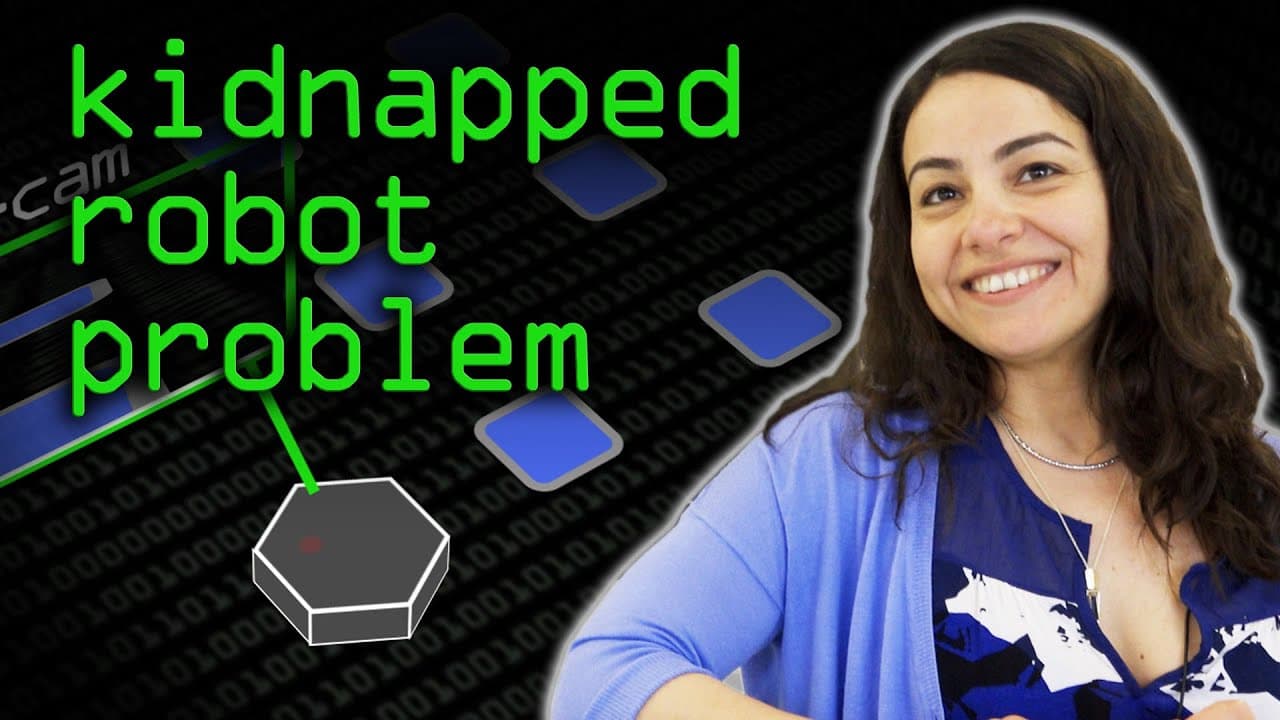
How Do Robots Solve the Kidnapped Robot Problem?
TL;DR
The kidnapped robot problem is a challenge where a mobile robot must determine its location after being placed in an unknown environment. This task is complicated by sensor uncertainties and motion drift, necessitating the integration of real-time sensor data and probabilistic methods. Advanced algorithms like SLAM help robots create maps while localizing themselves in unfamiliar spaces.
Transcript
so yeah i thought we could talk about the kidnap robot problem today so kidnap robot problem is a problem that is defined for mobile robots where you take a robot from a known location and put it in the space somewhere where the robot doesn't know where it is and it tries to relocalize itself to find where it is in that space and basicall... Read More
Key Insights
- 🤖 Robotics faces the challenge of the kidnapped robot problem, where robots must relocate themselves in unknown spaces within a known map.
- 🤖 Sensors in robots, like sonar, infrared, and vision, provide information about the environment but also introduce uncertainties and limitations.
- 🤳 Motion errors, known as drift, make self-localization difficult, requiring constant correction and refinement.
- 💁 Robotics combines information fusion, statistical formulations, and probabilistic approaches to handle uncertainties and improve localization.
- 🧘 Multiple sensors, such as GPS, can be utilized to enhance motion and position estimation, although they also have their own limitations.
- 🤖 Simultaneous Localization and Mapping (SLAM) algorithms help robots create maps of unknown environments while simultaneously determining their location.
- 🌍 Real-world robotics problems are more complex due to uncertain and dynamic environments, requiring adaptive and real-time solutions.
Install to Summarize YouTube Videos and Get Transcripts
Explore YouTube Video Summarizer or Get YouTube Transcript Extractor
Questions & Answers
Q: What is the kidnapped robot problem?
The kidnapped robot problem involves placing a robot in an unknown space, forcing it to relocalize itself and determine its location within a known map.
Q: How do real-world constraints make robotics problems more difficult than AI?
Unlike AI, robotics deals with real-world dynamics and uncertainties in sensors, motion, and the environment, making localization and movement challenges more complex and real-time.
Q: How does drift affect the localization problem?
Drift, caused by small errors in motion, accumulates over time, making it difficult for the robot to correct its location accurately, leading to challenges in self-localization.
Q: How does probabilistic robotics help refine uncertainties in location estimation?
Probabilistic robotics uses statistical formulations and updating belief distributions to refine uncertainties, incorporating measurements, movement, and sensor information to improve localization.
Summary & Key Takeaways
-
The kidnapped robot problem involves taking a robot from a known location and placing it in an unknown space, which it must navigate and relocalize itself within.
-
Mobile robots, like the toy robot described, face challenges in solving this problem due to real-world constraints, uncertainties in sensors, and drift in motion.
-
Robotics differs from AI in that it deals with the complexities and uncertainties of the real world, requiring the fusion of sensor information to improve movement and achieve localization.
Read in Other Languages (beta)
Share This Summary 📚
Summarize YouTube Videos and Get Video Transcripts with 1-Click
Try YouTube Summary with ChatGPT & Claude or YouTube Transcript Generator
Explore More Summaries from Computerphile 📚





Summarize YouTube Videos and Get Video Transcripts with 1-Click
Try YouTube Summary with ChatGPT & Claude or YouTube Transcript Generator