Manometer Pressure Problems, Introduction to Barometers - Measuring Gas & Atmospheric Pressure
TL;DR
Learn how to calculate gas pressure using a manometer by analyzing the height difference of a mercury column, and understand the importance of filling a barometer with mercury to measure atmospheric pressure accurately.
Transcript
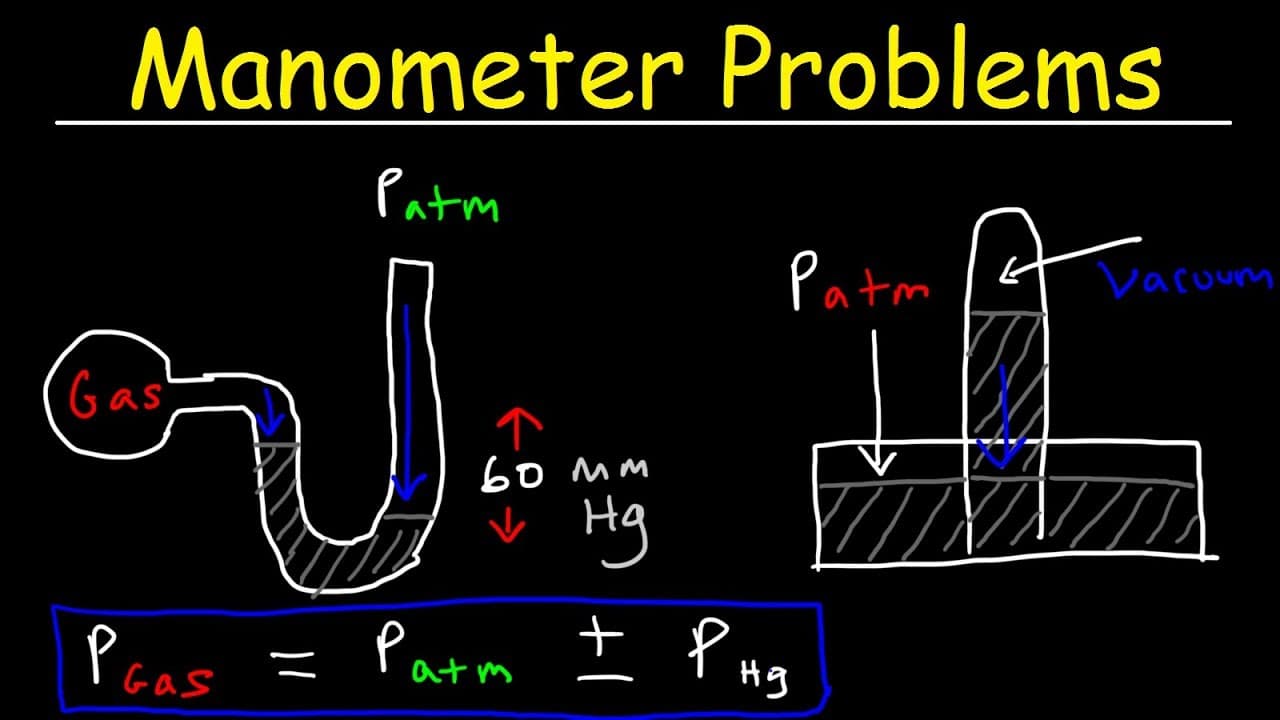
so how would you answer this question if the atmospheric pressure is 760 millimeters of mercury what is the pressure of the gas in a manometer if the mercury column is 60 millimeters higher on the atmospheric side let's find out let's draw a picture so in this bulb is going to contain the gas and this side is going to be open to the atmosphere and ... Read More
Key Insights
- 🫢 A manometer calculates gas pressure by considering the height difference of the mercury column and the atmospheric pressure.
- 🙃 The pressure of a gas is determined by comparing the heights of the mercury column on the two sides of a manometer.
- 👻 Filling a barometer with mercury before inverting it creates a vacuum, allowing for a precise measurement of atmospheric pressure.
- 😘 In a manometer, the gas with a higher pressure will push down on the mercury column more than the side with lower pressure.
- 🧪 Gas particles present in an "empty" test tube contribute to the pressure exerted, leading to no change in the mercury column if not filled with mercury.
Install to Summarize YouTube Videos and Get Transcripts
Explore YouTube Video Summarizer or Get YouTube Transcript Extractor
Questions & Answers
Q: How do you calculate the gas pressure in a manometer?
To calculate gas pressure, add or subtract the height difference of the mercury column from the atmospheric pressure, depending on whether the gas pressure is stronger or weaker than atmospheric pressure.
Q: How can the height of the mercury column determine the pressure of a gas in a manometer?
The higher the mercury column on a particular side, the stronger the pressure of the gas on that side, as pressure is defined by force per unit area.
Q: Why is it necessary to fill a barometer with mercury before inverting it?
Filling the test tube with mercury removes any gas particles inside, creating a vacuum. This allows the atmospheric pressure to be the only force exerted on the mercury column, accurately measuring atmospheric pressure.
Q: How does a barometer measure atmospheric pressure?
A barometer measures atmospheric pressure by adjusting the height of the mercury column until it matches the atmospheric pressure, providing an accurate reading.
Summary & Key Takeaways
-
Gas pressure in a manometer can be calculated by adding or subtracting the height difference of the mercury column from the atmospheric pressure.
-
Gas pressure is determined by comparing the height of the mercury column on both sides, with the higher side indicating a stronger pressure.
-
In a barometer, filling the test tube with mercury first and then inverting it creates a vacuum, allowing atmospheric pressure to balance with the weight of the mercury column.
Read in Other Languages (beta)
Share This Summary 📚
Summarize YouTube Videos and Get Video Transcripts with 1-Click
Try YouTube Summary with ChatGPT & Claude or YouTube Transcript Generator
Explore More Summaries from The Organic Chemistry Tutor 📚



Summarize YouTube Videos and Get Video Transcripts with 1-Click
Try YouTube Summary with ChatGPT & Claude or YouTube Transcript Generator