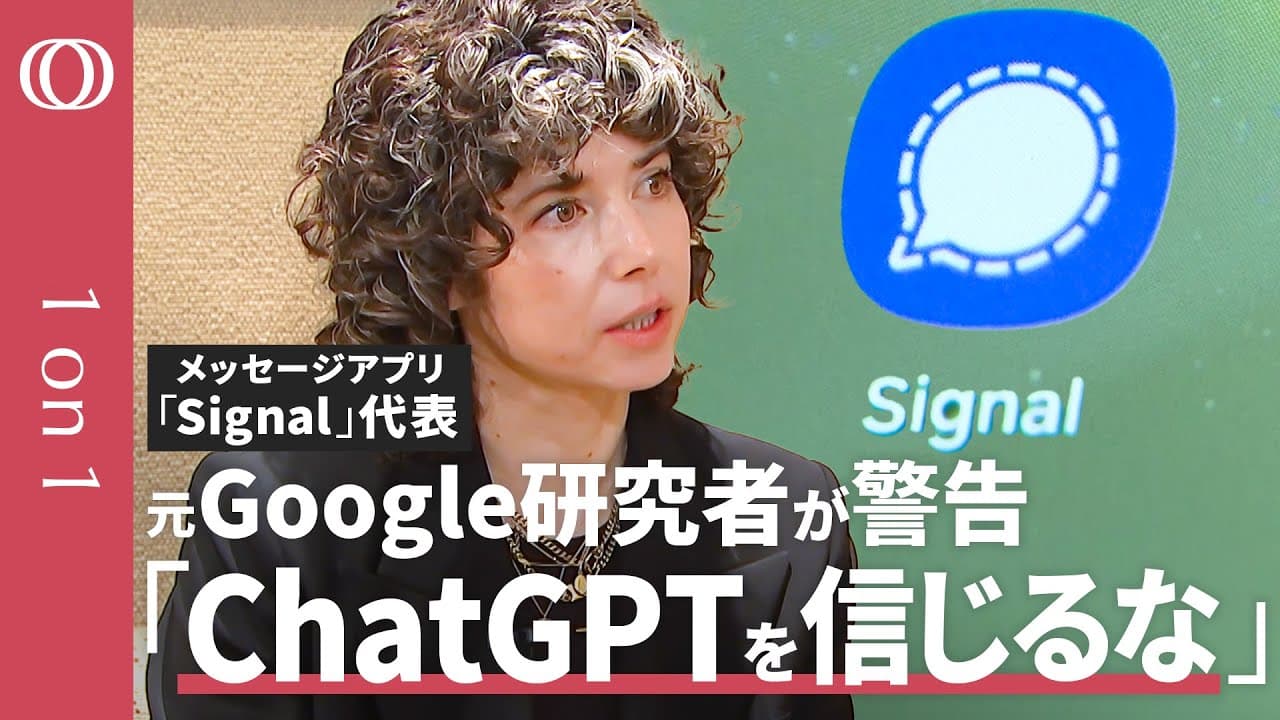
Why Does Signal Protect Privacy Differently? Meredith Whittaker on Surveillance, AI, and ChatGPT【1on1】
TL;DR
Signal protects private communication by encrypting every message from sender to recipient and collecting as close to zero data as possible. Meredith Whittaker explains that the nonprofit Signal Foundation relies primarily on donations, avoiding business incentives tied to advertising and AI training. She also warns that stored messages and metadata can be breached or weaponized by powerful actors. Read on to understand why privacy matters even in ordinary conversations.
Transcript
We live in a golden age of surveillance. Collecting data, that's the economic engine of tech. And really imagine every message you've ever sent to anyone is now in a database. Ultimately, that those who have power over you aren't able to weaponize that information. The only way to protect data is not to collect it. End toend encryption, the technol... Read More
Key Insights
- Signal is a nonprofit messaging app whose operating costs are covered primarily by donations. This structure is intended to prevent investors, shareholders, or a board focused on revenue from pressuring the organization to weaken its promise of privacy for greater profit.
- End-to-end encryption is the technology that keeps message contents inaccessible between the sender's and recipient's devices. Signal applies it by default to one-to-one messages, group texts, calls, and video calls, making encryption central to the service rather than an optional feature.
- Signal collects as close to no data as possible. According to Whittaker, it does not know who is talking to whom, who belongs to a group, what profile photo a person uses, or what information appears inside messages.
- Metadata is intimate information even when message contents are encrypted. Contact lists, group memberships, profile photos, communication partners, timing, and location can reveal relationships and behavior, so protecting only message text does not eliminate broader surveillance risks.
- The safest way to protect data is not to collect it. Information that appears harmless while sitting unused on a server can later be exposed, repurposed, or searched by a different political regime seeking to identify disfavored people or activities.
- Privacy is necessary for maintaining a full social life. People communicate differently with friends, relatives, colleagues, partners, and employers, and a searchable database of every past message could destroy relationships or provide powerful institutions with opportunities for coercion.
- The technology industry's economic engine is data collection. Companies can monetize personal information through personalized surveillance advertising or use collected material to train AI models, creating incentives that conflict with minimizing data retention and protecting private communication.
- Criminal use does not invalidate private infrastructure. Whittaker compares criminals using Signal with criminals driving on public roads, arguing that society does not ordinarily blame general-purpose infrastructure merely because people can use it while committing crimes.
Install to Summarize YouTube Videos and Get Transcripts
Explore YouTube Video Summarizer or Get YouTube Transcript Extractor
Questions & Answers
Q: How does Signal protect private messages?
Signal uses end-to-end encryption for all communications. Each message is secured from the sender’s device until it reaches the recipient, so the Signal Foundation, government agencies, and hackers cannot read its content in between.
Q: Why is Signal operated by a nonprofit foundation?
Signal operates as a nonprofit because the technology industry commonly makes money by collecting personal data for advertising or AI training. Funding its operating costs primarily through donations helps prevent investors, shareholders, or its board from pressuring Signal to weaken privacy for revenue and profit.
Q: Why should ordinary people care about digital privacy?
Ordinary conversations can include sensitive feelings, personal concerns, workplace discussions, or plans people do not want stored on a company’s servers. Whittaker argues that privacy allows everyone to communicate freely without powerful actors gaining information they could later expose or weaponize.
Q: What makes Signal different from other messaging apps?
Signal makes privacy the foundation of its service rather than an optional feature. It combines end-to-end encryption with an open-source approach that can be verified and aims to collect as close to zero data as possible.
Q: What is metadata, and why can it threaten privacy?
Metadata is information surrounding communication, such as who talks to whom, group membership, profile photos, timing, and location. Even without message contents, these details can reveal relationships, associations, routines, and behavior.
Q: Why does Whittaker say the safest data is uncollected data?
Stored information can later be leaked, stolen, repurposed, searched, or weaponized by companies, hackers, governments, or other powerful actors. Whittaker therefore argues that the only way to protect data reliably is not to collect it.
Q: How do advertising and AI encourage surveillance?
Technology companies can profit by collecting personal information for personalized surveillance advertising. They can also use collected data to train AI models, making data accumulation an economic engine that conflicts with Signal’s goal of minimizing collection.
Q: Does criminal use of Signal invalidate private messaging?
Whittaker argues that privacy infrastructure should not be blamed simply because criminals may use it. She compares this with criminals driving cars on public roads: society does not blame the roads for the crimes committed by their users.
Summary & Key Takeaways
-
Signal is a nonprofit messaging service designed around private communication. Its calls, video calls, group messages, and one-to-one messages use end-to-end encryption by default. The Signal Foundation also seeks to retain almost no data, reducing the information that hackers, companies, governments, or future political regimes could obtain and exploit.
-
Whittaker argues that privacy enables people to maintain relationships, express uncomfortable thoughts, and communicate differently with friends, relatives, colleagues, and institutions. A complete database of past messages could expose private conflicts and opinions, damage relationships, or give powerful actors leverage. Data protection is therefore presented as a fundamental right, not an abstract technical concern.
-
The interview connects surveillance to the technology industry's economic structure. Advertising platforms profit from collecting personal information, while AI developers can use collected data to train models. Signal uses donations and nonprofit governance because strong privacy conflicts with those incentives, although Whittaker acknowledges that nonprofit status itself is not a perfect organizational solution.
Read in Other Languages (beta)
Share This Summary 📚
Summarize YouTube Videos and Get Video Transcripts with 1-Click
Try YouTube Summary with ChatGPT & Claude or YouTube Transcript Generator
Explore More Summaries from TBS CROSS DIG with Bloomberg 📚






Summarize YouTube Videos and Get Video Transcripts with 1-Click
Try YouTube Summary with ChatGPT & Claude or YouTube Transcript Generator