How Does Firmware Enable Cyber Resilience?
TL;DR
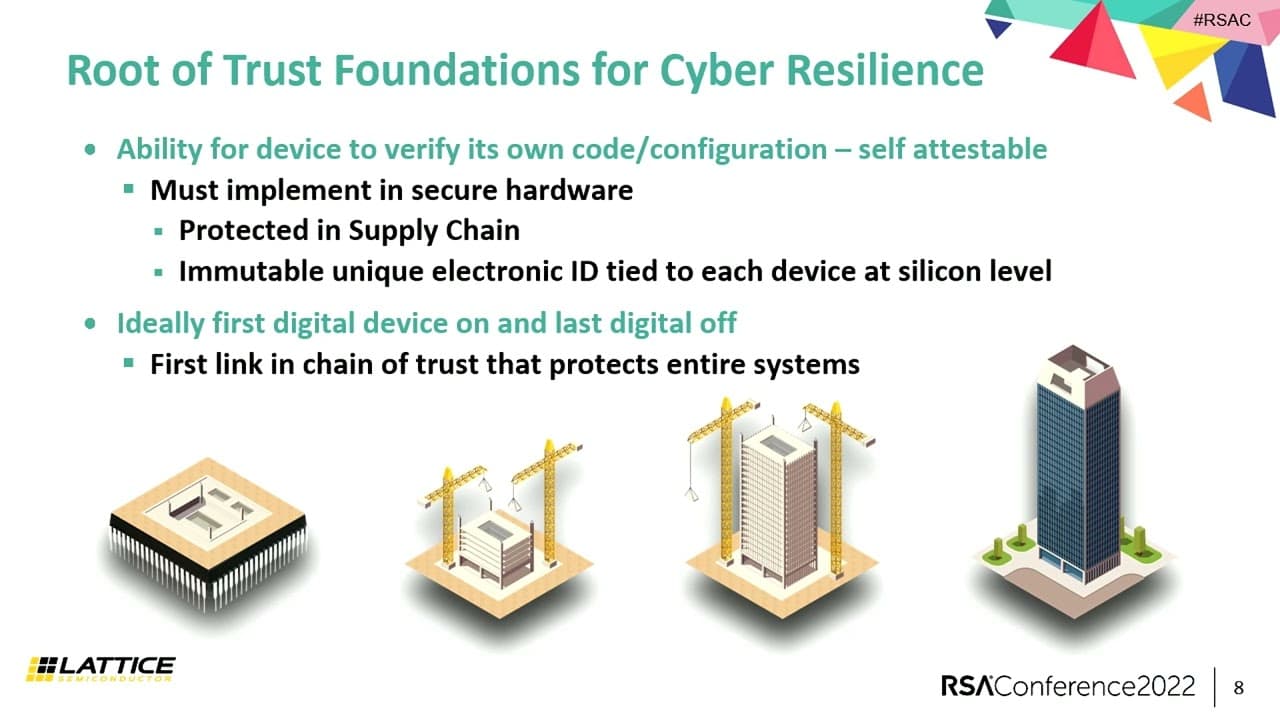
Cyber resilience requires a hardware root of trust and an automated cycle that protects firmware, detects compromise, and recovers known-good states. These capabilities must operate below the operating system because application-level tools cannot reliably identify a compromised BIOS or component firmware environment, while supply chain attacks can occur before systems are deployed.
Transcript
So, uh, my name's Eric Silvertson, and I'm the vice president of the security business at Lattice Semiconductor. Uh, we make, uh, field programmable gate arrays, FPGAs, and, uh, uh, probably you best would know, know what we do from, uh, server controls. Almost, uh, every server on the planet has our, uh, semiconductors in it to bring them up, powe... Read More
Key Insights
- Cyber resilience is the ability to continuously deliver an intended outcome despite adverse cyber events. It combines information security, business continuity, and organizational resilience, shifting the objective from merely preventing attacks to maintaining useful operation while systems are attacked or compromised.
- A hardware root of trust is the foundation of computing resilience. It must establish a trustworthy low-level basis for protecting firmware and should support automated responses because relentless attacks make continual human involvement impractical for detection, protection, and recovery.
- The firmware resiliency cycle consists of protection, detection, and recovery. Protection preserves authenticity and integrity, detection identifies compromise or unauthorized changes, and recovery restores known-good firmware and trusted credentials so the affected platform can return to an operational state.
- Firmware detection is most valuable when it begins at power-on and runs after every system update. Application and operating-system monitoring starts after BIOS initialization, so those tools may unknowingly operate inside an already compromised environment if low-level firmware has been altered.
- Automated recovery is required for continued operation during cyberattacks. Once compromise is detected, a resilient platform must restore known-good states and credentials without relying on slow manual intervention, eventually supporting continuous, real-time detection and reactive capabilities at the firmware level.
- Enterprise cyber resilience remains inconsistent according to the cited Ponemon report. Fifty-one percent of surveyed enterprises reported a significant data breach, sixty-one percent paid a ransom, seventy percent inconsistently applied incident-response plans, and fifty-nine percent cited delayed vulnerability patching as an obstacle.
- NIST Platform Firmware Resiliency guidelines define an approach for server protection at the BIOS and BMC levels. The Trusted Computing Group began a cyber-resilience working group in 2018 and was developing a specification intended to codify related practices as an industry standard.
- An immutable identifier tied to a unique piece of silicon strengthens device attestation. It helps confirm that a component is the same device previously trusted and makes attacks involving spoofing, cloning, excess production, counterfeiting, and other supply chain manipulation more difficult.
Install to Summarize YouTube Videos and Get Transcripts
Explore YouTube Video Summarizer or Get YouTube Transcript Extractor
Questions & Answers
Q: What is cyber resilience in computing systems?
Cyber resilience is the ability to continue delivering an intended outcome despite adverse cyber events, including active attacks. In computing systems, it brings together information security, business continuity, and broader organizational resilience. Its objective is not limited to blocking an attack. A resilient system also detects compromise, reacts automatically, restores trusted states, and continues performing its required functions.
Q: How does firmware protection support cyber resilience?
Firmware protection supports cyber resilience by preserving the authenticity and integrity of the low-level code and critical data that initialize and control a platform. Because firmware starts before the operating system and applications, its trustworthiness affects everything that runs afterward. Protection must therefore be paired with detection of unauthorized changes and recovery to known-good firmware and trusted credentials.
Q: What are the protect, detect, and recover stages?
Protection keeps firmware and critical data free from corruption while preserving their authenticity and integrity. Detection determines whether firmware has been compromised or is currently being altered, ideally at power-on, after updates, and eventually in real time. Recovery restores known-good states and trusted credentials, allowing the system to resume or continue its intended operation after an attack.
Q: Why must firmware security operate below the operating system?
Firmware security must operate below the operating system because BIOS and component firmware execute before application-level monitoring tools become active. If that foundational code is compromised, later tools may start inside an untrusted environment and fail to recognize the problem. Low-level checks can validate firmware before the platform relies on it to launch the operating system and security applications.
Q: Why must firmware resilience be automated?
Firmware resilience must be automated because attacks can occur relentlessly and from many sources, making continuous human participation impractical. Components need to protect themselves, identify compromise, and initiate recovery without waiting for manual action. The expected progression is toward low-level systems that perform detection and reactive recovery rapidly and continuously, much like monitoring already performed at application level.
Q: What do NIST Platform Firmware Resiliency guidelines cover?
The NIST Platform Firmware Resiliency guidelines provide design guidance for cyber-resilient platforms, particularly servers. Their focus includes protecting, detecting changes to, and recovering BIOS and BMC firmware. According to the presentation, server manufacturers, hyperscalers, and data centers broadly follow these guidelines, and almost every new server includes a related platform firmware resiliency function for BIOS and BMC protection.
Q: How does a hardware root of trust protect the supply chain?
A hardware root of trust provides a trustworthy foundation for cybersecurity and firmware resilience throughout the supply chain. It should be self-testable and include an immutable electronic identifier tied to the exact piece of silicon. That identifier enables strong attestation, helping verify that a device is the same component previously trusted and making spoofing, cloning, counterfeiting, and excess production more difficult.
Q: Where is firmware resilience especially important?
Firmware resilience is especially important in cloud servers, edge inference engines, embedded vision systems, industrial controls, and automobiles. These environments depend on low-level firmware to initialize processors, BMCs, and other components or to support automated decisions and control. Compromise at that level can undermine the operating system and applications that depend on the affected hardware platform.
Summary & Key Takeaways
-
Cyber resilience is the ability to continue delivering an intended outcome despite adverse cyber events. For computing platforms, it depends on a strong hardware root of trust and automated mechanisms that can respond without human intervention. This foundation is increasingly important across servers, edge inference, embedded vision, automobiles, and industrial control systems.
-
Firmware resilience follows a protect, detect, and recover cycle. Protection preserves firmware authenticity and integrity. Detection checks for compromise at power-on, after updates, and eventually in real time. Recovery restores known-good firmware, trusted credentials, and operational capability so a system can continue functioning during or after an attack.
-
NIST Platform Firmware Resiliency guidelines provide direction for protecting server firmware, particularly the BIOS and BMC. The Trusted Computing Group is developing related industry specifications. Supply chain protection also requires self-testable roots of trust and immutable identifiers bound to individual silicon devices, enabling stronger attestation and resistance to spoofing and counterfeiting.
Read in Other Languages (beta)
Share This Summary 📚
Summarize YouTube Videos and Get Video Transcripts with 1-Click
Try YouTube Summary with ChatGPT & Claude or YouTube Transcript Generator
Explore More Summaries from RSAC Cybersecurity 📚





Summarize YouTube Videos and Get Video Transcripts with 1-Click
Try YouTube Summary with ChatGPT & Claude or YouTube Transcript Generator