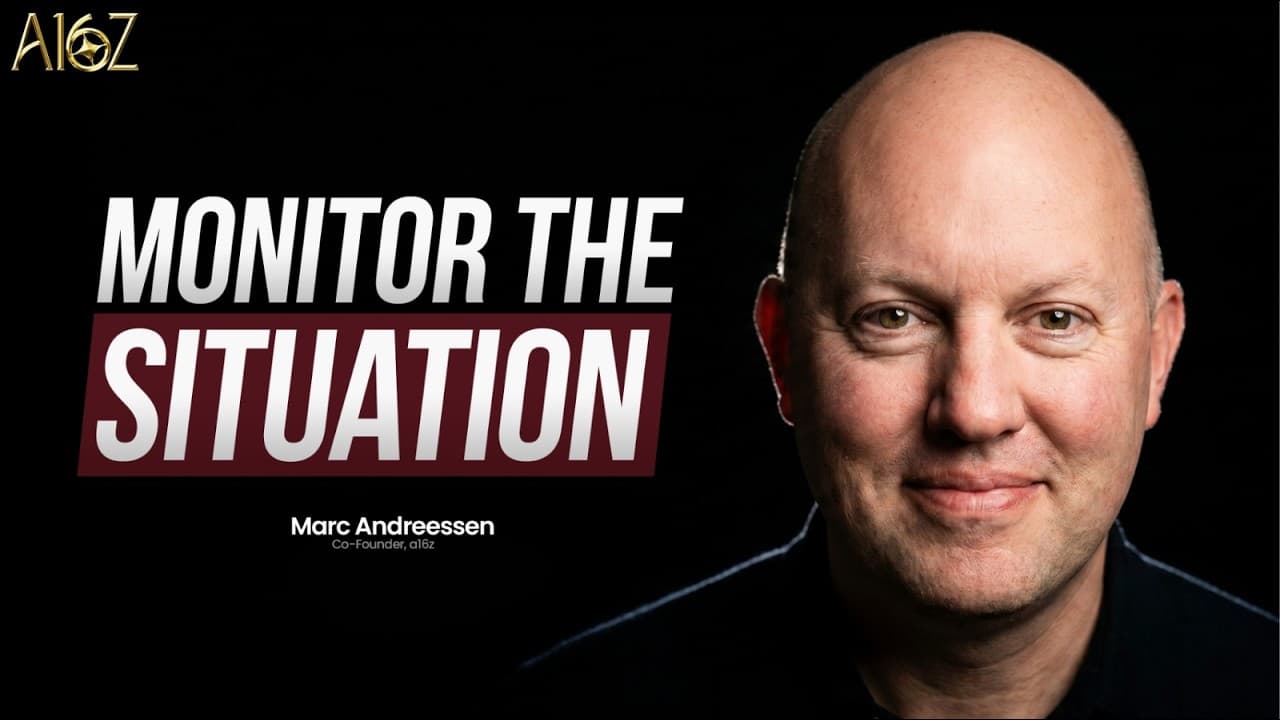
How Does Marc Andreessen Think the Internet Changed News, Politics, and Outrage? | The a16z Show
TL;DR
Marc Andreessen argues that the internet accelerated news and political outrage into recurring two-and-a-half-day panic cycles while giving conflict a virtual outlet. He connects today’s fixation on the “current thing” to CNN’s original “randemonium” strategy: continuously covering the most compelling event, even with fragmentary reports. Read on to understand how sensationalism, social media, podcasts, and internet-native politics reshape public attention.
Transcript
Each viral social media meme explosion is like a two and a half day panic cycle. It was not that long ago grown men in serious positions of power and authority in the US got mad at each other and literally have a physical duel. And that was like a normal part of life. If you're sitting at home scrolling social media getting mad, at least you're not... Read More
Key Insights
- The internet has accelerated the news cycle, creating a rapid two-and-a-half-day cycle of viral outrage.
- Political violence is at an all-time low in Western society, partly due to virtual conflicts replacing physical ones.
- Traditional media has shifted from a focus on importance to a focus on sensationalism to capture audience attention.
- The concept of 'randemonium' describes media's focus on the most sensational, current events.
- The global village concept suggests modern media connects everyone, leading to a lack of privacy and constant interaction.
- Social media has enabled the rise of moral tribes, where people form groups based on shared outrage or beliefs.
- Legacy media is struggling to adapt to the new media landscape dominated by podcasts and social media.
- The future may see a truly internet-native political candidate, relying solely on digital platforms for communication.
Install to Summarize YouTube Videos and Get Transcripts
Explore YouTube Video Summarizer or Get YouTube Transcript Extractor
Questions & Answers
Q: How does Marc Andreessen think the internet changed news and politics?
Andreessen says the internet accelerated public outrage into viral panic cycles that last about two and a half days. It also moved many political conflicts online, where people can fight rhetorically instead of confronting one another physically.
Q: How long does a viral social media outrage cycle last?
Andreessen describes each viral social media meme explosion as a roughly two-and-a-half-day panic cycle. Attention then shifts as another hot or outrageous subject becomes the new focus.
Q: Why does Andreessen connect online outrage with lower political violence?
He argues that scrolling social media and getting angry can provide an outlet for conflict without physical confrontation. He points to political violence being at an all-time low in Western society, while contrasting online arguments with the era when powerful American men fought physical duels.
Q: What does “randemonium” mean in media?
“Randemonium” was CNN co-founder Reese Schonfeld’s concept for locking onto the most compelling, controversial, or transfixing event happening at a given moment. A news channel would cover that “current thing” continuously and air whatever reports or interviews became available, apologizing later if something proved wrong.
Q: Why does news prioritize sensational events over important events?
Andreessen distinguishes “the news” from “the importance.” He argues that audiences want the hot, new, or outrageous event, whereas a publication presenting only the day’s important developments would struggle to attract the same interest.
Q: How did CNN’s original 24-hour news model work?
Reese Schonfeld and Ted Turner developed the idea of a round-the-clock news channel around 1981. Its original model was to identify the world’s most compelling current event and cover it continuously for as long as it held public attention.
Q: What event proved CNN’s continuous-news strategy could work?
Andreessen identifies the 1991 Gulf War as CNN’s breakthrough. For about a week, viewers stayed glued to its around-the-clock coverage, including live reporting from Baghdad while bombing raids were happening.
Q: What might an internet-native political campaign look like?
The discussion anticipates a political candidate who relies on digital platforms rather than traditional media. Such a campaign would communicate through social media, podcasts, and other online tools to reach and engage voters directly.
Summary & Key Takeaways
-
The internet has drastically changed how news is consumed, leading to a rapid cycle of outrage and reaction. This shift has reduced physical violence, allowing for virtual conflicts to take place instead. Traditional media's focus has moved from importance to sensationalism, with social media and podcasts becoming dominant platforms.
-
Marc Andreessen discusses the concept of 'randemonium,' where media focuses on the most sensational current events. The global village concept suggests modern media connects everyone, resulting in a lack of privacy and constant interaction. Social media enables the rise of moral tribes, where people form groups based on shared outrage or beliefs.
-
Legacy media is struggling to adapt to the new media landscape, which is now dominated by podcasts and social media. The future may see a truly internet-native political candidate, relying solely on digital platforms for communication, marking a significant shift in how political campaigns are conducted.
Read in Other Languages (beta)
Share This Summary 📚
Summarize YouTube Videos and Get Video Transcripts with 1-Click
Try YouTube Summary with ChatGPT & Claude or YouTube Transcript Generator
Explore More Summaries from a16z 📚


Summarize YouTube Videos and Get Video Transcripts with 1-Click
Try YouTube Summary with ChatGPT & Claude or YouTube Transcript Generator