How Did OpenAI Five Outplay Dota 2 Pros?
TL;DR
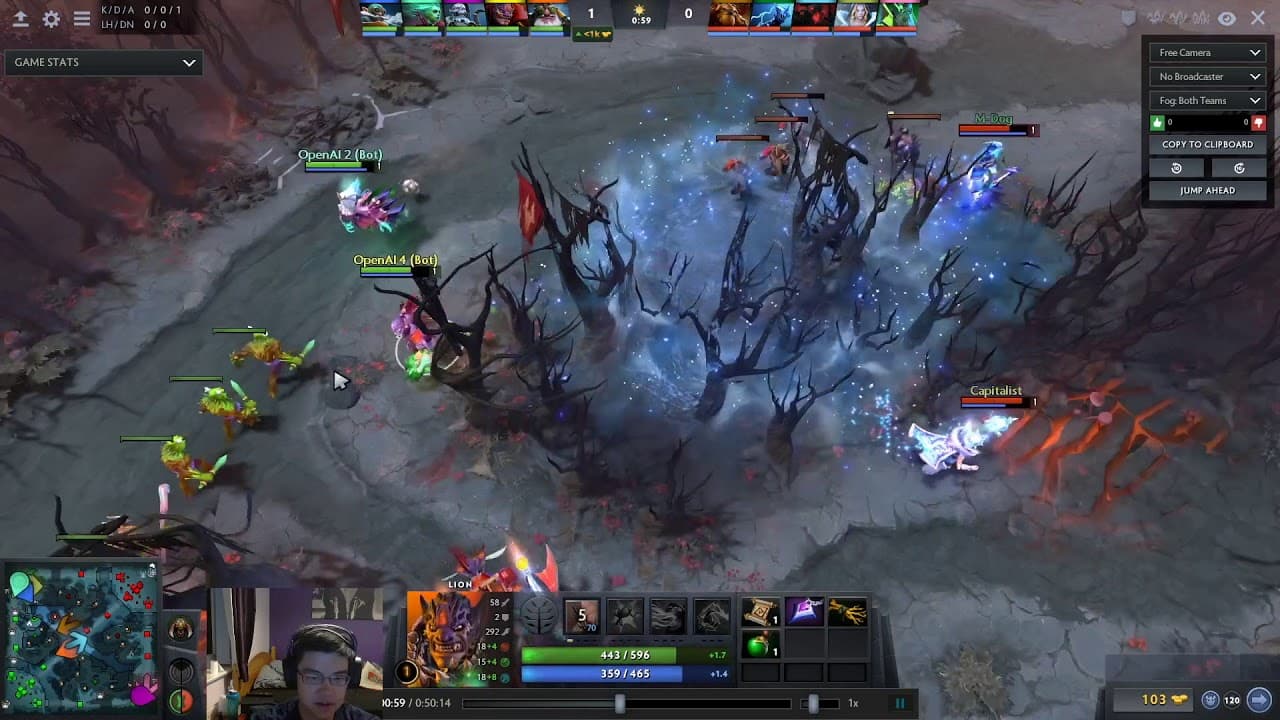
OpenAI Five gained control by coordinating heroes with unusual speed, taking early tier-one towers, exploiting experience advantages, and keeping the right number of heroes near each engagement. Although its mechanics were imperfect, its synchronized rotations, lane swaps, positioning, crowd control, and ability to collapse from multiple directions made the human team’s responses feel consistently late and ineffective.
Transcript
okay here we go started the video hello everybody that's hello everybody that's gonna be watching this I'm blitz I am a professional dota 2 caster / commentator was a former professional player I am joined here by Kyle who I guess Kyle you are a former professional / current professional player who is played at can I say several several t is a litt... Read More
Key Insights
- OpenAI Five’s greatest advantage was team coordination, as its heroes synchronized attacks, moved between lanes quickly, and arrived near engagements with the right numbers. The human players repeatedly felt that their own rotations produced little value while the bots’ movements created immediate pressure.
- Lich was OpenAI Five’s highest-priority hero in the available pool, according to the post-game discussion. His spells remained useful throughout fights, and maximizing Sacrifice denied creeps while granting experience, helping the bot’s level-dependent cores and supports gain an experience advantage.
- Gyrocopter was considered one of the most important heroes in the pool because he could independently secure kills. Homing Missile combined with Rocket Barrage gave him solo-kill potential that many of the other available heroes lacked, making him an effective source of direct pressure.
- The human team selected Earthshaker because fog-of-war initiation could disrupt the bots and Echo Slam was expected to remain useful. In practice, Earthshaker struggled to come online because the humans could not find kills, leaving the player uncertain about where he could contribute effectively.
- OpenAI Five’s laning patterns were unconventional but effective, including an early group configuration and a three-lane swap. Moving Sniper from mid to the offlane appeared dangerous in theory, yet it placed him away from the lanes where the human team was concentrating its pressure.
- Early tier-one tower destruction gave OpenAI Five extensive map control and limited the human team’s options. The loss of the mid tower was especially damaging because it affected control around the jungle and made later movements, defensive reactions, and attempts to find favorable engagements more difficult.
- The bots were not mechanically perfect, as Sniper placed overlapping Shrapnel and other errors were visible. Their coordinated denying was nevertheless exceptional, with multiple heroes timing attacks together, and their broader positioning and reactions compensated for isolated execution mistakes.
- OpenAI Five created simultaneous pressure by attacking in multiple locations and approaching fights from different directions. The humans struggled to determine where the bots had fewer heroes because the units stayed close enough to regroup, sandwich opponents, or support one another before a response developed.
Install to Summarize YouTube Videos and Get Transcripts
Explore YouTube Video Summarizer or Get YouTube Transcript Extractor
Questions & Answers
Q: How did OpenAI Five gain an early advantage against the human team?
OpenAI Five gained its early advantage through coordinated denying, rapid hero movement, tower pressure, and efficient grouping. Its heroes timed attacks together, rotated quickly to threatened lanes, and repeatedly brought enough heroes to secure kills or protect vulnerable teammates. The early destruction of tier-one towers expanded its map control, while Lich’s Sacrifice contributed to an experience lead across its lineup.
Q: Why was Lich a high-priority hero for OpenAI Five?
Lich was described as the bot’s highest-priority hero in the available hero pool because all of his spells were useful and the bot had achieved strong results with him. OpenAI Five maximized Sacrifice, allowing it to deny creeps while gaining experience. That approach accelerated level-dependent heroes and contributed to an experience advantage for both cores and supports.
Q: Why did the analysts consider Gyrocopter especially important?
Gyrocopter was considered especially important because he functioned as a direct killer in a pool where few heroes had comparable independent kill potential. The combination of Homing Missile and Rocket Barrage allowed him to threaten solo kills. The analysts also observed that OpenAI Five repeatedly selected Gyrocopter together with Death Prophet whenever those heroes were available.
Q: Why did the human team choose Earthshaker against OpenAI Five?
The human team chose Earthshaker because it expected fog-of-war abilities to disrupt the AI and believed Echo Slam would remain useful in team fights. However, Earthshaker had difficulty becoming effective because the team could not reliably kill opponents or create favorable openings. The player consequently struggled to identify where he should position himself and contribute on the map.
Q: How did OpenAI Five use unusual lane swaps effectively?
OpenAI Five moved heroes between lanes in combinations that human teams rarely used, including sending Sniper from mid to the offlane. Although the offlane appeared dangerous for a vulnerable hero, it became safer because the humans were largely avoiding pressure in that area. The swap also placed Sniper against Razor, a matchup Razor was poorly suited to handle while behind.
Q: Why were early tier-one towers important in these games?
Early tier-one towers were important because destroying them gave OpenAI Five greater map control and restricted the human team’s safe movements. The mid tier-one tower was particularly valuable because it influenced access to the jungle. Once the bots collapsed on these structures, the humans found it harder to defend territory, organize rotations, and locate fights with favorable numbers.
Q: Was OpenAI Five mechanically perfect during the benchmark games?
OpenAI Five was not mechanically perfect, and the analysts identified visible errors such as Sniper placing overlapping Shrapnel. Its coordinated denying was still unusually strong because multiple heroes could time their attacks together. More importantly, its positioning, rapid reactions, crowd control, and synchronized rotations often compensated for individual mistakes and kept the human team under continuous pressure.
Q: Why did the human team struggle to win fights against OpenAI Five?
The human team struggled because OpenAI Five reacted faster, remained close enough to reinforce engagements, and frequently approached from multiple directions. When the humans brought several heroes to create a bait or secure a kill, the bots already appeared positioned to respond. OpenAI Five also pressured separate locations simultaneously, making it difficult to identify where a numerical advantage actually existed.
Summary & Key Takeaways
-
Blitz and Kyle review games one and three from the August 5, 2018 OpenAI Five Benchmark. They examine drafting choices, laning decisions, rotations, and fights, contrasting the human team’s expectations with the bot’s unusual approach. The analysis emphasizes how OpenAI Five succeeded despite making some visible mechanical errors.
-
The human team valued Earthshaker for fog-of-war disruption and reliable team-fight impact, but overestimated Necrophos. They later viewed Gyrocopter as one of the most important available heroes because Homing Missile and Rocket Barrage provided rare solo-kill potential. OpenAI Five repeatedly prioritized Lich and frequently selected Gyrocopter with Death Prophet when available.
-
OpenAI Five used synchronized denies, rapid rotations, lane swaps, tower pressure, and tightly coordinated collapses to build map control. Lich’s Sacrifice supported an experience advantage, while vulnerable heroes were moved into unexpectedly safe lanes. The humans struggled to identify favorable fights because the bots reacted faster and remained positioned near one another.
Read in Other Languages (beta)
Share This Summary 📚
Summarize YouTube Videos and Get Video Transcripts with 1-Click
Try YouTube Summary with ChatGPT & Claude or YouTube Transcript Generator
Explore More Summaries from OpenAI 📚






Summarize YouTube Videos and Get Video Transcripts with 1-Click
Try YouTube Summary with ChatGPT & Claude or YouTube Transcript Generator