How to choose between incremental and exponential AI startups
TL;DR
Define your mode of play early. If you pursue incremental growth you focus on immediate product market fit and understand competition, while exponential ventures aim for moonshots with longer horizons and potential high rewards but higher risk. Align your team, timing, and learning pace to the chosen path and prepare for external skepticism accordingly.
Transcript
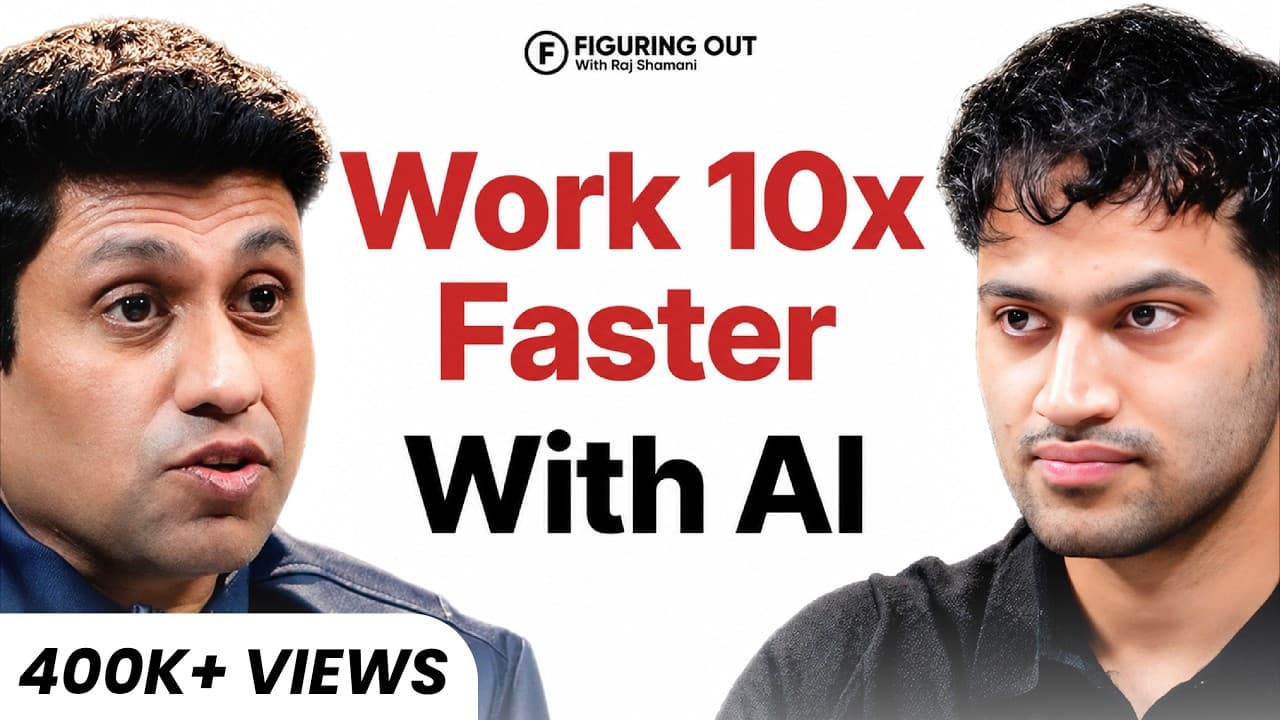
Can we make our entire organization AI native with AI when I look I'm worrying that people are getting dumber for sure the people you can hire tomorrow are all going to be dumb humans shouldn't be the ones pulling AI AI should be pulling humans what I see is across the board leaders are asking team members to get on a co-pilot and then what they're... Read More
Key Insights
- Incremental vs exponential defines the game you play, with different risks and rewards.
- Incremental requires PMF from day one and visible, short-term progress to stay understandable.
- Exponential tasks you with a long horizon, where there may be no PMF early and misperception is common.
- In incremental markets you face external competition and need to tailor culture to respond to feedback.
- In exponential ventures you replace PMF with compound learning until the paradigm shift lands.
- Two games require different strategies: one is a march to today’s demand, the other a leap to a future market.
- Ambition must be broken into smaller goals to avoid paralysis and maintain practical momentum.
- Conviction must be balanced with external challenges and evidence to avoid blind risk.
Install to Summarize YouTube Videos and Get Transcripts
Explore YouTube Video Summarizer or Get YouTube Transcript Extractor
Questions & Answers
Q: How do you decide which game to play when starting a company?
Choosing between an incremental and an exponential game hinges on your ambitions, available time, and willingness to accept risk. If your goal is near-term demand and clear PMF, pursue incremental growth with a roadmap of stepwise milestones. If you want a paradigm shift, prepare for a longer horizon, higher uncertainty, and a strategy that seeks a breakthrough rather than immediate market fit.
Q: What is the main difference between incremental and exponential businesses?
Incremental businesses prioritize today and aim for product market fit with competitive awareness and steady, repeatable gains. Exponential businesses chase a fundamental shift, often with no PMF in year one, where learning compounds and the reward comes from a breakthrough rather than incremental improvement.
Q: Why is it important to understand PMF in the incremental path?
PMF is the yardstick for success in the incremental path because it validates that the product meets a real market need today. It guides iterative learning, helps conserve resources, and reduces risk by ensuring there is demand before scaling, making progress measurable and defensible.
Q: Why can exponential ventures be misunderstood or called stupid?
Exponential ventures operate beyond current norms, aiming for large, disruptive changes with long development cycles. Since early results may be weak or ambiguous, outsiders often misread the effort as foolish. The founder must tolerate scrutiny while maintaining conviction and a clear long-term plan.
Q: What role does learning play in the exponential game?
In the exponential game, learning compounds continuously as you work toward a breakthrough. The focus shifts from immediate PMF to building capabilities, uncovering insights, and iterating toward a transformative product or business model, with progress measured by cumulative understanding rather than short-term metrics.
Q: How should founders handle skepticism from others when pursuing a bold idea?
Founders should welcome constructive challenge as a signal of engagement and potential improvement. They should articulate a logical plan, demonstrate progress in smaller steps, and maintain conviction when data supports their direction, while being willing to pivot if evidence suggests a better path.
Q: What mindset helps young founders navigate AI opportunities safely?
Young founders benefit from distinguishing between playing for a quick win and aiming for long-term impact. They should learn the space thoroughly, build an advisory network, and avoid reckless leaps. Start small, validate assumptions, and balance ambition with a realistic pace of progress to maximize learning and resilience.
Q: What should be done to prepare for the long-term horizon in exponential ventures?
Prepare by breaking the big vision into smaller, achievable milestones, securing foundational capabilities, and continuously learning from the environment. Build a culture that tolerates risk and experimentation, while keeping a clear narrative of how the long-term goal will be realized, and align the team around these milestones to sustain momentum.
Summary & Key Takeaways
-
A founder should first decide which game they are playing: incremental or exponential, because the rules and expectations are fundamentally different. Incremental aims for near-term PMF and clear, repeatable progress, while exponential targets a paradigm shift with long development cycles.
-
In incremental markets you compete in a landscape with existing players, so understanding the competitive context and delivering steady PMF is essential. In exponential markets there may be little to no competition initially, but the risk and learning needed are far greater.
-
Regardless of path, builders must balance conviction with evidence, learn from failure, and break long-term ambitions into smaller milestones to maintain momentum and attract the right kind of support and talent.
Read in Other Languages (beta)
Share This Summary 📚
Summarize YouTube Videos and Get Video Transcripts with 1-Click
Try YouTube Summary with ChatGPT & Claude or YouTube Transcript Generator
Explore More Summaries from Raj Shamani 📚


Summarize YouTube Videos and Get Video Transcripts with 1-Click
Try YouTube Summary with ChatGPT & Claude or YouTube Transcript Generator