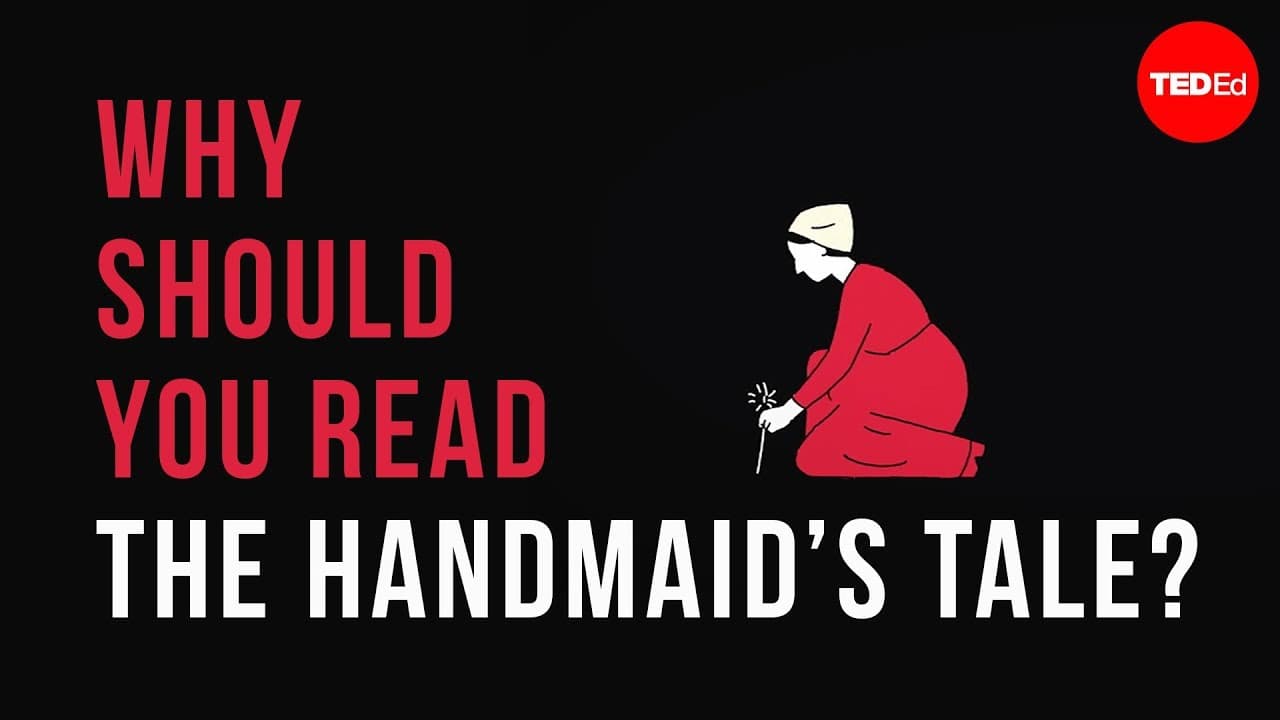
Why Read 'The Handmaid's Tale' by Margaret Atwood?
TL;DR
'The Handmaid's Tale' is a crucial dystopian novel that warns against complacency and power imbalances, depicting a future where women are oppressed under a theocratic regime. Atwood's narrative parallels the conservative backlash against feminism in the 1980s and highlights the importance of language and identity, emphasizing how societies can set themselves on destructive paths.
Transcript
In Margaret Atwood's near-future novel, "The Handmaid's Tale," a Christian fundamentalist regime called the Republic of Gilead has staged a military coup and established a theocratic government in the United States. The regime theoretically restricts everyone, but in practice a few men have structured Gilead so they have all the power, especially ... Read More
Key Insights
- ✊ Margaret Atwood's "The Handmaid's Tale" is a dystopian speculative fiction that explores the consequences of power imbalances and societal oppression.
- 🛟 The novel serves as a warning about how societies can destroy themselves by setting oppressive paths, drawing parallels to real-life conservative backlash against feminist movements.
- 👯 Atwood's personal connection to Puritan society influences the portrayal of Gilead, emphasizing control over every aspect of people's lives.
- 😀 The protagonist, Offred, symbolizes the loss of identity and the struggle for resistance in the face of a totalitarian regime.
- 💠 "The Handmaid's Tale" highlights the importance of language and its role in shaping identity, as well as the potential for resistance to challenge oppressive systems.
- ✊ The novel's exploration of power dynamics and complacency remains relevant in contemporary society.
- 😃 Atwood's masterful storytelling gradually reveals the details of Gilead's oppressive regime through the eyes of its characters.
Install to Summarize YouTube Videos and Get Transcripts
Explore YouTube Video Summarizer or Get YouTube Transcript Extractor
Questions & Answers
Q: What is the main premise of "The Handmaid's Tale"?
"The Handmaid's Tale" depicts a future society where a fundamentalist regime has established a theocratic government, stripping women of their rights and reducing them to reproductive tools for men.
Q: How is Gilead similar to Puritan society?
Gilead resembles Puritan society in terms of rigid moral codes, modest clothing, banishment of dissenters, and strict control over people's lives and relationships, reflecting Atwood's personal connection to the Puritans through her studies and possible ancestry.
Q: How does Offred, the protagonist, navigate her life in Gilead?
Offred, initially accepting the loss of her rights, is ultimately reduced to being a handmaid, a two-legged womb for the regime's population, and she struggles to maintain her identity and resist the regime's control over language, behavior, and thoughts.
Q: What is the significance of resistance in the novel?
Resistance, through the actions of individuals who challenge the oppressive rules of Gilead, drives the plot of "The Handmaid's Tale" and highlights the consequences of complacency in the face of power abuse.
Summary & Key Takeaways
-
"The Handmaid's Tale" is a near-future novel set in a theocratic regime called the Republic of Gilead, where a few men hold all the power and women are oppressed.
-
Atwood explores possible negative futures through speculative fiction, serving as a warning about societal destruction.
-
The novel reflects the conservative backlash against feminist movements in the 1980s and draws parallels to the strict rules of the Puritans in colonial Massachusetts.
Read in Other Languages (beta)
Share This Summary 📚
Summarize YouTube Videos and Get Video Transcripts with 1-Click
Try YouTube Summary with ChatGPT & Claude or YouTube Transcript Generator
Explore More Summaries from TED-Ed 📚



Summarize YouTube Videos and Get Video Transcripts with 1-Click
Try YouTube Summary with ChatGPT & Claude or YouTube Transcript Generator