How Is Comma AI Building a Level 5 Self-Driving Car?
TL;DR
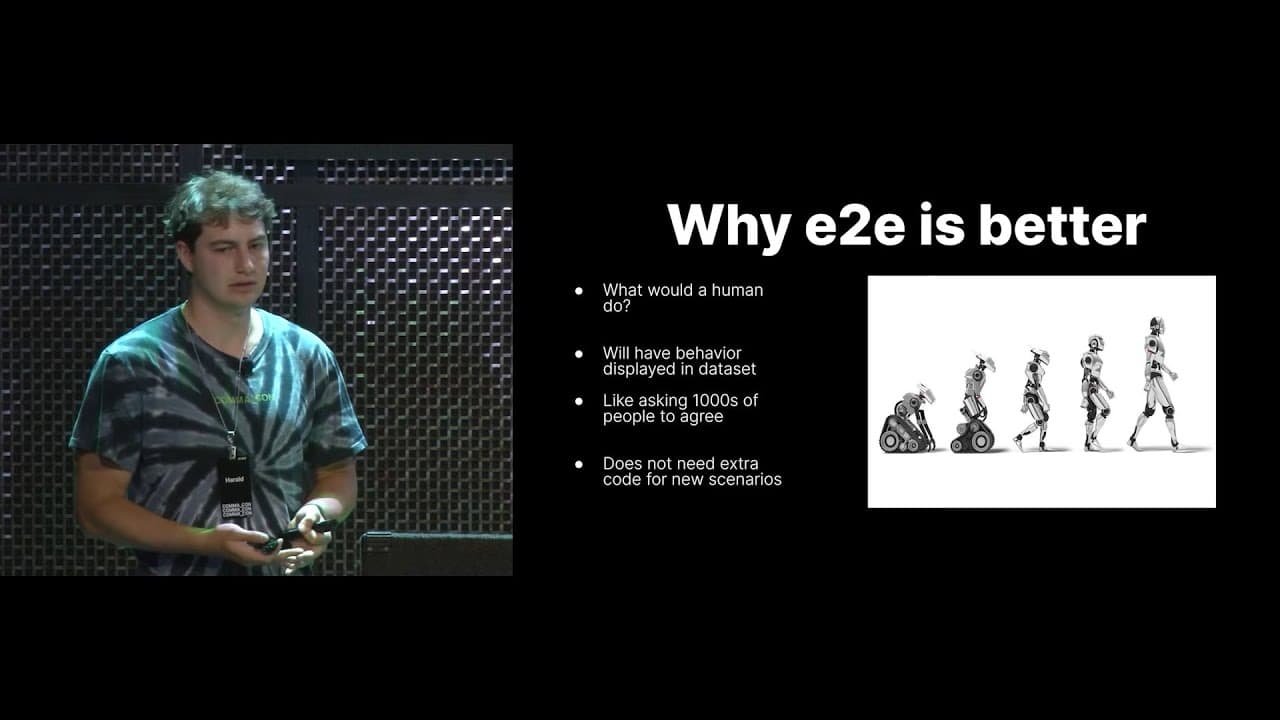
Comma AI aims to develop a level 5 self-driving car that drives as well as a human by minimizing crashes and navigating all roads without needing infrastructure changes. Their innovative end-to-end approach uses machine learning models trained on real human driving data to predict trajectories and enhance adaptability in complex driving scenarios.
Transcript
good morning good morning so i'm harold from research and i'm going to give an overview of the kind of work we do at coma so our stated goal at coma is to build a superhuman driving agent which is basically a level five self-driving car and i'll talk about the way we're trying to achieve that first i'm gonna test my uh pointers right that works hmm... Read More
Key Insights
- ❤️🩹 The end-to-end approach to self-driving eliminates the need for hand-labeled data and complex optimizers, making it more scalable and adaptable to different scenarios.
- ❤️🩹 Comma Research's end-to-end system learns from a diverse dataset of human driving behavior, which leads to more robust and natural driving behavior.
- ✋ The system is trained to predict the trajectory a human driver would take, incorporating factors such as lane changes, stops, and anticipation of other vehicles' movements.
- ❤️🩹 While the end-to-end approach shows promise, there is ongoing research to improve the system's ability to handle complex scenarios and adapt to different driving conditions.
Install to Summarize YouTube Videos and Get Transcripts
Explore YouTube Video Summarizer or Get YouTube Transcript Extractor
Questions & Answers
Q: How does Comma Research define their goal for building a self-driving car?
Comma Research aims to build a level five self-driving car that minimizes crashes, drives efficiently on all roads like a human driver, and doesn't require infrastructure changes.
Q: What are the main flaws with the classical approach to self-driving?
The classical approach relies on hand-labeled data, complex and hard-coded optimizers, and a growing list of perception outputs for planning. This leads to a complex and difficult-to-maintain system.
Q: What are the key principles of Comma Research's end-to-end approach to self-driving?
The end-to-end approach involves training machine learning models to predict the trajectory a human driver would take based on raw sensor data. It eliminates the need for hand-labeled data and complex optimizers.
Q: How does Comma Research evaluate the performance of their end-to-end self-driving system?
Comma Research tests the system offline using simulations and real-world data. They measure metrics such as accuracy, lane deviation, and ability to handle different scenarios. They also run thousands of minutes of driving simulations to assess overall performance.
Summary & Key Takeaways
-
Comma Research's goal is to build a level five self-driving car that minimizes crashes, drives efficiently on all roads, and doesn't require infrastructure changes.
-
They have explored the classical approach to self-driving, which involves multiple layers of perception, planning, and control.
-
The end-to-end approach involves training machine learning models to predict the trajectory a human driver would take, and it has shown promising results in simulations and real-world testing.
Read in Other Languages (beta)
Share This Summary 📚
Summarize YouTube Videos and Get Video Transcripts with 1-Click
Try YouTube Summary with ChatGPT & Claude or YouTube Transcript Generator
Explore More Summaries from george hotz archive 📚

Summarize YouTube Videos and Get Video Transcripts with 1-Click
Try YouTube Summary with ChatGPT & Claude or YouTube Transcript Generator