What Does Cold War II Mean for U.S.-China Relations?
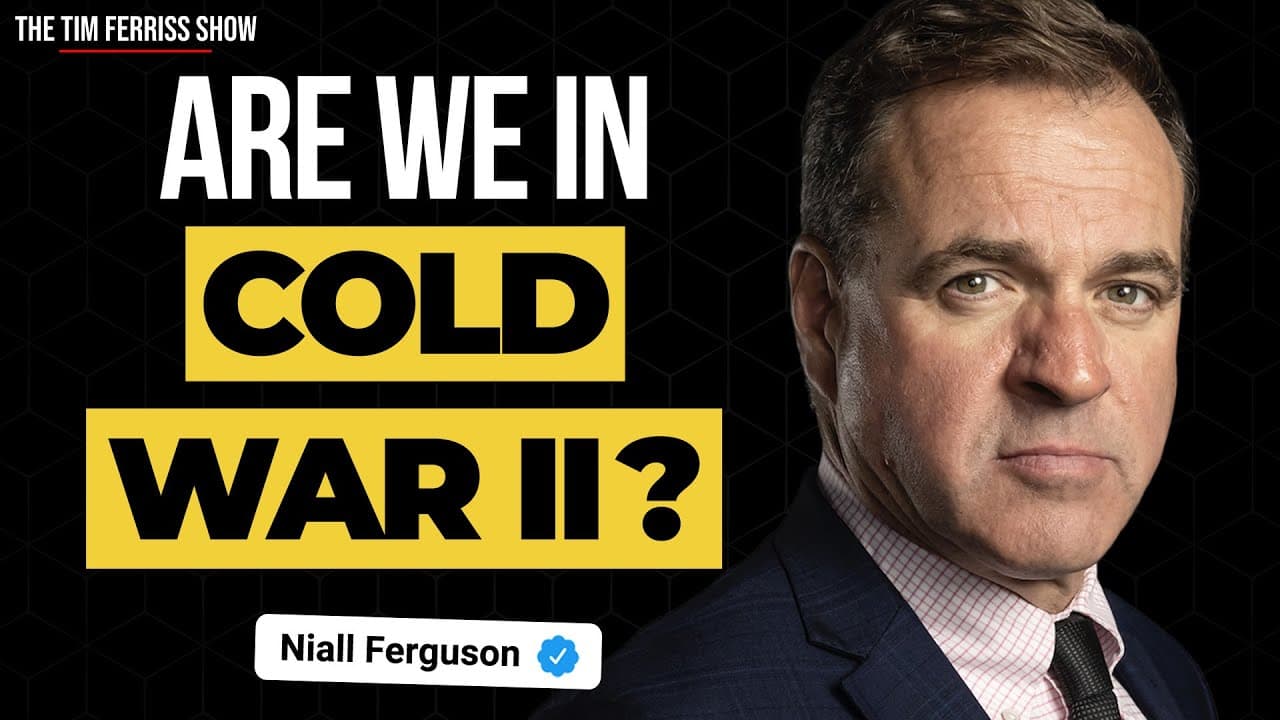
TL;DR
Cold War II signifies an ideological, technological, and geopolitical rivalry between the U.S. and China, with tensions escalating primarily over Taiwan. The conflict over Taiwan is anticipated to be a flashpoint, much like Cuba was in the first Cold War, and could lead to a crisis due to its critical semiconductor manufacturing. Multiple global crises may arise simultaneously, making it challenging to keep the situation from escalating into a hot war.
Transcript
foreign let's talk about Cold War II I was actually going to segue to your thinking and observations of the not mutually exclusive combination of maybe conditions that have been set over the last five to ten or more years that are now leading to certain types of inertia in terms of Trends converging trends that may or may not be avoidable then ther... Read More
Key Insights
- 🦾 Cold War II is characterized by ideological rivalry, a technological arms race, and geopolitical tensions between the US and China.
- 🫱 The war in Ukraine parallels the Korean War in Cold War I, signifying the beginning of a hot war.
- 🇹🇼 Taiwan, due to its significance in semiconductor manufacturing, has the potential to be the flashpoint of Cold War II.
- 📌 Crises are expected to occur in multiple locations simultaneously, with the Middle East being an additional hotspot.
- ✌️ The lesson from Cold War I is that a peaceful outcome and victory for the US is not guaranteed.
- 🫱 Cold War II poses challenges in maintaining a cold war status and may lead to a real hot war.
- 🤞 Predictions about global politics in complex systems are often uncertain and rely on luck rather than judgment.
Install to Summarize YouTube Videos and Get Transcripts
Explore YouTube Video Summarizer or Get YouTube Transcript Extractor
Questions & Answers
Q: How does Cold War II differ from Cold War I?
While there are similarities, such as ideological rivalry and a potential for a hot war, Cold War II involves an AI and quantum computing race, greater economic interdependence between the US and China, and the flashpoint of Taiwan.
Q: When might a crisis over Taiwan occur?
The crisis over Taiwan could potentially happen in 2024, coinciding with Taiwan's scheduled elections. China may see this as an opportune moment, given uncertainties about the US President in 2025.
Q: What other areas could see crises during Cold War II?
The Middle East is likely to experience a crisis as the Iranian regime has an incentive to engage in conflict to suppress domestic opposition. Multiple locations could become hotspots simultaneously, just as in Cold War I.
Q: Is it possible to avoid a hot war in Cold War II?
Keeping Cold War II a cold war will be a challenge, especially if crises erupt in Eastern Europe, the Middle East, and the Far East. A peaceful victory for the West, as in Cold War I, is not guaranteed.
Summary & Key Takeaways
-
Cold War II is characterized by an ideological rivalry, a technological race, and a geopolitical dimension between the United States and China.
-
The war in Ukraine is considered the first hot war of Cold War II, reminiscent of the Korean War in Cold War I.
-
The escalating tensions over Taiwan, where advanced semiconductors are manufactured, may lead to a crisis and potential invasion in the next few years.
Read in Other Languages (beta)
Share This Summary 📚
Summarize YouTube Videos and Get Video Transcripts with 1-Click
Try YouTube Summary with ChatGPT & Claude or YouTube Transcript Generator
Explore More Summaries from Tim Ferriss 📚






Summarize YouTube Videos and Get Video Transcripts with 1-Click
Try YouTube Summary with ChatGPT & Claude or YouTube Transcript Generator