What Is Newton's Law of Universal Gravitation?
TL;DR
Newton's law of universal gravitation states that every mass attracts every other mass with a force that is proportional to the product of their masses and inversely proportional to the square of the distance between them. This law established a foundational understanding of gravity, linking the motion of falling objects to the orbits of celestial bodies, and remains essential in modern physics.
Transcript
When people say that Isaac Newton completely transformed the field of physics, they really aren't kidding. Now, we’ve already talked about his three laws of motion, which we use to describe how things move. But another of Newton’s famous contributions to physics was his understanding of gravity. When Newton was first starting out, scientists’ conce... Read More
Key Insights
- Isaac Newton's understanding of gravity connected the motion of falling objects on Earth with the orbits of celestial bodies, fundamentally transforming physics.
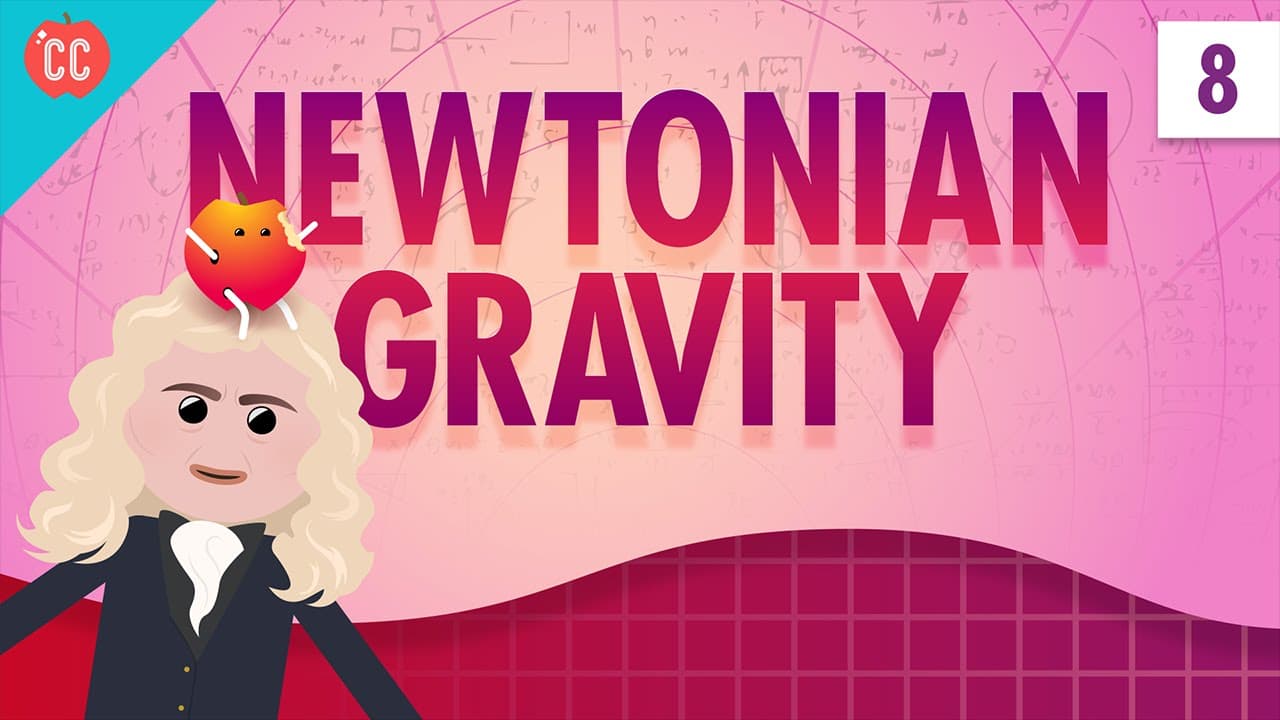
- Newton's apple story, whether fully true or not, illustrates his realization that gravity affects both terrestrial and celestial objects.
- Newton deduced that gravitational force decreases with the square of the distance between two objects, and increases with their masses.
- The gravitational constant, G, was later measured by Henry Cavendish, confirming Newton's theory with a small but precise value.
- Newton's law of universal gravitation complemented Kepler's laws of planetary motion, explaining the elliptical orbits of planets.
- Kepler's laws describe planetary orbits as ellipses, with equal areas swept over equal times and a consistent ratio of orbital radius and period.
- Newton's gravitational insights are still applied today, such as calculating Martian gravity for NASA’s space missions.
- Newton's laws, combined with calculus, provided a mathematical foundation for understanding celestial mechanics and gravitational interactions.
Install to Summarize YouTube Videos and Get Transcripts
Explore YouTube Video Summarizer or Get YouTube Transcript Extractor
Questions & Answers
Q: What was Newton's realization about gravity?
Newton realized that gravity is a universal force affecting both terrestrial and celestial objects. He connected the falling of an apple to the gravitational pull that keeps the Moon in orbit around Earth. This insight led to the formulation of his law of universal gravitation.
Q: How did Newton's law of universal gravitation relate to Kepler's laws?
Newton's law of universal gravitation complemented Kepler's laws by providing a physical explanation for the elliptical orbits of planets. Newton showed that gravitational force, dependent on mass and distance, could account for the orbital paths described by Kepler.
Q: What is the significance of the gravitational constant, G?
The gravitational constant, G, is a key component in Newton's law of universal gravitation, determining the strength of gravitational force. Although Newton couldn't measure it, Henry Cavendish later determined its value, confirming the small magnitude of gravitational interactions between everyday objects.
Q: How does Newton's law of universal gravitation explain planetary orbits?
Newton's law explains that planets orbit in ellipses due to the gravitational pull from the Sun. The force decreases with the square of the distance and increases with the masses involved, aligning with Kepler's observations of planetary motion and providing a mathematical basis for celestial mechanics.
Q: What role did Newton's insights play in modern space exploration?
Newton's insights into gravity are crucial for modern space exploration, including calculating gravitational forces on different planets. For instance, NASA uses his equations to simulate Martian gravity for testing spacesuits, demonstrating the lasting impact of his work on contemporary scientific endeavors.
Q: Why was the apple story significant to Newton's work?
The apple story, whether fully accurate or not, represents Newton's thought process in realizing that the same force causing an apple to fall also governs celestial motions. It symbolizes his groundbreaking insight into the universality of gravity, which led to his formulation of gravitational laws.
Q: How did Newton's work validate Kepler's laws?
Newton's work validated Kepler's laws by providing the gravitational explanation for the elliptical orbits of planets. His laws of motion and gravitational theory mathematically proved Kepler's observations, showing that gravitational forces dictated the motion of celestial bodies.
Q: What is the relationship between Newton's laws and gravitational acceleration?
Newton's laws relate gravitational acceleration to the mass of a celestial body and the distance from its center. For Earth, this is expressed as small g, derived from the gravitational constant G, Earth's mass, and its radius. This relationship helps calculate gravitational forces on other planets, like Mars.
Summary & Key Takeaways
-
Isaac Newton's contributions to physics include the law of universal gravitation, which connects the motion of falling objects on Earth with the orbits of celestial bodies. His insights were foundational for modern physics and are still used today.
-
Newton's apple story symbolizes his realization that gravity affects objects at all distances. He developed a formula showing gravitational force depends on mass and distance, with the gravitational constant G later measured by Henry Cavendish.
-
Newton's work supported and explained Kepler's laws of planetary motion, showing how gravity governs celestial orbits. His laws of motion and calculus provided a comprehensive framework for understanding gravitational interactions.
Read in Other Languages (beta)
Share This Summary 📚
Summarize YouTube Videos and Get Video Transcripts with 1-Click
Try YouTube Summary with ChatGPT & Claude or YouTube Transcript Generator
Explore More Summaries from CrashCourse 📚




Summarize YouTube Videos and Get Video Transcripts with 1-Click
Try YouTube Summary with ChatGPT & Claude or YouTube Transcript Generator