What Is the Teleological Argument for God's Existence?
TL;DR
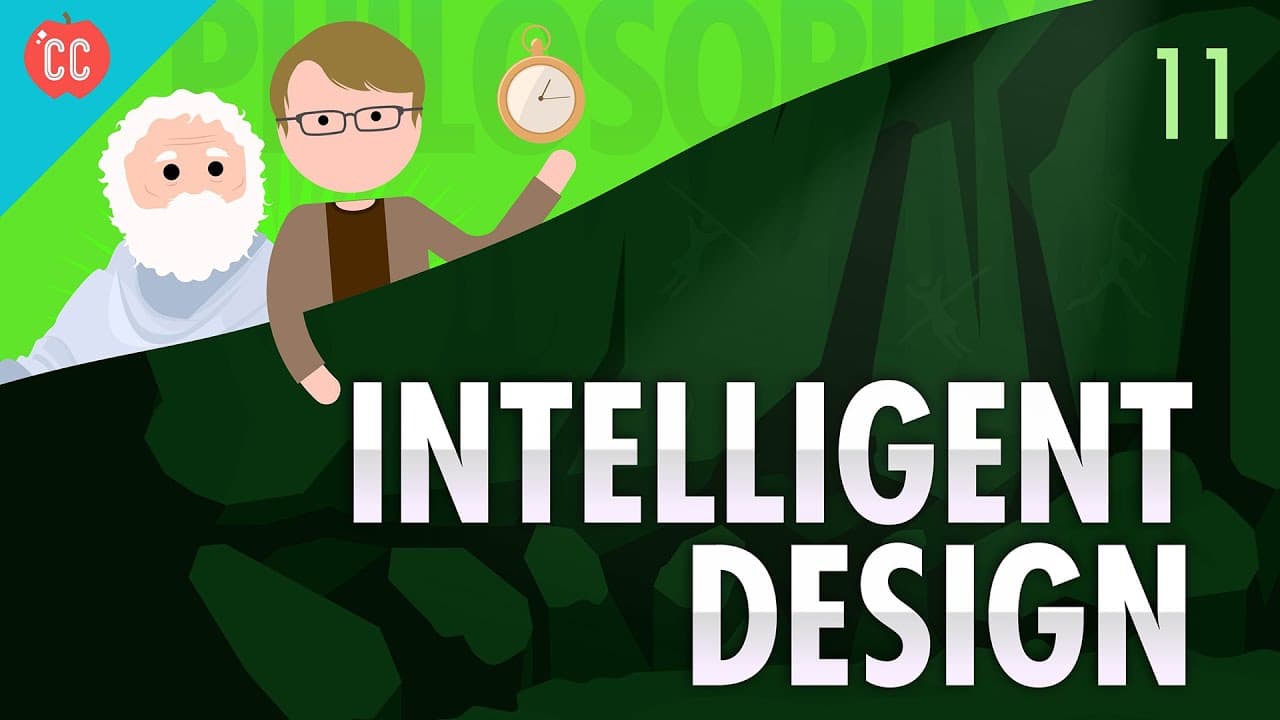
The teleological argument posits that the complexity and purposefulness of the universe suggest an intelligent designer, similar to how a watch implies a watchmaker. Critics highlight flaws in the world as indicators of a flawed creator, while modern supporters utilize probability and fine-tuning arguments to assert that God's existence is more likely than random chance. Despite challenges from evolutionary biology, the argument remains a significant topic in philosophy.
Transcript
Crash Course Philosophy is brought to you by Squarespace. Squarespace: share your passion with the world. Over the centuries, the effort to craft a perfect, bullet-proof argument for the existence of God has taken many forms. There was the ontological argument of Anselm. There were the four cosmological arguments of Aquinas. And they still have the... Read More
Key Insights
- William Paley's teleological argument uses analogy to suggest that the complexity of the world implies a designer, similar to how a watch implies a watchmaker.
- Critics argue that disanalogies between natural elements and man-made objects weaken the teleological argument, questioning the existence of a designer.
- David Hume criticized the teleological argument by highlighting flaws in the world, suggesting a flawed creator if one exists.
- Modern responses to the teleological argument include Richard Swinburne's probability-based approach, proposing that God's existence is more probable than random chance.
- Fine-Tuning Arguments suggest that the precise conditions for life on Earth imply deliberate design, rather than accidental occurrences.
- Critics of modern teleological arguments argue against making probability claims with a single Earth as the sample set.
- The development of evolutionary biology has provided a scientific explanation for the complexity of life, challenging the need for a designer.
- The teleological argument remains popular and continues to evolve, exemplifying the dynamic nature of philosophical debate.
Install to Summarize YouTube Videos and Get Transcripts
Explore YouTube Video Summarizer or Get YouTube Transcript Extractor
Questions & Answers
Q: What is William Paley's teleological argument?
William Paley's teleological argument posits that the complexity and purposefulness observed in the world suggest the existence of an intelligent designer, much like a watch implies a watchmaker. He uses analogy to draw parallels between man-made objects, which clearly have creators, and natural elements, arguing that both require a designer.
Q: How do critics refute the teleological argument?
Critics refute the teleological argument by pointing out disanalogies between natural elements and man-made objects, questioning the assumption of a designer. They argue that natural complexity does not necessarily imply purposefulness or intentional design. Additionally, they highlight flaws in the world, suggesting that if a creator exists, it is likely flawed.
Q: What are modern responses to the teleological argument?
Modern responses to the teleological argument include Richard Swinburne's probability-based approach, which suggests that God's existence is more probable than random chance. Fine-Tuning Arguments also propose that the precise conditions necessary for life imply deliberate design rather than accidental occurrences, accepting scientific truths like the Big Bang and evolution.
Q: How does evolutionary biology challenge the teleological argument?
Evolutionary biology challenges the teleological argument by providing a scientific explanation for the complexity and functionality of life through natural selection and random mutation. This explanation diminishes the need for a designer, as it accounts for the development of complex organisms without invoking an intelligent creator.
Q: What is the significance of David Hume's critique of the teleological argument?
David Hume's critique of the teleological argument is significant because it highlights the imperfections and flaws in the world, suggesting that if a creator exists, it is likely flawed. Hume's argument challenges the assumption of a benevolent and omnipotent designer, questioning the validity of the analogy between natural complexity and man-made objects.
Q: What are Fine-Tuning Arguments?
Fine-Tuning Arguments are a modern defense of the teleological argument, suggesting that the precise conditions required for life on Earth are unlikely to have occurred by chance. Proponents argue that these conditions imply deliberate design, possibly by a divine creator, rather than being the result of random processes.
Q: Why do critics challenge probability claims in modern teleological arguments?
Critics challenge probability claims in modern teleological arguments because they argue that making such claims with only one Earth as a sample set is problematic. Without multiple Earths to compare, it is difficult to determine how likely or unlikely the conditions for life are, thus questioning the validity of probability-based arguments for a designer.
Q: How does the teleological argument exemplify philosophical debate?
The teleological argument exemplifies philosophical debate by showcasing the dynamic nature of philosophical inquiry. It has evolved over time, adapting to critiques and incorporating modern scientific understanding, while still remaining a popular and influential argument. This ongoing dialogue reflects the continuous exploration and questioning inherent in philosophy.
Summary & Key Takeaways
-
The video discusses William Paley's teleological argument, which uses analogy to argue for God's existence, comparing the complexity of the world to a watch that implies a watchmaker.
-
Critics of the teleological argument, including David Hume, highlight flaws in the world that suggest a flawed creator, while modern defenders rely on probability and fine-tuning arguments.
-
Evolutionary biology offers an alternative explanation for the complexity of life, challenging the necessity of a designer, yet the teleological argument remains influential in philosophical discourse.
Read in Other Languages (beta)
Share This Summary 📚
Summarize YouTube Videos and Get Video Transcripts with 1-Click
Try YouTube Summary with ChatGPT & Claude or YouTube Transcript Generator
Explore More Summaries from CrashCourse 📚



Summarize YouTube Videos and Get Video Transcripts with 1-Click
Try YouTube Summary with ChatGPT & Claude or YouTube Transcript Generator