How to Secure Enterprise LLM Applications
TL;DR
Secure enterprise LLM applications by protecting sensitive data across build-time sources, runtime retrieval, prompts, model responses, and external foundational models. Treat the LLM as a black box with identifiable interfaces, scan data before training, automate safeguards, and use a proxy to withhold sensitive outputs, while preserving the business value of adding AI to existing applications.
Transcript
Hello, everyone. Welcome to this talk on, uh, securing your LLM apps in the enterprise. Thanks for making it, uh, very early in the morning on the most hungover day of RSA. Um, hopefully, you made it to all the seven dinners you were invited to and the seven happy hours. Um, so I'm, uh-- By way of introduction, my name is Ravi Aithal, um, CTO and c... Read More
Key Insights
- An LLM is a module that understands, interprets, and generates human language at scale. For security analysis, it can be treated as a black-box library, service, or smart database that accepts prompts and returns responses through identifiable interfaces.
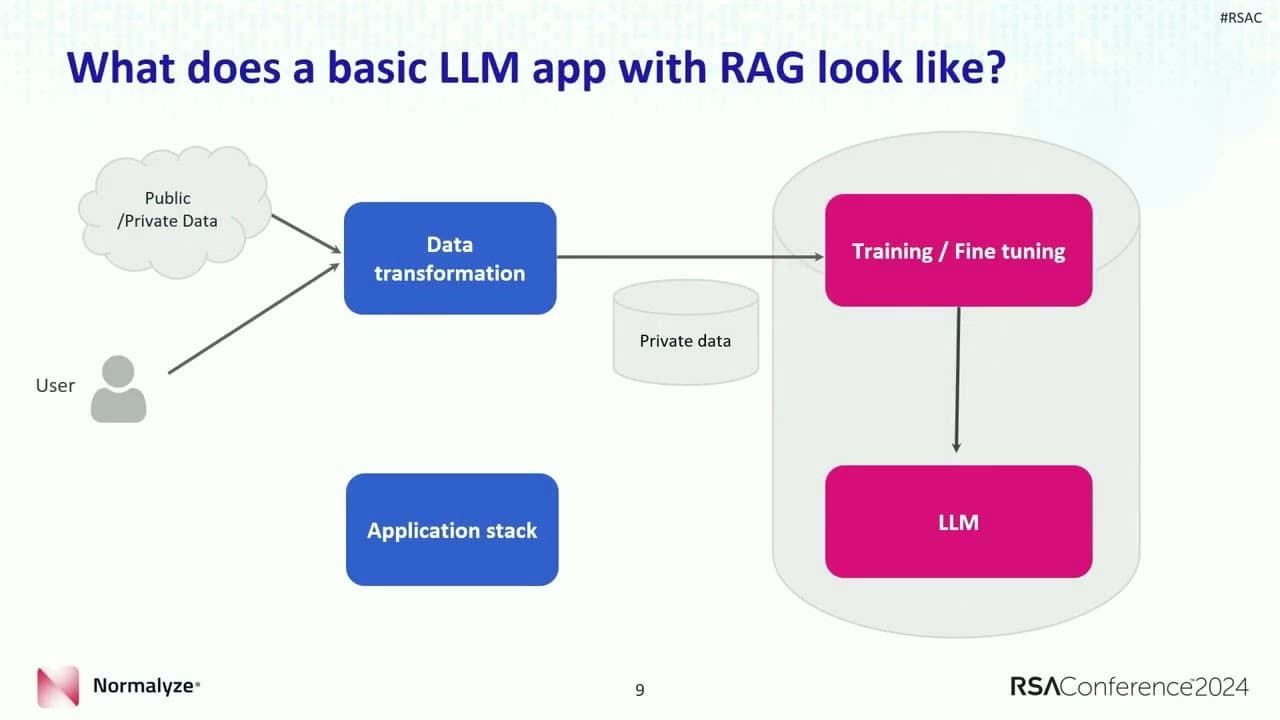
- An LLM application is structurally similar to a traditional application. Public, private, and user-generated data enter during development, while users send runtime requests that the application converts into prompts before returning model-generated answers.
- Runtime retrieval augmentation introduces private repository data into prompts. The application identifies relevant information, adds it to the user request, sends the combined prompt to the model, and returns the resulting response, creating additional locations where sensitive data must be controlled.
- Natural-language instruction following expands the potential attack surface because possible prompts are practically unlimited. An attacker can express nuanced requests, vary wording, request fragmented disclosures, or ask for information in different languages instead of relying on simple prohibited keywords.
- Data privacy and confidentiality are the primary enterprise security concerns for LLM applications. Other issues, including bias or inappropriate use, still matter, but preventing unauthorized exposure of organizational information is presented as the most important responsibility for security professionals.
- LLM contents are difficult to inspect because learned information is represented through neural-network weights rather than ordinary database records. Unlike a conventional database, a trained model does not provide a straightforward way to enumerate and classify all information it may contain.
- External foundational models create a data-origin challenge because they arrive with substantial pretrained knowledge already embedded in them. Enterprises must consider what data may have shaped those models even though the internal learned content cannot be directly examined like conventional stored data.
- A practical LLM security approach combines on-demand data scanning, automated protections during training, data-origin tracing, and a proxy that can withhold sensitive responses. These controls address both information entering the system and potentially confidential material leaving it.
Install to Summarize YouTube Videos and Get Transcripts
Explore YouTube Video Summarizer or Get YouTube Transcript Extractor
Questions & Answers
Q: How should enterprises secure LLM applications?
Enterprises should map every interface through which data enters or leaves an LLM application, including training sources, private repositories, augmented prompts, model responses, and external foundational models. They should scan data on demand, automate safeguards around training, trace data origins, and place a proxy in the response path so sensitive outputs can be detected and withheld.
Q: What is the main security risk of enterprise LLM applications?
Data privacy and confidentiality are the main security risks identified for enterprise LLM applications. These systems may process private organizational information during training or retrieve it from internal repositories at runtime. Because models follow nuanced natural-language instructions, an attacker may attempt to obtain protected information through varied, indirect, multilingual, or deliberately fragmented requests that simple keyword controls may miss.
Q: How is an LLM application similar to a traditional application?
Both application types can be reduced to a similar structure. They collect public, private, and user-generated information, transform that data during development, receive requests at runtime, consult a data-holding component, and return responses. In the LLM version, the model functions like a smart database, while prompts and generated answers replace conventional queries and database results.
Q: How is securing an LLM different from securing a database?
A conventional database can be inspected to determine what records and sensitive data it contains. An LLM is different because learned information is mixed into neural-network weights, preventing the same direct inspection. Security teams therefore cannot rely only on examining stored contents. They must control source data, runtime context, prompts, responses, and the interfaces surrounding the model.
Q: Why does retrieval augmentation create security concerns?
Retrieval augmentation brings relevant information from private repositories into a prompt at runtime. That process helps the model answer questions without placing all organizational data into training, but it also creates a path through which confidential material can reach the model or appear in its response. Access, prompt construction, retrieved context, and generated output consequently require protection.
Q: Why are prompt attacks difficult to prevent with keyword filters?
Prompt attacks are difficult to stop with keyword filters because an LLM understands natural language and follows instructions rather than matching only fixed commands. A requester can rephrase an instruction, use nuanced wording, switch languages, or ask for sensitive information in fragments. The practically unlimited variety of possible prompts makes rigid lists of blocked terms an incomplete defense.
Q: Why should security teams treat an LLM as a black box?
Treating an LLM as a black box helps security teams avoid becoming distracted by every internal technical nuance. They can instead identify the system's exposed interfaces and determine where information enters, where private context is added, how prompts reach the model, and how responses leave it. This simplified model supports practical controls around the data paths that matter most.
Q: What controls can prevent sensitive LLM outputs?
The described approach uses a proxy system capable of withholding sensitive outputs before they reach the user. That response control should be combined with on-demand scanning of source data, automated safeguards around training, and tracing of data origins. Together, these measures reduce exposure by addressing sensitive information before model use and by filtering potentially confidential generated responses.
Summary & Key Takeaways
-
Enterprise LLM adoption should be enabled safely because developers are adding AI capabilities to existing applications across large organizations. The central security objective is protecting data privacy and confidentiality. Security teams should focus on the interfaces through which information enters, augments, trains, queries, and exits an LLM-based application.
-
An LLM application resembles a traditional application when viewed as a simplified architecture. Both ingest public, private, and user-generated data, transform information, and answer runtime requests. The difference is that an LLM behaves like a smart database whose stored knowledge cannot be inspected as directly as records in a conventional database.
-
Runtime retrieval adds another security boundary because applications commonly collect relevant information from private repositories, add it to a prompt, and send that augmented prompt to a pretrained model. Effective safeguards therefore include source scanning, training automation, prompt and response controls, data-origin tracing, and a proxy capable of withholding sensitive outputs.
Read in Other Languages (beta)
Share This Summary 📚
Summarize YouTube Videos and Get Video Transcripts with 1-Click
Try YouTube Summary with ChatGPT & Claude or YouTube Transcript Generator
Explore More Summaries from RSAC Cybersecurity 📚


Summarize YouTube Videos and Get Video Transcripts with 1-Click
Try YouTube Summary with ChatGPT & Claude or YouTube Transcript Generator