How Did Richard Wickham’s Area Rule Solve the Convair YF-102’s Supersonic Drag Problem?
TL;DR
Richard Wickham’s area rule explained why the Convair YF-102 could barely reach Mach 0.98 despite being designed for Mach 1.25: its wings created a sharp discontinuity in the aircraft’s total cross-sectional area, increasing wave drag. Wickham recognized that designers had to optimize the shape of the entire aircraft rather than its fuselage and wings separately. Read on to understand the observation and reasoning behind his breakthrough.
Transcript
let me take a moment to thank today's sponsor Squarespace the all-in-one platform for building your brand and growing your business online with Squarespace you can stand out with a beautiful website engage with your audience and sell anything from your products to the content you create and even your time are you ready to take your online presence ... Read More
Key Insights
- 🥅 The Prototype convair yf102 initially failed to meet its design goals, prompting Richard Wickham to discover the area rule.
- 👻 The area rule, which optimized an aircraft's overall shape to reduce wave drag, allowed the yf102 to meet its design goals and improved aircraft performance in both military and civilian aviation.
- 📏 Wickham's contributions to aerodynamics extended beyond the area rule, including the development of the supercritical airfoil and winglets.
- 🧑🚒 Wickham's discoveries have had a significant impact on the design and performance of fighter aircraft and civilian airliners.
Install to Summarize YouTube Videos and Get Transcripts
Explore YouTube Video Summarizer or Get YouTube Transcript Extractor
Questions & Answers
Q: Why did the prototype Convair YF-102 fail to meet its design goals?
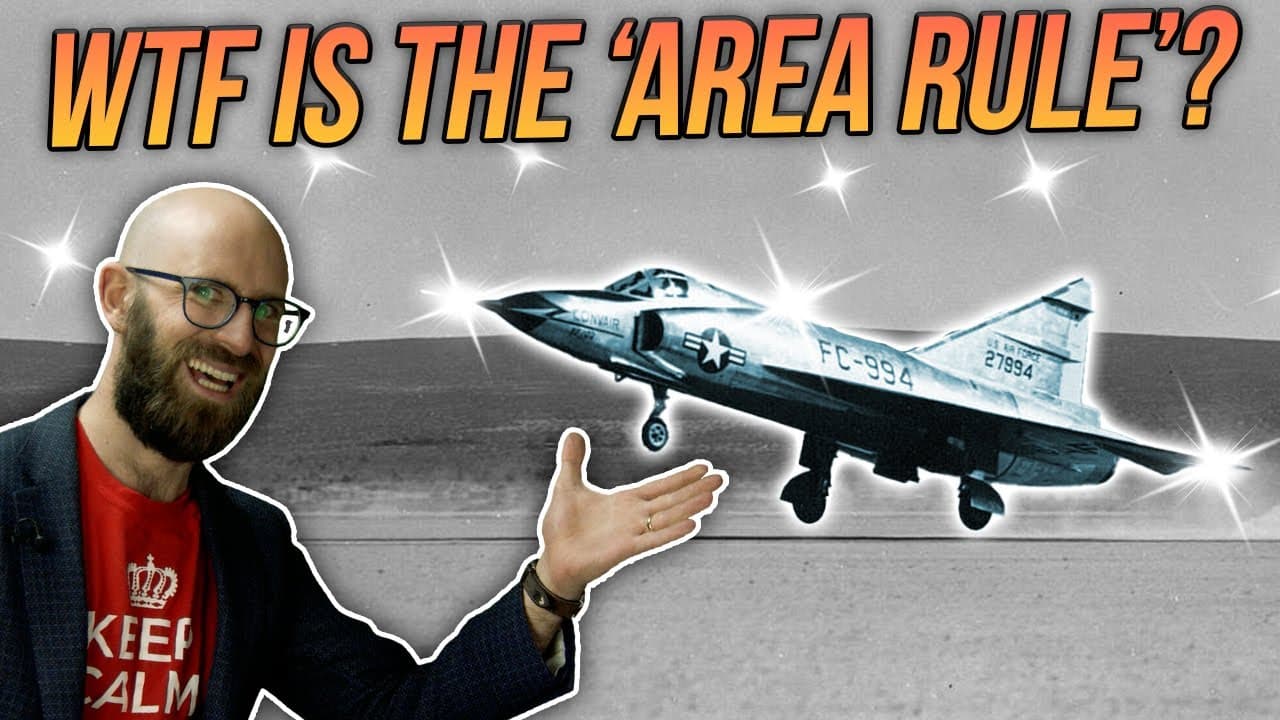
The YF-102 suffered far more wave drag than its designers expected. Although it was designed to fly at Mach 1.25, it barely reached Mach 0.98 with full afterburner and also struggled to reach an altitude of 14 500 meters.
Q: What was Richard Wickham’s area rule?
The area rule held that transonic drag depends on how the cross-sectional area of the entire aircraft develops along its length. Wickham realized that the gradual area changes associated with the Sears hack body had to apply to the whole aircraft, not merely the fuselage.
Q: How did the wings increase the YF-102’s wave drag?
Adding the wings produced a sharp discontinuity in the aircraft’s overall cross-sectional area distribution. That abrupt change caused a large increase in wave drag, even though the fuselage and wings had each been designed to reduce drag when considered separately.
Q: How did Wickham discover the cause of the YF-102’s poor performance?
While testing high-speed aircraft models in Langley’s supersonic wind tunnel, Wickham observed that the complete aircraft produced more wave drag than the fuselage and wings did individually. By examining how their airflow interactions affected the whole aircraft, he arrived at the basic idea of the area rule.
Q: Why had other aerodynamicists overlooked the area-rule problem?
The transcript says Wickham’s colleagues tended to specialize in analyzing and designing individual aircraft components. Wickham instead took a holistic view, studying the interaction of airflow around the complete aircraft.
Q: What drag-reducing features did the original YF-102 already use?
Its pointed, cigar-like fuselage was based on the Sears hack body, whose gradual area changes minimized supersonic drag. Its swept-back delta wing was also intended to delay shockwave formation while providing lift and maneuverability at low speeds.
Q: What was the prototype Convair YF-102 designed to do?
The YF-102 was designed as an interceptor that could climb into the stratosphere at supersonic speed and attack incoming Soviet nuclear bombers. It used a delta wing and a 52 kilonewton thrust engine.
Q: What role did Langley Research Center play in Wickham’s breakthrough?
Wickham joined Langley Research Center after graduating from Worcester Polytechnic Institute. He helped perfect the supersonic wind tunnel that was later central to investigating the YF-102’s disappointing performance.
Summary & Key Takeaways
-
In 1953, the Prototype convair yf102, an interceptor jet, failed to meet its design goals due to poor performance.
-
Richard Wickham, a brilliant engineer, discovered the area rule, which involved optimizing the cross-sectional area distribution of an aircraft to reduce wave drag.
-
The area rule allowed the redesigned yf102, now known as the F1 22 Delta Dagger, to meet its design goals and paved the way for improved aircraft performance in both military and civilian aviation.
Read in Other Languages (beta)
Share This Summary 📚
Summarize YouTube Videos and Get Video Transcripts with 1-Click
Try YouTube Summary with ChatGPT & Claude or YouTube Transcript Generator
Explore More Summaries from Today I Found Out 📚






Summarize YouTube Videos and Get Video Transcripts with 1-Click
Try YouTube Summary with ChatGPT & Claude or YouTube Transcript Generator