How to Create a Real-Time Web Framework Easily
TL;DR
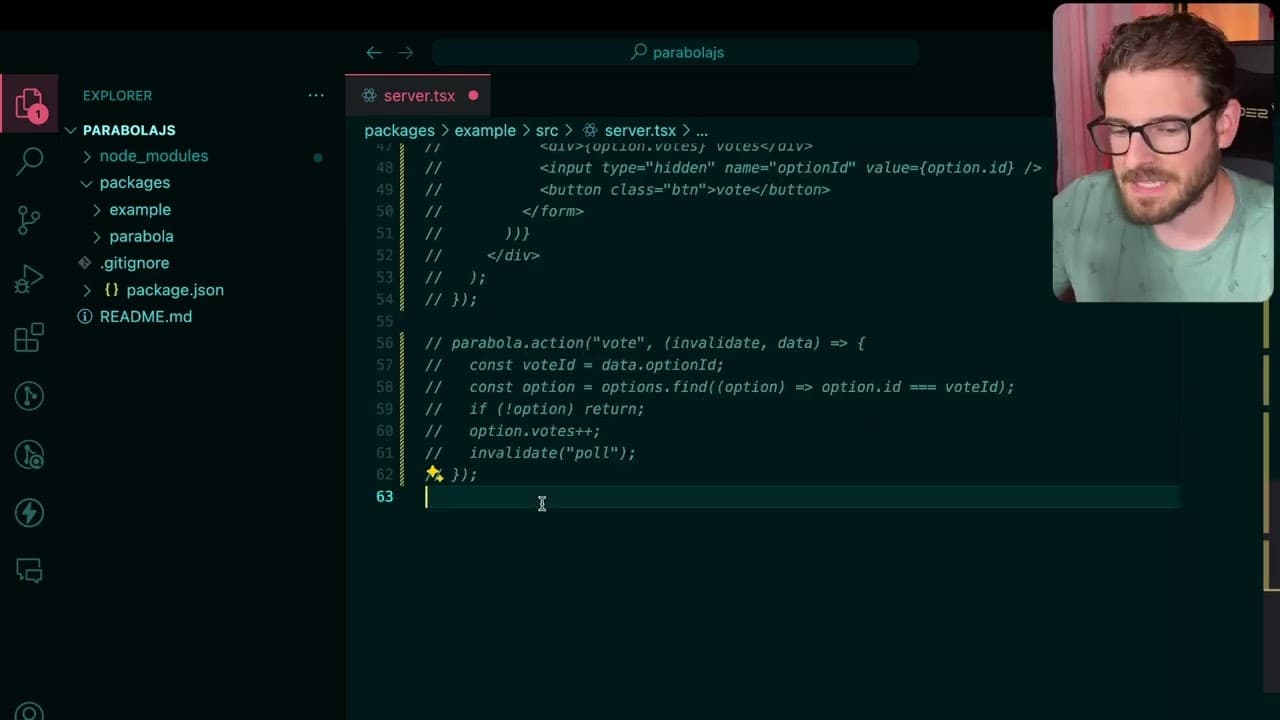
To create a real-time web framework, use WebSockets to sync data across users without heavy JavaScript. The framework, named Parabola, allows updates in real-time by managing templates and actions efficiently, enabling developers to build reactive applications with minimal code.
Transcript
so instead of actually working on my starter kit and finishing it I got distracted and started building out a framework that's very inspired by convex with this real-time database updates maybe you can say this is inspired by larel Livewire um also kind of like htx I like the philosophy of htx of like try not to write any JavaScript let htx handle ... Read More
Key Insights
- ❣️ Parabola leverages WebSockets for real-time communication, significantly enhancing user interaction without heavy JavaScript reliance.
- 👻 The framework's model promotes lightweight UI development by allowing the server to handle most data rendering efficiently.
- 😄 Inspiration from existing frameworks like Convex and HTMX helped shape Parabola's functionality, ensuring ease of use.
- 👨💻 Encouraging a minimalistic approach to coding, the author highlights how developers can quickly build reactive applications with reduced overhead.
- 👤 The demo's features exemplify effective multi-user interaction, demonstrating the framework's real-world applicability for collaborative environments.
- 👤 The reactive nature of Parabola allows multiple users to engage simultaneously, enhancing the user experience in web applications.
- 👤 The flexible template structure supporting custom actions enables developers to tailor their applications to meet specific user needs.
Install to Summarize YouTube Videos and Get Transcripts
Explore YouTube Video Summarizer or Get YouTube Transcript Extractor
Questions & Answers
Q: What is the main inspiration behind the Parabola framework?
The Parabola framework is primarily inspired by Convex for its reactive data handling and HTMX for its focus on reducing JavaScript. The author aims to offer real-time database updates seamlessly, allowing developers to create reactive UIs without getting bogged down by additional scripting.
Q: How does the framework achieve real-time updates?
Parabola employs WebSockets to enable real-time communication. When a user interacts with a UI element, such as pressing a button, an event is sent to the server using a WebSocket connection. The server processes this event, updates the relevant data, and then broadcasts the updated state to all connected users, ensuring that they see the same current information.
Q: Can you explain how the architecture of the Parabola framework works?
The architecture revolves around template management and event-driven updates. When a page loads, the client subscribes to specific templates via WebSocket. Actions initiated by events trigger updates that invalidate the cached responses, prompting the server to re-render and push the latest HTML back to all clients subscribed to that template key.
Q: What features did the author implement in their demo?
The demo includes features like real-time updates on a voting system for ice cream flavors, where votes are synchronized across multiple tabs. As votes are submitted, the HTML content updates automatically, demonstrating the framework's reactivity and responsiveness.
Q: What role does JavaScript play in this framework?
The framework significantly minimizes the need for JavaScript by using embedded scripts for managing template subscriptions and updating the UI. The author showcases that simple HTML templates can be dynamically rendered and manipulated through a minimal amount of script, thus streamlining development efforts.
Q: How does the server respond to actions taken by users?
When a user submits an action, like voting, the server invokes the action specified by the event type. Depending on the action, it may update the related data in the database, invalidate cached templates, and broadcast the updated template to all clients listening on that specific template key.
Q: What future improvements does the author suggest for the framework?
The author expresses a desire to integrate additional features such as loading indicators and refining the existing code for better performance and clarity. They also hinted at the possibility of continued development, although they acknowledged a tendency to abandon projects as they explore new ideas.
Q: Where can users access the source code of Parabola?
The complete source code of the Parabola framework is available on GitHub, where users can freely explore, contribute, and utilize it for their applications. The author invites feedback and collaboration from the community to enhance the framework further.
Summary & Key Takeaways
-
The author describes designing a framework called Parabola that offers real-time updates using WebSockets to sync data across multiple users without extensive JavaScript coding.
-
An interactive demo illustrates the framework's capabilities by showcasing live data updates when events occur in a multi-user environment.
-
The content includes a detailed explanation of the underlying architecture, including how templates, actions, and subscriptions work to create a responsive user experience.
Read in Other Languages (beta)
Share This Summary 📚
Summarize YouTube Videos and Get Video Transcripts with 1-Click
Try YouTube Summary with ChatGPT & Claude or YouTube Transcript Generator
Explore More Summaries from Web Dev Cody 📚

Summarize YouTube Videos and Get Video Transcripts with 1-Click
Try YouTube Summary with ChatGPT & Claude or YouTube Transcript Generator