How Does a Formlabs 3D Printer Create High-Detail Models?
TL;DR
The Formlabs 3D printer uses photosensitive resin and a laser to build intricate models layer by layer, enabling high detail comparable to industrial SLA machines but at a lower cost. It also supports innovative applications like microfluidic devices and custom-colored parts, making it ideal for both prototyping and functional components.
Transcript
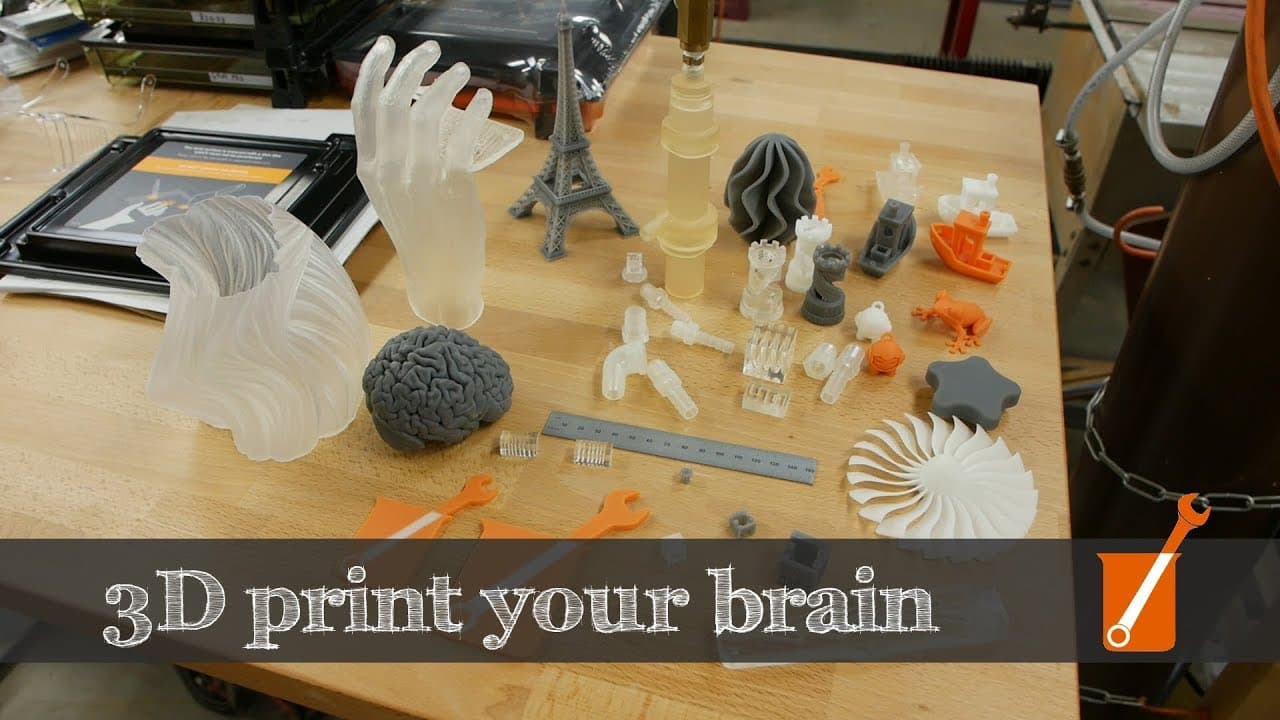
today on Applied Science I'm going to show you how to print some cool stuff with this new formlabs printer including a copy of your own brain using some open-source software that I found so let's start off by taking a look at a time-lapse of how this printer works this time-lapse shows about an eight-hour print and you can see how the machine works... Read More
Key Insights
- ✋ The Formlabs printer offers a cost-effective alternative to industrial SLA machines while maintaining high-quality results.
- 🥳 The printer can create complex and functional parts with passageways and custom-colored resins.
- 👻 Using negative space and printing in multiple materials allows for the creation of unique and intricate designs.
- 😷 MRI data can be used to print models of real-life objects, with potential applications in medical research.
- ⌛ The ability to create synchronized time-lapse videos provides a visual representation of the printing process.
- ✋ The printer's materials have different properties, including high-temperature resistance and soon-to-be-released ceramic resins.
- 🥳 Downloading models from platforms like Thingiverse and McMaster-Carr allows for easy printing of functional parts.
Install to Summarize YouTube Videos and Get Transcripts
Explore YouTube Video Summarizer or Get YouTube Transcript Extractor
Questions & Answers
Q: How does the Formlabs printer work?
The printer uses photosensitive resin and a laser to cure the resin into solid material one layer at a time, creating objects with impressive detail.
Q: How does the printer create synchronized time-lapse videos?
By adding a micro switch and remote shutter release, the printer can trigger the camera to take photos at specific intervals as it moves the print tray, creating a time-lapse video.
Q: Can the Formlabs printer produce complex and functional parts?
Yes, the printer can create intricate and functional parts, such as microfluidic devices and pipe fittings, with the ability to print passageways and even custom-colored resins.
Q: Is it possible to print models of real-life objects, like a brain?
Yes, by using MRI data and following specific software instructions, it is possible to print detailed models of objects like a brain, opening up opportunities in medical and research fields.
Summary & Key Takeaways
-
The Formlabs printer uses photosensitive resin and a laser to create solid objects in a layer-by-layer process, allowing for synchronized time-lapse videos.
-
The level of detail and quality achieved with the Formlabs printer rivals that of industrial SLA machines, at a fraction of the cost.
-
The printer can create microfluidic devices with tiny passageways and even functional pipe fittings from downloaded models.
Read in Other Languages (beta)
Share This Summary 📚
Summarize YouTube Videos and Get Video Transcripts with 1-Click
Try YouTube Summary with ChatGPT & Claude or YouTube Transcript Generator
Explore More Summaries from Applied Science 📚
Summarize YouTube Videos and Get Video Transcripts with 1-Click
Try YouTube Summary with ChatGPT & Claude or YouTube Transcript Generator