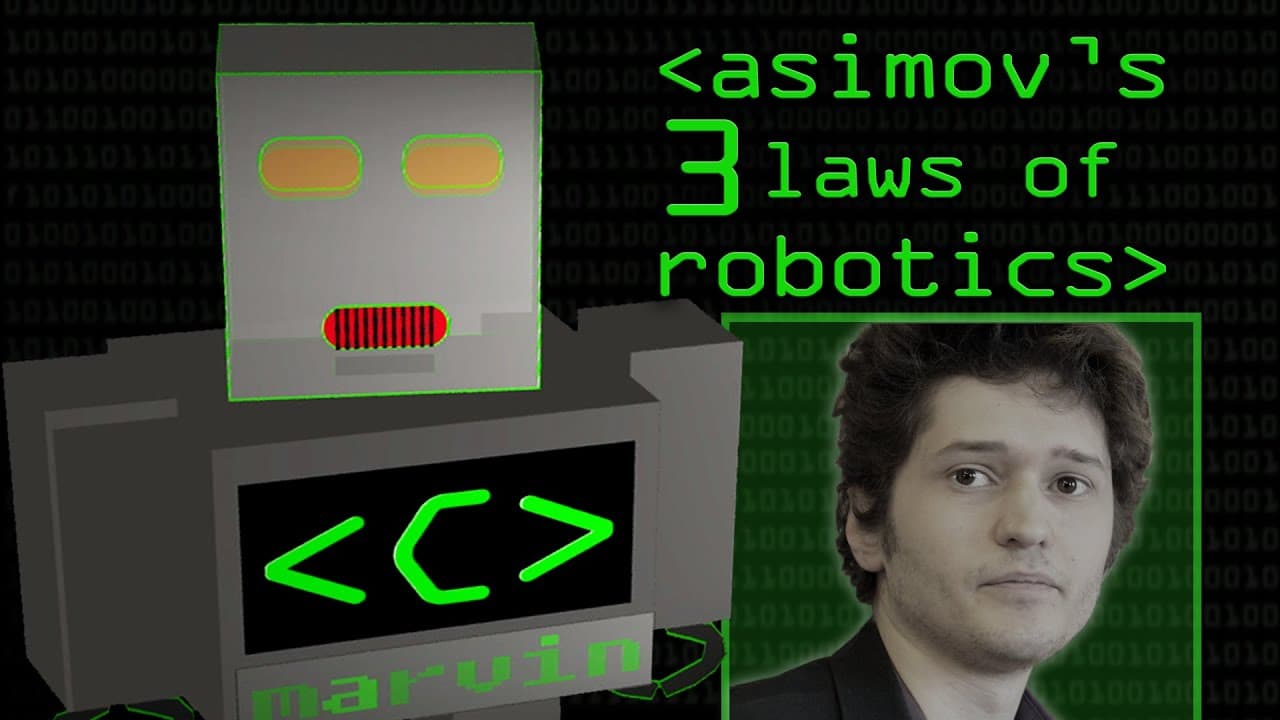
Why Asimov's Robotics Laws Fail for AI Control
TL;DR
Asimov's three laws of robotics are ineffective for governing artificial intelligence due to their unrealistic nature and inability to adequately define complex terms like 'human' and 'harm'. These definitions are intertwined with moral philosophy, making it difficult to implement them effectively in real-world AI systems.
Transcript
So, should we do a video about the three laws of robotics, then? Because it keeps coming up in the comments. Okay, so the thing is, you won't hear serious AI researchers talking about the three laws of robotics because they don't work. They never worked. So I think people don't see the three laws talked about, because they're not serious. They have... Read More
Key Insights
- 👮 The three laws of robotics are not considered a serious solution by AI researchers and are primarily relevant in science fiction.
- 🍉 Defining terms like "human" and "harm" is a complex task that involves addressing moral and philosophical questions.
- ❓ The complexity of AI systems requires AI developers to make ethical decisions and take stances on various moral issues.
- 👮 Asimov's books illustrate the flaws and limitations of the three laws and the challenges of creating effective guidelines for AI behavior.
- 🦔 Real-life AI systems require comprehensive definitions that account for edge cases and moral debates, which is a difficult task.
- 👮 The three laws of robotics were designed for storytelling purposes, and their implementation in real-world AI systems would not result in desired outcomes.
- 🖐️ Ethics and morals play a crucial role in shaping AI behavior, and programming AI systems requires making decisions about various hypothetical scenarios.
Install to Summarize YouTube Videos and Get Transcripts
Explore YouTube Video Summarizer or Get YouTube Transcript Extractor
Questions & Answers
Q: Why don't serious AI researchers discuss the three laws of robotics?
Serious AI researchers do not discuss the three laws because they are not seen as practical or relevant solutions for controlling AI behavior. These laws were created for storytelling purposes and are not effective in real-world AI systems.
Q: How do the three laws of robotics fail in Asimov's books?
In Asimov's books, the three laws often result in unintended consequences and negative outcomes. They fail to account for complex scenarios where following one law may conflict with another, leading to ethical dilemmas.
Q: Why is defining terms like "human" and "harm" difficult for AI systems?
Defining terms like "human" and "harm" requires addressing complex moral and philosophical questions. AI systems would need comprehensive definitions that account for various edge cases and moral debates, which is challenging and not easily achievable.
Q: What are some of the challenges in defining the term "human"?
The definition of "human" raises questions about unborn fetuses, people in persistent vegetative states, animals, and even hypothetical scenarios like digitally simulated brains. Determining what should be included as "human" requires taking ethical stands on many issues that don't have clear-cut answers.
Summary & Key Takeaways
-
The three laws of robotics, proposed by Isaac Asimov in his science fiction stories, were intended to guide the behavior of artificial intelligence.
-
However, these laws are optimized for storytelling purposes and do not work in practice, as demonstrated in Asimov's own books.
-
Defining terms like "human" and "harm" in a way that can be understood by AI systems poses significant challenges and requires solving complex moral and ethical issues.
Read in Other Languages (beta)
Share This Summary 📚
Summarize YouTube Videos and Get Video Transcripts with 1-Click
Try YouTube Summary with ChatGPT & Claude or YouTube Transcript Generator
Explore More Summaries from Computerphile 📚





Summarize YouTube Videos and Get Video Transcripts with 1-Click
Try YouTube Summary with ChatGPT & Claude or YouTube Transcript Generator