How to Prioritize Security Controls for Products
TL;DR
Prioritize the security controls that address the most consequential and common risks for the product, rather than spending scarce engineering time on exotic threats. The appropriate cutoff depends on the product’s use case, deployment environment, safety implications, and cost of correcting failures, especially when industrial equipment requires on-site service instead of a simple software update.
Transcript
Thank you very much for joining. Uh, we're gonna dive into this. You guys saw me walking around, and the point of me walking around is really to get context of you, right? Because this is a presentation for you. I really wanna make sure that, you know, the information that I have, that I frame it in a way that when you walk out of here, you've got ... Read More
Key Insights
- Security prioritization is a product decision because the value of each control depends on the product’s use case, technology, customers, and consequences of failure. A generic checklist cannot determine the right investment without understanding what the product does and where it operates.
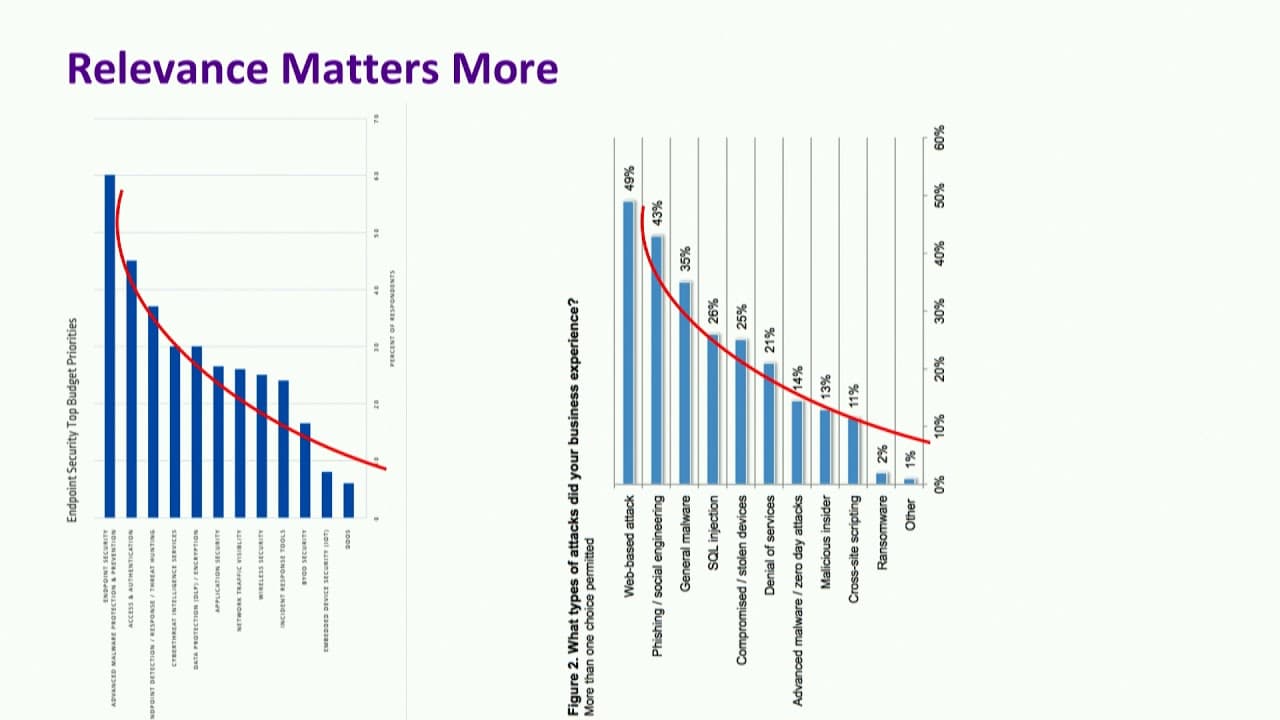
- The head of the security curve contains controls with the greatest practical impact, while the long tail contains increasingly specialized responses to narrower risks. Limited engineering capacity should first support controls that deliver the most benefit across customers and deployed products.
- Industrial product failures are harder to correct than ordinary application defects because remediation may require someone to travel to each affected location. That operational burden makes careful engineering essential when products are installed across thousands or millions of locations.
- Security rigor should increase with product severity because some failures can affect people, physical environments, or expensive equipment. The presentation points to tiered approaches in FedRAMP, ISA, and CSA as examples of matching control sensitivity to deployment needs.
- Threat visibility is not the same as threat priority because communication often concentrates on unusual actors, fashionable technologies, and buzzwords. Teams should compare that attention with recurring security patterns and redirect effort toward the controls most relevant to their actual exposure.
- Identity and access management is an example of a foundational security area that can include two-factor authentication before teams pursue more extreme or specialized measures. The sequence matters because strong basic controls may provide more practical value than attention-grabbing technologies.
- Risk assessment should begin with the question of what matters to the product rather than with a predetermined threat such as a malicious insider. Teams can then evaluate whether a risk deserves scarce engineering time based on its relevance, likelihood, impact, and product context.
- Scalable product security requires cooperation with global developers and product teams because controls must work across cloud platforms, subscriptions, products, and customer environments. The method is intended to direct vital engineering hours toward protections that benefit customers most while still meeting industrial requirements.
Install to Summarize YouTube Videos and Get Transcripts
Explore YouTube Video Summarizer or Get YouTube Transcript Extractor
Questions & Answers
Q: How should product teams prioritize security controls?
Product teams should first identify the risks that matter most to the product, its customers, its deployment environment, and its technology. They should then concentrate engineering effort on controls with the highest practical impact before moving into the long tail of specialized threats. The appropriate boundary changes when failures can affect people, require major capital, or demand on-site remediation across many locations.
Q: What does the long tail of security controls mean?
The long tail describes a distribution in which a small group of controls provides substantial value, followed by many increasingly specialized controls aimed at narrower risks. The proposed product approach emphasizes the head of that distribution first. It does not treat every possible control as equally valuable, because security effort must reflect the product’s real use case, risk severity, and available engineering time.
Q: Why can ignoring some long-tail security risks be useful?
Ignoring or postponing some long-tail risks can preserve engineering capacity for protections that benefit more customers and address more significant exposures. The argument is not that specialized threats never matter. It is that product teams should establish high-impact controls first, then extend requirements when the product’s severity, deployment conditions, human consequences, or remediation costs justify additional investment.
Q: How does product context affect cybersecurity priorities?
Product context determines which risks deserve attention and how rigorous the controls must be. A product that manages temperature, sprinklers, lighting, sensors, or other building functions has different consequences from a phone application that can be updated easily. Teams must consider the use case, the underlying technology, customer expectations, human impact, and the effort required to correct a deployed defect.
Q: Why is security engineering different for industrial products?
Industrial products may be installed across thousands or millions of locations, and correcting a defect can require someone to travel to each site. Their operation can also influence physical conditions, including temperature and energy use. These characteristics make failures an operational and customer experience problem, so teams must balance delivery speed with careful engineering and controls appropriate to the consequences.
Q: How should minimum viable products handle security requirements?
A minimum viable product should include the controls necessary for its most important risks rather than treating security as an unlimited list of possible features. Teams should define what matters, assess severity, and allocate limited engineering hours accordingly. Products involving human risk, industrial environments, or costly field remediation require a stronger minimum baseline than products whose problems can be corrected through a simple update.
Q: Why should teams be cautious about security buzzwords?
Security discussion can give disproportionate attention to unusual threat actors, highly specialized attacks, or fashionable technologies. That attention does not automatically indicate where a product receives the greatest protection value. Teams should step back, examine recurring patterns in the security information they use, and focus on controls near the top of their relevant risk distribution before investing in increasingly extreme measures.
Q: How can security teams work effectively with product engineers?
Security teams can work effectively with engineers by framing requirements around product outcomes, customer benefit, and concrete risk rather than presenting every control as equally mandatory. They should ask what matters to the product, account for deployment severity and remediation difficulty, and explain where foundational measures provide the greatest value. This creates a practical basis for balancing security requirements with delivery pressure across global teams.
Summary & Key Takeaways
-
Security investment should concentrate on the head of the risk distribution, where controls provide the greatest customer benefit, rather than automatically pursuing the long tail of specialized threats. Teams should begin by identifying what matters to the product and then compare control value against the risks the product actually faces.
-
Product context determines how far security requirements should extend. Products that can endanger people, disrupt physical environments, or require costly visits to many deployed locations demand greater sensitivity than easily updated applications. Severity frameworks can help teams increase control rigor according to the technology, deployment setting, and consequences of failure.
-
Product and security teams must balance speed with reliability when creating minimum viable products at scale. Global teams, cloud subscriptions, industrial requirements, and diverse customer environments make universal control lists insufficient. A practical program allocates limited engineering hours to foundational protections before addressing highly specialized risks or fashionable security topics.
Read in Other Languages (beta)
Share This Summary 📚
Summarize YouTube Videos and Get Video Transcripts with 1-Click
Try YouTube Summary with ChatGPT & Claude or YouTube Transcript Generator
Explore More Summaries from RSAC Cybersecurity 📚
Summarize YouTube Videos and Get Video Transcripts with 1-Click
Try YouTube Summary with ChatGPT & Claude or YouTube Transcript Generator