What Is the Soviet Ekranoplan?
TL;DR
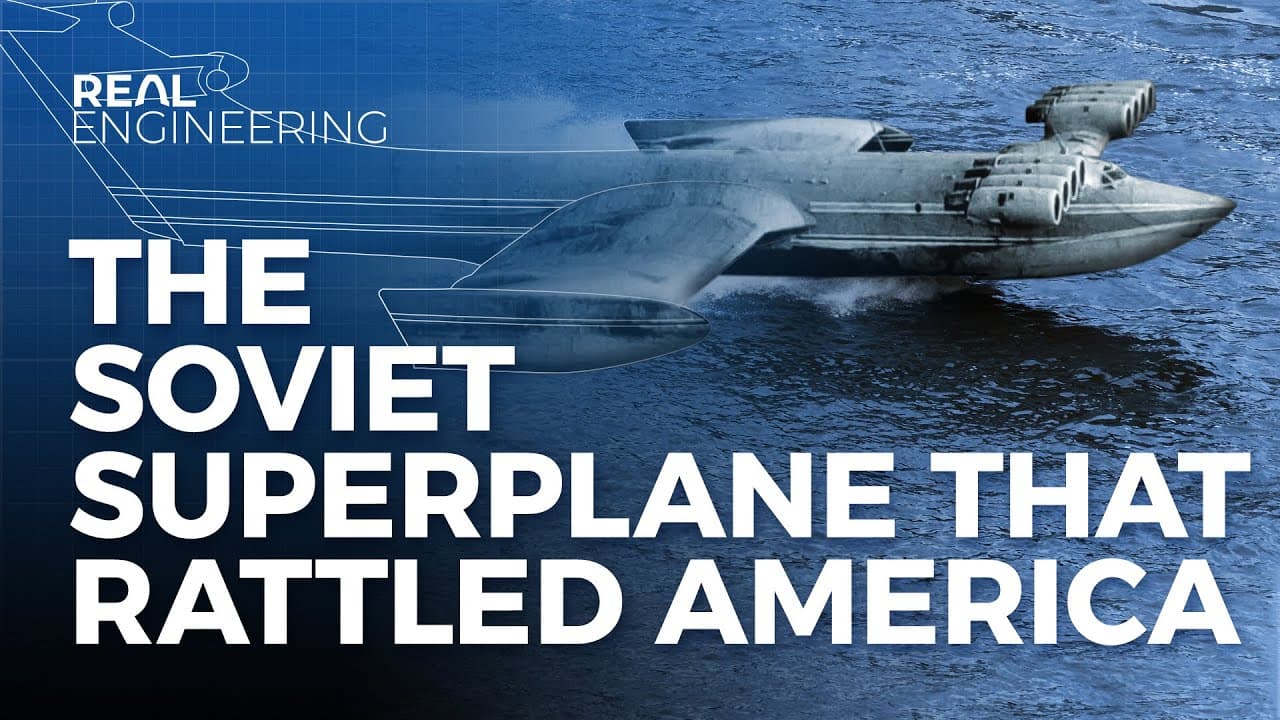
The Soviet Union developed the Ekranoplan, a unique aircraft designed to utilize ground effect to skim at high speeds over water. This allowed it to transport heavy loads quickly and evade radar detection. Despite its potential, the Ekranoplan did not find a niche in military use due to safety and reliability concerns.
Transcript
his episode of Real Engineering is brought to you by Brilliant, a problem solving website that teaches you to think like an engineer. At the height of the Cold War, with nuclear anxiety at a fever pitch, the United States launched their first spy satellites, the Corona. Tasked with photographing deep inside the Soviet Union. US Intelligence was foc... Read More
Key Insights
- The Ekranoplan is a ground-effect vehicle that flies at low altitudes over water, utilizing the increased lift from compressed air between its wings and the surface.
- Developed during the Cold War, the Ekranoplan was initially mistaken by US intelligence for a new type of Soviet superplane.
- The KM was the first and largest Ekranoplan prototype, with a wingspan of 37.6 meters and a length of 92 meters.
- Ekranoplans can transport large amounts of equipment and personnel quickly, staying under radar detection and avoiding mines and torpedoes.
- The Orlyonok was a smaller, transport-focused version of the Ekranoplan, featuring powerful engines and a unique design to minimize water intake.
- Despite their potential, Ekranoplans faced challenges such as limited operational conditions and the need for calm weather conditions.
- The Soviet Union's collapse halted further development, although other countries, like China and Germany, also experimented with similar designs.
- Future applications of Ekranoplan technology could include short-haul passenger transport in regions with many islands, like Southeast Asia.
Install to Summarize YouTube Videos and Get Transcripts
Explore YouTube Video Summarizer or Get YouTube Transcript Extractor
Questions & Answers
Q: What is a Soviet Ekranoplan?
A Soviet Ekranoplan is a ground-effect vehicle designed to fly at low altitudes over water, utilizing the increased lift from compressed air between its wings and the surface. Developed during the Cold War, it was intended for rapid transport of heavy loads while evading radar detection. Despite its innovative design, it faced challenges in operational reliability and safety.
Q: How does an Ekranoplan utilize ground effect?
An Ekranoplan utilizes ground effect by flying at an altitude less than its wingspan over water, which compresses air between the wings and the surface. This compression creates an area of higher pressure, providing additional lift and allowing the craft to carry heavier loads with less power. This effect is maximized in Ekranoplans, enabling them to skim efficiently over water.
Q: Why did the Soviet Union develop the Ekranoplan?
The Soviet Union developed the Ekranoplan during the Cold War to create a rapid transport vehicle capable of carrying heavy loads over water while evading radar detection. The Ekranoplan's ability to fly under enemy radar and avoid mines and torpedoes made it an attractive option for military applications, although it ultimately did not find a lasting niche.
Q: What were the key features of the KM prototype?
The KM prototype was the first and largest Ekranoplan, featuring a wingspan of 37.6 meters and a length of 92 meters. It was powered by eight turbojets, providing significant thrust. The KM could carry heavy loads at high speeds, demonstrating the potential of ground-effect vehicles for military transport. Despite its size and capabilities, only one KM was ever built.
Q: How did the Orlyonok differ from the KM?
The Orlyonok was a smaller, transport-focused version of the Ekranoplan, designed to carry military equipment and troops. It featured a unique engine layout with powerful turboprop and turbofan engines to enhance ground effect and minimize water intake. The Orlyonok was more practical for transport purposes, but only four units were built, and it remained in service until 1993.
Q: What challenges did Ekranoplans face in military use?
Ekranoplans faced several challenges in military use, including safety and reliability concerns due to their low-altitude flight, which allowed little time for corrective maneuvers. They were also limited by weather conditions, as high waves or wind could prevent operation. These factors, combined with the Soviet Union's collapse, halted further development and widespread military adoption.
Q: Have other countries developed similar ground-effect vehicles?
Yes, other countries have developed similar ground-effect vehicles. Germany experimented with the X-114 in the 1970s, and China developed the XTW-4 in 1999. Boeing also proposed the Pelican, a large ground-effect vehicle, but the project was not pursued. Despite these efforts, no ground-effect vehicle has achieved widespread adoption due to operational challenges.
Q: What future applications could Ekranoplan technology have?
Ekranoplan technology could find future applications in short-haul passenger transport, particularly in regions with many islands, like Southeast Asia. These vehicles could provide quick transport over short distances where traditional planes are less efficient due to time spent climbing and descending. However, addressing safety and reliability concerns remains crucial for their successful implementation.
Summary & Key Takeaways
-
The Soviet Ekranoplan was a Cold War-era innovation designed to fly at low altitudes over water using ground effect, offering rapid transport capabilities while avoiding radar detection. Despite its potential for military applications, development ceased due to safety concerns and the Soviet Union's collapse.
-
The first prototype, KM, was the largest aircraft of its time, capable of carrying heavy loads at high speeds. The Orlyonok, a smaller version, featured advanced engine designs to enhance ground effect and reduce water intake, but only a few units were built.
-
While other countries have experimented with similar designs, Ekranoplans remain niche due to operational limitations. They could find future use in short-haul passenger transport, especially in island-rich regions, if safety and reliability issues are addressed.
Read in Other Languages (beta)
Share This Summary 📚
Summarize YouTube Videos and Get Video Transcripts with 1-Click
Try YouTube Summary with ChatGPT & Claude or YouTube Transcript Generator
Explore More Summaries from Real Engineering 📚




Summarize YouTube Videos and Get Video Transcripts with 1-Click
Try YouTube Summary with ChatGPT & Claude or YouTube Transcript Generator