What Are Carbohydrates and How Do They Function?
TL;DR
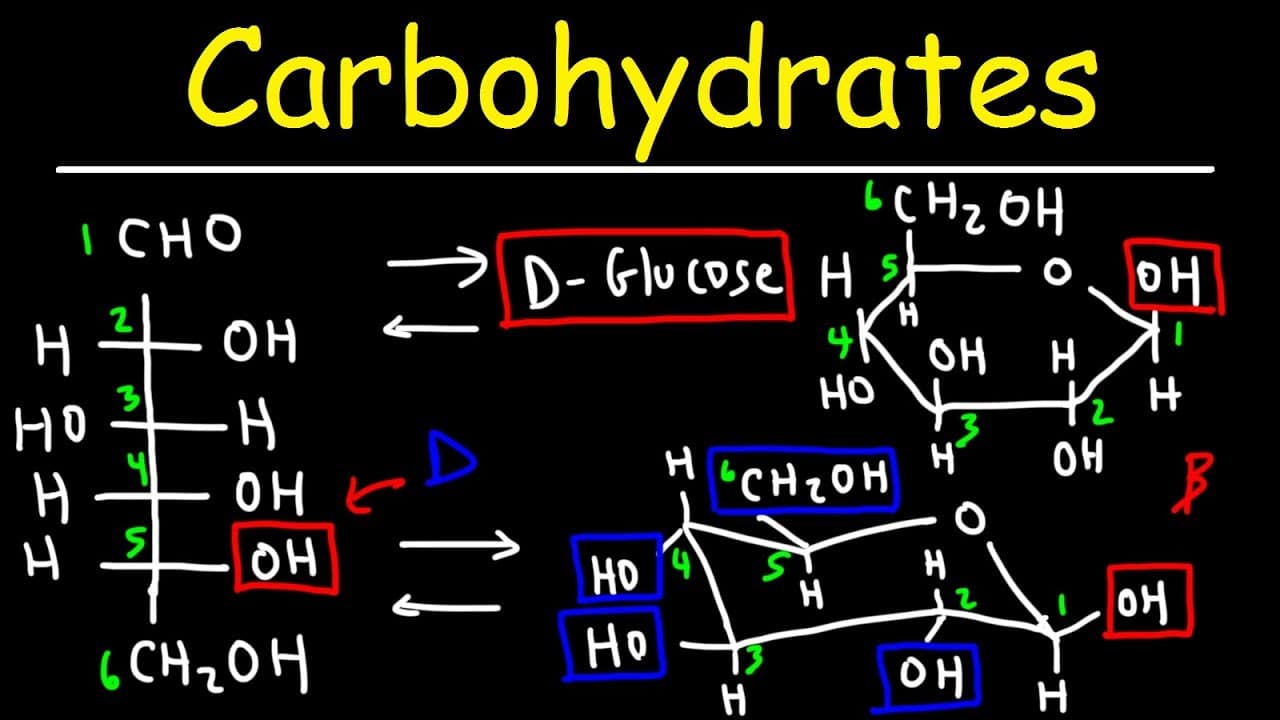
Carbohydrates are biomolecules that store energy and consist of monosaccharides like glucose and fructose, disaccharides like sucrose, and polysaccharides like starch and cellulose. Glucose, typically found in cyclic forms (alpha and beta), is the most common aldo hexose, with beta-D-glucose being more stable due to its chair conformation. Beta-D-galactose is an epimer of glucose and can be derived by changing the chiral center at carbon 4.
Transcript
in this video we're going to talk about carbohydrates so what exactly is a carbohydrate well early chemists thought of them as hydrates of carbon so consider the molecular formula of glucose c6h12o if you divide every subscript by 6 you'll get c1 h2o1 or ch2o and so that looks like carbon plus water thus we have the name carbohydrates and carbohydr... Read More
Key Insights
- 🫒 Carbohydrates are biomolecules used to store energy in living organisms.
- 🅰️ Monosaccharides, disaccharides, and polysaccharides are the three main types of carbohydrates.
- 💁 Glucose and fructose are common monosaccharides, and glucose exists in cyclic forms (alpha and beta).
- 💁 Beta-D-glucose is more stable in its chair conformation, making it the dominant form in nature.
- 😄 Beta-D-galactose, an epimer of glucose, can be derived by changing the chiral center at carbon 4.
- 👥 The equatorial positioning of hydroxyl groups in the cyclic structure contributes to stability.
- 👥 Glucose and fructose are isomers, with different functional groups (aldehyde and ketone, respectively).
Install to Summarize YouTube Videos and Get Transcripts
Explore YouTube Video Summarizer or Get YouTube Transcript Extractor
Questions & Answers
Q: What are the three main types of carbohydrates?
The three main types of carbohydrates are monosaccharides (e.g., glucose, fructose), disaccharides (e.g., sucrose, maltose, lactose), and polysaccharides (e.g., starch, cellulose).
Q: What is the difference between glucose and fructose?
Glucose and fructose are isomers, meaning they have the same chemical formula but differ in structure. The main difference is the functional group: glucose has an aldehyde group, while fructose has a ketone group.
Q: How does glucose exist in a cyclic form?
Glucose exists in a cyclic form due to its aldehyde functional group. The OH group on carbon 5 attacks the carbonyl carbon, forming a cyclic structure. Glucose can exist in an alpha or beta form based on the position of the OH group at carbon 1.
Q: Why is beta-D-glucose more common than alpha-D-glucose?
The chair conformation of beta-D-glucose is more stable due to the equatorial positioning of the hydroxyl groups. This stability favors the beta form, making it more prevalent in nature.
Q: How is beta-D-galactose related to glucose?
Beta-D-galactose is the C4 epimer of glucose, which means it differs from glucose in the configuration at carbon 4. By changing the chiral center at carbon 4 of glucose, beta-D-galactose can be drawn.
Summary & Key Takeaways
-
Carbohydrates are important biomolecules used for energy storage, consisting of monosaccharides (e.g., glucose, fructose), disaccharides (e.g., sucrose, maltose, lactose), and polysaccharides (e.g., starch, cellulose).
-
Glucose and fructose are common monosaccharides, and glucose exists in cyclic forms (alpha and beta) due to its aldehyde functional group.
-
The chair conformation of beta-D-glucose is more stable, making it the predominant form in nature.
-
Beta-D-galactose, an epimer of glucose, can be drawn by changing the chiral center at carbon 4.
Read in Other Languages (beta)
Share This Summary 📚
Summarize YouTube Videos and Get Video Transcripts with 1-Click
Try YouTube Summary with ChatGPT & Claude or YouTube Transcript Generator
Explore More Summaries from The Organic Chemistry Tutor 📚



Summarize YouTube Videos and Get Video Transcripts with 1-Click
Try YouTube Summary with ChatGPT & Claude or YouTube Transcript Generator