What Is the Difference Between dy/dx and d/dx in Calculus?
TL;DR
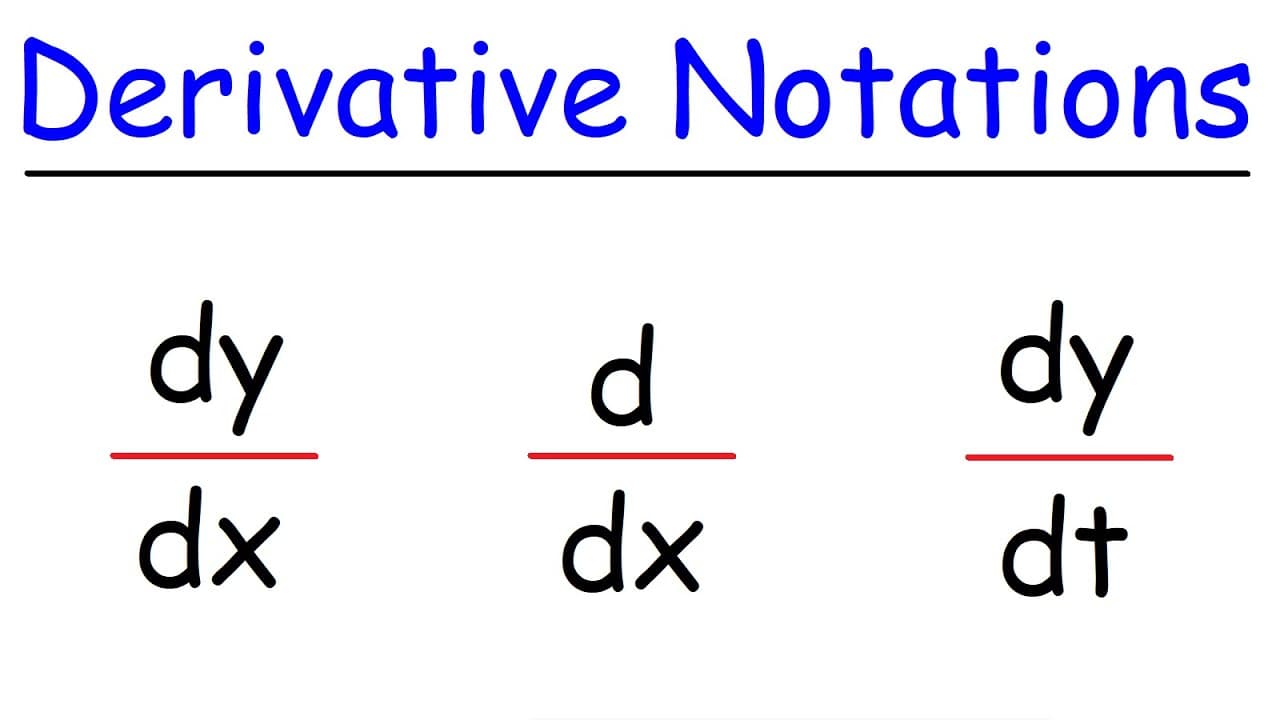
The main difference is that dy/dx indicates the derivative of y with respect to x, while d/dx is an instruction to differentiate whatever is inside the brackets with respect to x. Both notations yield the same result when finding derivatives, such as applying the power rule. They also extend to other variables in contexts like related rates or implicit differentiation.
Transcript
in this video i kind of want to discuss the difference between dydx and also d over dx because when dealing with derivatives typically you'll see these two things and you might be wondering what to do when you see them well let's say that y is equal to x cubed plus 4x what does it mean when you see dydx in a problem like this and sometimes you'll s... Read More
Key Insights
- 🐞 dy/dx represents the derivative of a function y with respect to x, while d/dx is a command to differentiate a function with respect to x.
- ✊ Both dy/dx and d/dx can be used to find derivatives using the power rule.
- 🐞 In implicit differentiation, when differentiating a function with variables that don't match, dy/dx needs to be included in the solution.
Install to Summarize YouTube Videos and Get Transcripts
Explore YouTube Video Summarizer or Get YouTube Transcript Extractor
Questions & Answers
Q: What is the difference between dy/dx and d/dx?
dy/dx tells you what something is: it states that this is the derivative of the function y with respect to x. d/dx tells you what to do: it is a command to differentiate whatever expression is inside the brackets with respect to x. In short, dy/dx makes a statement while d/dx expresses an instruction.
Q: Do dy/dx and d/dx give the same answer?
Yes, when applied to the same function they produce the same result. For y = x³ + 4x², writing dy/dx or differentiating with d/dx both give 3x² + 8x using the power rule. dy/dx is equivalent to saying take the derivative of y with respect to x, then replacing y with its expression.
Q: Why does dy/dx appear when differentiating y³ with respect to x?
When the variable you are differentiating does not match the variable you are differentiating with respect to, an extra factor appears. The derivative of y³ with respect to x is 3y² times dy/dx by the power rule. You typically see this when dealing with implicit differentiation.
Q: What is implicit differentiation?
Implicit differentiation is used when you differentiate a function whose variables do not match the variable of differentiation, such as differentiating y³ with respect to x. You apply the power rule and include dy/dx in the answer, giving results like 3y² times dy/dx.
Q: Can you differentiate with respect to variables other than x?
Yes, you can differentiate with respect to many variables, such as x, another variable s, or time t. For example, the derivative of x⁵ with respect to s is 5x⁴ times dx/ds. In related rates problems you often differentiate with respect to time using d/dt.
Q: How do you differentiate x⁴ + y³ with respect to time?
You differentiate each term and attach the matching rate factor. The derivative is 4x³ times dx/dt plus 3y² times dy/dt. Here dx/dt is the derivative of x with respect to time and dy/dt is the derivative of y with respect to time, which is common in related rates problems.
Q: If r = x³ + t⁵, what is dr/dy?
You differentiate r with respect to y, so each term picks up a rate factor. The derivative of x³ with respect to y is 3x² times dx/dy, and the derivative of t⁵ with respect to y is 5t⁴ times dt/dy. So dr/dy = 3x² dx/dy + 5t⁴ dt/dy.
Summary & Key Takeaways
-
The video discusses the difference between dy/dx and d/dx in terms of their meanings and usage in differentiation problems.
-
dy/dx represents the derivative of a function y with respect to x, while d/dx is a command to differentiate a function with respect to x.
-
Both dy/dx and d/dx can be used to find derivatives using the power rule, and in related rates problems, they can be differentiated with respect to different variables, such as t or s.
Read in Other Languages (beta)
Share This Summary 📚
Summarize YouTube Videos and Get Video Transcripts with 1-Click
Try YouTube Summary with ChatGPT & Claude or YouTube Transcript Generator
Explore More Summaries from The Organic Chemistry Tutor 📚



Summarize YouTube Videos and Get Video Transcripts with 1-Click
Try YouTube Summary with ChatGPT & Claude or YouTube Transcript Generator