How to Use Prompt Engineering for AI Agents
TL;DR
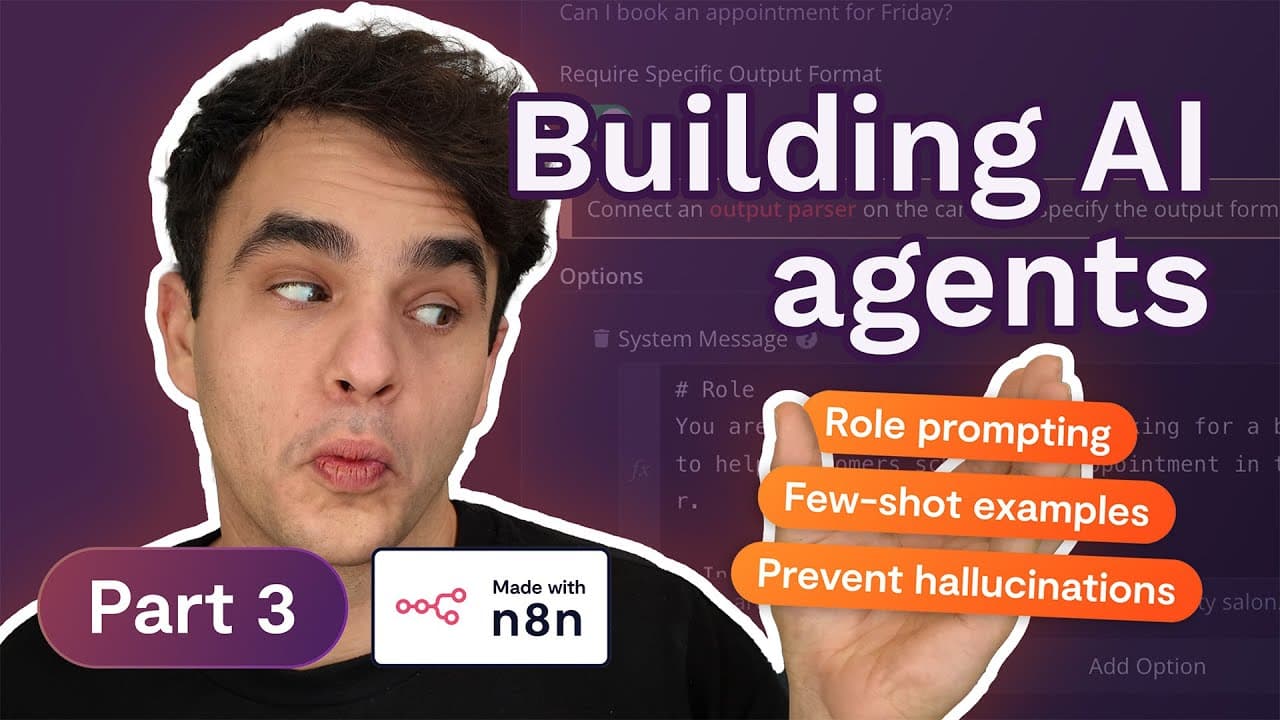
Prompt engineering is crucial for defining how AI agents complete tasks. By focusing on single-task agents, you can achieve more effective results. Start by defining the role, instructions, and rules in the system layer, then refine the input and action layers to improve task execution. This method ensures AI agents are efficient and reliable in task completion.
Transcript
hey welcome to part three of the building AI agents tutorial Series in part one we covered Basics like what AI agents are how to use tools and memory and if you don't know what I'm talking about go watch part 1 and two then come right back here in this video we're going to focus on prompt engineering specifically for single task AI agents so an AI ... Read More
Key Insights
- Prompt engineering is essential for successful AI agent task completion.
- Focus on single-task agents before expanding to multitask agents.
- Role prompting defines the AI agent's identity and high-level purpose.
- Instructions guide the AI agent's steps without being overly prescriptive.
- Rules prevent AI agents from hallucinating or making errors.
- Few-shot prompting provides examples to guide AI agent responses.
- Input layer manages user requests, whether human or programmatic.
- Action layer defines tools and how AI agents should use them.
Install to Summarize YouTube Videos and Get Transcripts
Explore YouTube Video Summarizer or Get YouTube Transcript Extractor
Questions & Answers
Q: How to define the role of an AI agent?
Defining the role of an AI agent involves specifying its identity and high-level purpose. This is similar to the first few sentences of a job description, providing context for the AI agent's actions. Role prompting helps the agent understand its function and scope, ensuring it can make informed decisions in ambiguous situations.
Q: What are task instructions in prompt engineering?
Task instructions are high-level steps that guide an AI agent on how to complete a task. They provide a framework for the agent to follow without being overly prescriptive, allowing the agent to leverage its autonomy. Instructions should be clear, concise, and aligned with the role and purpose of the AI agent.
Q: Why are rules important in AI prompt engineering?
Rules are crucial in AI prompt engineering because they prevent the AI agent from making errors or hallucinating information. They provide guidelines for handling specific situations, ensuring the agent operates within defined boundaries. Rules can be added iteratively as new challenges or errors are identified during testing or production.
Q: What is few-shot prompting?
Few-shot prompting involves providing one or more examples to guide an AI agent's responses. These examples help the agent understand the expected output format or tone, reducing ambiguity and improving the accuracy of its responses. Few-shot prompting is particularly useful for complex tasks where clear examples can significantly enhance performance.
Q: How does the input layer function in AI agents?
The input layer in AI agents is where user requests are processed. In chat-based interactions, this typically involves direct user input. In programmatic use cases, the input layer can involve dynamic data merged with static prompts to form a complete request. Proper management of the input layer ensures the AI agent receives accurate and relevant information for task execution.
Q: What is the role of the action layer in AI agents?
The action layer defines the tools and functions that an AI agent can use to complete tasks. It includes detailed descriptions and parameters for each tool, ensuring the agent understands how to use them effectively. Properly defining the action layer is crucial for tasks that require interaction with external systems or performing specific actions.
Q: How can hallucinations be reduced in AI agents?
Reducing hallucinations in AI agents involves providing clear guidelines and escape routes. This includes instructing the agent to admit when it doesn't know an answer and to ask clarifying questions when needed. Additionally, ensuring the agent outputs relevant quotes or data from tools can help maintain accuracy and prevent it from generating false information.
Q: What is the significance of additional context in prompt engineering?
Additional context provides environmental or situational information that an AI agent may not inherently know, such as the current date or specific business details. This context helps the agent make informed decisions and tailor its responses to the specific needs of the task or user, enhancing its overall effectiveness and reliability.
Summary & Key Takeaways
-
Prompt engineering is the backbone of effective AI agent task management, focusing on defining roles, instructions, and rules. This ensures precise and reliable task execution.
-
By concentrating on single-task AI agents, developers can refine their approach, ensuring the AI agent efficiently completes well-defined tasks before expanding capabilities.
-
The system, input, and action layers are integral to setting up AI agents, each playing a role in how the agent processes tasks and interacts with tools and users.
Read in Other Languages (beta)
Share This Summary 📚
Summarize YouTube Videos and Get Video Transcripts with 1-Click
Try YouTube Summary with ChatGPT & Claude or YouTube Transcript Generator
Explore More Summaries from n8n 📚

Summarize YouTube Videos and Get Video Transcripts with 1-Click
Try YouTube Summary with ChatGPT & Claude or YouTube Transcript Generator