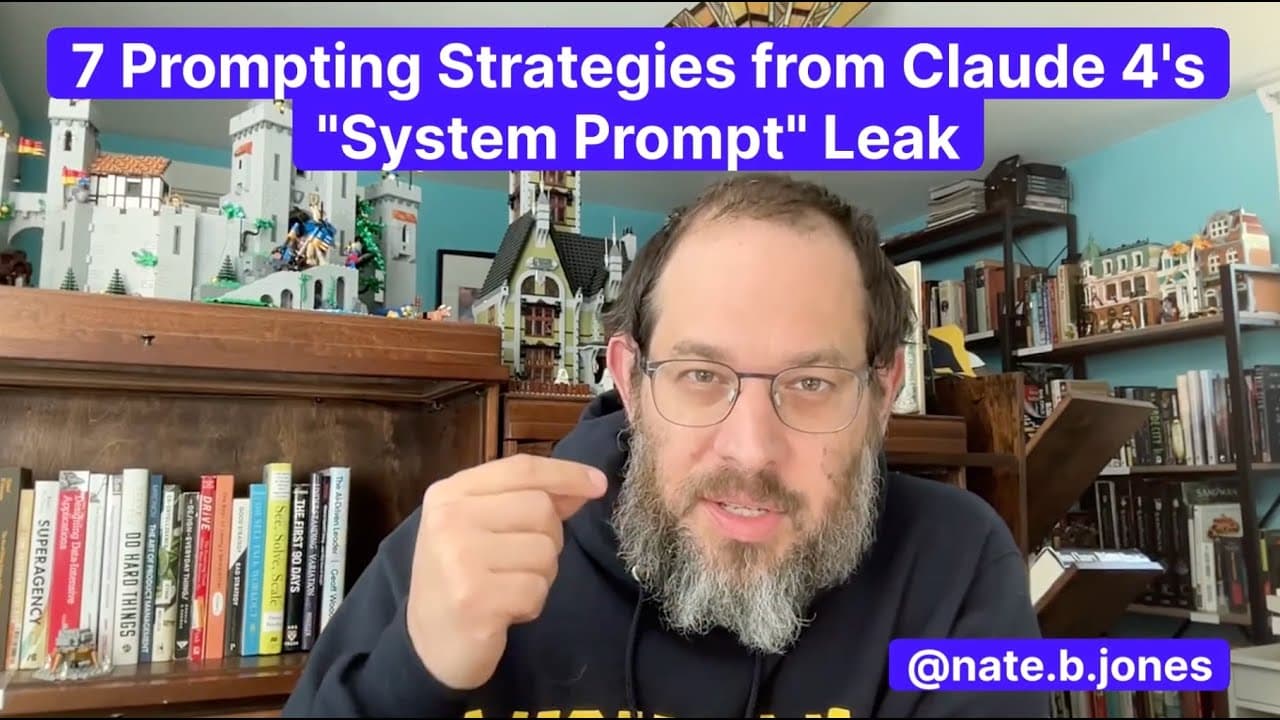
What Are the 7 Prompting Strategies from Claude 4’s Alleged “System Prompt” Leak?
TL;DR
The seven strategies are identity anchoring, edge-case conditionals, three-tier uncertainty routing, locked tool grammar, binary style rules, positional reinforcement, and post-tool reflection. Together, they turn prompts into policies that prevent predictable failures instead of merely describing desired outputs. Read on to see how each strategy improves clarity, consistency, tool use, and handling of uncertainty.
Transcript
I have never done this before. I'm actually going to break down what I learned by studying the leaked alleged system prompt of Claude 4. Now, the reason I haven't covered this in the past is because I feel very ambiguous about the idea of leaking system prompts. It's a grey hat tactic at best. It happens all the time. I would say on average you hav... Read More
Key Insights
- Identity anchoring is the practice of placing fixed facts, including model identity, the current date, and core capabilities, at the beginning of a long prompt. Establishing stable context early reduces the model’s working-memory burden and supports more consistent reasoning later in the interaction.
- Edge-case conditionals are explicit “if X, then Y” rules that define how the model should handle refusals, safety boundaries, and unusual situations. Carefully spelling out these cases reduces ambiguity, which is a major source of inconsistent model behavior across similar requests.
- Three-tier uncertainty routing distinguishes timeless, slow-changing, and live information. Timeless questions receive direct answers, slow-changing information receives an answer plus an offer to verify, and live information triggers immediate search, giving the model criteria for when different actions are appropriate.
- Locked tool grammar uses examples of both valid and invalid API or function calls. Correct examples establish the required format, while counter-examples reveal common mistakes, making tool-use expectations clearer for agents working with functions, APIs, or MCP servers.
- Binary style rules replace subjective guidance with unambiguous constraints. Instructions such as never beginning with flattery, using no bullets unless requested, or using no emojis unless requested are easier to apply consistently than broad requests to be concise or minimize formatting.
- Positional reinforcement is the repetition of critical constraints at strategic points throughout a lengthy prompt. Restating requirements, such as anonymizing personally identifiable information, helps refresh attention and limits instruction drift as the model processes substantial intervening content.
- Post-tool reflection is a deliberate reasoning checkpoint after receiving function results. Because tool outputs can be difficult to interpret, asking the model to process the result before choosing its next action can improve accuracy during long, multi-step reasoning and tool-use sequences.
- Declarative prompting frames requirements as standing policies instead of one-time procedural commands. A rule such as “if X, always Y” establishes persistent behavior, while defensive coverage of hallucination, copyright, harmful content, and other failure modes makes the intended operating boundaries explicit.
Install to Summarize YouTube Videos and Get Transcripts
Explore YouTube Video Summarizer or Get YouTube Transcript Extractor
Questions & Answers
Q: What are the 7 prompting strategies from Claude 4’s alleged system prompt leak?
The seven strategies are identity anchoring, explicit edge-case conditionals, three-tier uncertainty routing, locked tool grammar, binary style rules, positional reinforcement, and post-tool reflection. They treat a prompt as a set of policies designed to prevent failure modes rather than simply tell a model what to produce.
Q: How can I build more reliable prompts for AI models?
Define stable context first, then specify failure boundaries and explicit rules for edge cases, uncertainty, style, and tool use. Include valid and invalid examples, repeat critical constraints in long prompts, and require the model to interpret tool results before choosing its next action.
Q: What is identity anchoring in prompt engineering?
Identity anchoring places facts that should remain fixed at the beginning of a prompt, such as the model’s identity, the current date, and its core capabilities. Establishing steady context early reduces working-memory burden and gives later reasoning a consistent foundation.
Q: How does three-tier uncertainty routing work?
It classifies information as timeless, slow-changing, or live. The model answers timeless information directly, answers slow-changing information while offering to verify it, and immediately searches for live information such as today’s stock prices.
Q: Why should prompts include both valid and invalid tool-call examples?
Valid examples establish the required function or API format, while invalid examples expose common mistakes. This locked tool grammar clarifies what the model should and should not do when using functions, APIs, or MCP servers.
Q: Why are binary style rules more reliable than vague guidance?
Binary rules give the model a clear compliance test, while subjective guidance remains open to interpretation. Rules such as “never start with flattery,” “no bullets unless requested,” and “no emojis unless requested” are clearer than instructions like “be concise” or “minimize formatting.”
Q: How does positional reinforcement improve long prompts?
Positional reinforcement repeats critical constraints at strategic points throughout a lengthy prompt instead of stating them only once. Because attention can degrade over long contexts, these reminders refresh important requirements and reduce instruction drift.
Q: What should an AI agent do after receiving tool results?
The agent should pause and interpret the tool output before selecting its next action. This post-tool reflection checkpoint helps prevent a mistaken interpretation from carrying into later stages of a long, multi-step task.
Summary & Key Takeaways
-
Effective prompting is less about issuing a command and more about constructing policies that prevent predictable failures. The discussed Claude 4 prompt reportedly devotes most of its attention to prohibited or constrained behavior, showing how defensive instructions can address ambiguity, hallucination, unsafe content, copyright concerns, and other recurring failure modes.
-
Seven strategies structure reliable model behavior: identity anchoring, explicit edge-case conditionals, three-tier uncertainty routing, locked tool grammar with counter-examples, binary style rules, positional reinforcement, and post-tool reflection. Together, they define stable context, clarify decisions, constrain formatting, refresh important instructions, and improve the interpretation of tool results.
-
Prompts can be treated like operating system configuration files rather than magic phrases. Declarative policies such as “if X, always Y” make expectations more consistent than loosely worded sequences or subjective adjectives. Detailed defensive programming can therefore improve output quality for both API-based agents and people interacting with models through chat.
Read in Other Languages (beta)
Share This Summary 📚
Summarize YouTube Videos and Get Video Transcripts with 1-Click
Try YouTube Summary with ChatGPT & Claude or YouTube Transcript Generator
Explore More Summaries from AI News & Strategy Daily | Nate B Jones 📚






Summarize YouTube Videos and Get Video Transcripts with 1-Click
Try YouTube Summary with ChatGPT & Claude or YouTube Transcript Generator