How to Find and Grow Profitable Indie Businesses
TL;DR
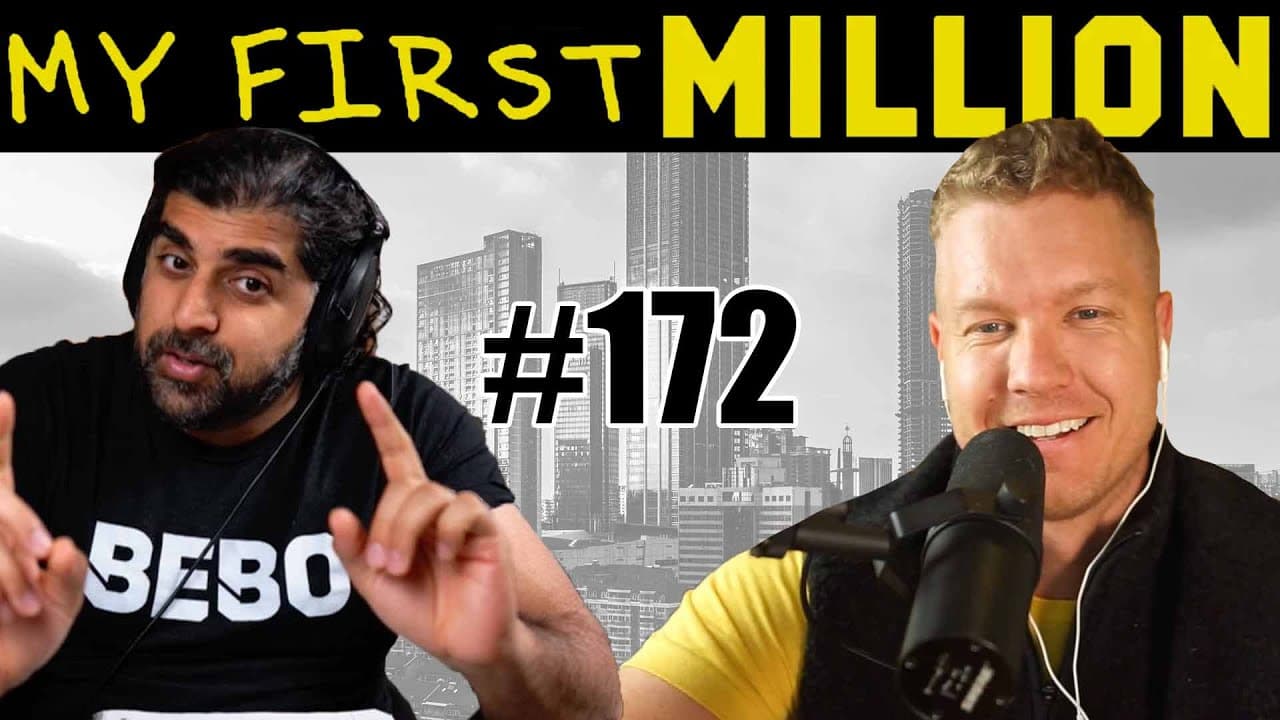
Profitable businesses can begin with tiny audiences, simple assets, and overlooked market gaps. The discussion recommends validating demand through direct selling, studying humble beginnings instead of polished outcomes, and choosing opportunities whose operational barriers discourage competitors. Growth comes from repeated execution, focused distribution, and business models that solve clear customer problems.
Transcript
When I, I first hosted my, uh, I hosted my first event in June, and the event happened... Or I decided to do it around June 1st, and the event went, placed seven weeks later in August. And when I started, I had close to nothing. I had, um, a 200-person email list, so there wasn't like this, "Oh, it's easy for you. You had The Hustle." No, no, no, i... Read More
Key Insights
- Hustle Con is evidence that a paid event can be launched from a very small base. It started with roughly 200 email subscribers, a domain name, and no website, then produced about $60,000 in revenue and approximately $50,000 in profit within six weeks.
- Direct selling is central to validating an event before building extensive infrastructure. The first Hustle Con was organized on a seven-week timeline, showing that a founder can establish demand and generate meaningful ticket revenue without beginning with a large audience or a sophisticated digital presence.
- Regional Bitcoin arbitrage worked by buying where Bitcoin was cheaper and selling where it traded at a premium. The described Korean premium sometimes reached 50 percent, while the Japanese opportunity was closer to 10 percent and presented a more workable operational target.
- The hardest part of arbitrage is completing the entire money cycle. After selling Bitcoin for Korean won or another local currency, a trader must legally convert the proceeds into dollars and transfer them out, which can trigger regulatory limits and bank concerns resembling money-laundering patterns.
- Operational feasibility is more valuable than the largest theoretical margin. Sam Bankman-Fried reportedly abandoned the more attractive Korean premium and pursued Japan's smaller premium because the required banking, currency conversion, and transaction steps could actually be assembled into a repeatable process.
- Compounding becomes powerful when a profitable transaction can be repeated frequently. The episode describes an operation trading as much as $25 million per day at a stated 10 percent margin, with the proceeds contributing to a trading company and later supporting the creation of FTX.
- Effective altruism is presented as a philosophy of maximizing earnings to increase charitable giving. The episode describes Bankman-Fried's stated aim as giving away at least half of what he earned, connecting aggressive capitalist execution with an unusually large personal commitment to philanthropy.
- Large companies often have beginnings that look unimpressive in retrospect. The discussion points to Coinbase's early appearance on Hacker News and encourages young entrepreneurs to study initial products, audiences, and distribution tactics instead of assuming successful companies began with obvious scale or polish.
Install to Summarize YouTube Videos and Get Transcripts
Explore YouTube Video Summarizer or Get YouTube Transcript Extractor
Questions & Answers
Q: How can a founder launch a profitable paid event?
A founder can begin by choosing a clear event concept, setting a near-term date, and selling directly to a small relevant audience before investing in elaborate infrastructure. Hustle Con reportedly started with roughly 200 email subscribers, no website, and only a domain name. Within six weeks, the first event generated about $60,000 in revenue and approximately $50,000 in profit, with the event occurring seven weeks after the decision to organize it.
Q: Do entrepreneurs need a large audience before selling tickets?
A large existing audience is not presented as a requirement for launching a paid event. Hustle Con began before The Hustle existed, using an email list of roughly 200 people and a domain name without a completed website. The first event then produced about $60,000 in revenue and around $50,000 in profit, suggesting that focused outreach and a compelling offer can matter more than initial audience size.
Q: What is a regional Bitcoin price premium?
A regional Bitcoin price premium is a difference between the price available in one market and the higher price paid in another. The episode describes Bitcoin hypothetically selling for $10,000 in the United States and $15,000 in Korea, with the Korean difference called the kimchi premium. It also describes a Japanese premium near 10 percent, which was smaller but considered more operationally accessible.
Q: Why is international cryptocurrency arbitrage difficult?
International cryptocurrency arbitrage requires more than buying cheaply and selling at a higher quoted price. A trader must purchase the asset, move or sell it in the higher-priced market, receive local currency, convert that currency back into dollars, and transfer the funds so the cycle can restart. Regulations, conversion caps, banking scrutiny, and questions about large one-way currency flows can obstruct those steps.
Q: Why pursue a smaller arbitrage premium instead of a larger one?
A smaller premium can be preferable when it supports a complete and repeatable transaction cycle. The Korean premium was described as reaching 50 percent and averaging around 30 percent over time, but converting large amounts of Korean won back into dollars was difficult. The Japanese premium was closer to 10 percent, yet the episode says Bankman-Fried spent extensive effort assembling the operational steps needed to capture it repeatedly.
Q: How did the arbitrage operation become highly profitable?
The operation became highly profitable by repeating a positive-margin trade at substantial volume. According to the episode, Bankman-Fried's organization eventually arbitraged about $25 million per day and captured a stated margin near 10 percent. The hosts attribute hundreds of millions of dollars to repeated arbitrage activity, followed by the creation of FTX, an exchange offering sophisticated products such as derivatives and options on different coins internationally.
Q: What entrepreneurial lesson comes from Coinbase's origins?
The lesson is that a major business may initially appear small, uncertain, or unremarkable. The description notes Coinbase's humble origins on Hacker News and argues that many large businesses begin similarly. Young entrepreneurs should therefore examine how a company found its earliest users and solved an initial problem, rather than judging an opportunity only through the polished scale visible after years of growth.
Q: How should entrepreneurs evaluate indie business ideas?
Entrepreneurs should look for a clear customer problem, evidence that people will pay, manageable distribution, and a model that can be repeated. The discussion uses indie businesses such as MicroAcquire and Photopea as brainstorming references and also considers opportunities framed as "Affirm for X." Its event and arbitrage examples further suggest testing demand early and examining every operational step before assuming an attractive idea will work.
Summary & Key Takeaways
-
The hosts examine how apparently large businesses can emerge from modest beginnings. Hustle Con began with a domain name, no website, and an email list of roughly 200 people, yet its first event generated about $60,000 in revenue and around $50,000 in profit during its first six weeks of preparation.
-
A cryptocurrency arbitrage story illustrates why visible price differences do not automatically produce easy profits. Capturing a regional premium required completing every stage of the transaction, including selling Bitcoin for local currency and converting that currency back into dollars despite banking scrutiny, regulations, transfer limits, and operational complexity.
-
The broader discussion connects entrepreneurial advice with podcast growth and business brainstorming. The hosts consider Coinbase's humble origins, indie companies such as MicroAcquire and Photopea, and opportunities modeled as "Affirm for X." Their recurring lesson is to investigate small beginnings, practical distribution, operational obstacles, and repeatable customer value.
Read in Other Languages (beta)
Share This Summary 📚
Summarize YouTube Videos and Get Video Transcripts with 1-Click
Try YouTube Summary with ChatGPT & Claude or YouTube Transcript Generator
Explore More Summaries from My First Million 📚

Summarize YouTube Videos and Get Video Transcripts with 1-Click
Try YouTube Summary with ChatGPT & Claude or YouTube Transcript Generator