How to Evaluate Composite Functions Using Function Tables
TL;DR
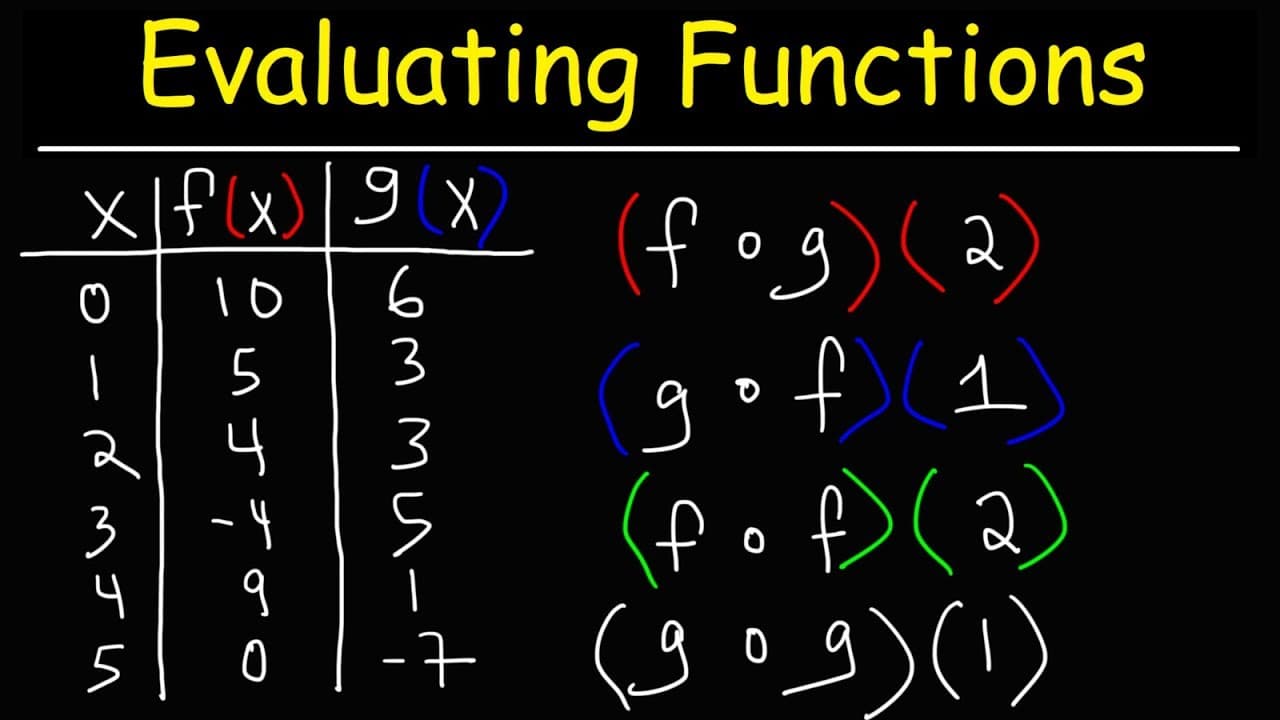
To evaluate composite functions using function tables, first determine the value of the inner function and substitute it into the outer function. For example, to find f(g(2)), calculate g(2) first, then use that result in f. This step-by-step approach simplifies evaluating composite functions.
Transcript
in this video we're going to talk about how to evaluate composite functions using tables so let's start with this expression what is the value of this expression what does that expression even mean f which is written first is on the outside g which is written second is on the inside so what appears to look like fog is really f of g of 2. so what we... Read More
Key Insights
- 🍽️ Composite functions involve evaluating an inner function first and then substituting its output into an outer function.
- 🚰 Tables are useful in organizing the values and simplifying the evaluation process.
- 🪈 The order of evaluating composite functions is crucial, with the outer function applied last.
- 🦻 Practice problems aid in mastering the concept.
- 🎮 Composite functions can be evaluated efficiently using the step-by-step process outlined in the video.
- ⏮️ Each function within a composite function operates on the output of the previous one.
- ❓ Evaluating composite functions is a fundamental concept in mathematics.
Install to Summarize YouTube Videos and Get Transcripts
Explore YouTube Video Summarizer or Get YouTube Transcript Extractor
Questions & Answers
Q: How are composite functions evaluated using tables?
Composite functions are evaluated by substituting values from the inner function into the outer function, following a specific order. This is done to find the final output value of the composite function.
Q: What is the process for evaluating composite functions using tables?
Start by evaluating the inner function and finding its output value for a given input. Then, substitute this output value into the outer function to get the final result of the composite function.
Q: Can you explain an example of evaluating composite functions using tables?
Sure. Let's consider the composite function f of g of 2. First, evaluate g of 2 and find its output value, which is 3. Then, substitute this value into f, and when x is 3, f has a value of -4. Hence, f of g of 2 equals -4.
Q: How can I practice evaluating composite functions using tables?
You can try solving practice problems provided in the video. Example problems include evaluating f of f of 2 and g of g of 1. Follow the step-by-step process of substituting values from the inner function and then the outer function to find the final results.
Summary & Key Takeaways
-
Composite functions are evaluated by substituting values from the inner function into the outer function.
-
To solve a composite function f of g of x, first find the value of g of x, then substitute it into f to get the final result.
-
Practice problems are provided to enhance understanding and application of the concept.
Read in Other Languages (beta)
Share This Summary 📚
Summarize YouTube Videos and Get Video Transcripts with 1-Click
Try YouTube Summary with ChatGPT & Claude or YouTube Transcript Generator
Explore More Summaries from The Organic Chemistry Tutor 📚




Summarize YouTube Videos and Get Video Transcripts with 1-Click
Try YouTube Summary with ChatGPT & Claude or YouTube Transcript Generator