How to Secure Complex Smart Home Automation
TL;DR
Complex smart homes can introduce enterprise-level risk when many devices are functionally chained through one automation platform. The researchers evaluated this problem by building bolt-on and purpose-built environments, connecting devices through local, virtual, and cloud-based services, and testing smart attacks against the resulting systems. Protection begins with understanding how rules, bridges, protocols, and connected devices create shared dependencies.
Transcript
All right. Good afternoon, everyone. Welcome to this afternoon's session on the Hackers and Threats track. The title is Securing the Pod Bay Doors, HAL: Uh, Cybersecurity Risks of IoT Automation. Our speakers are Stephen and Numan. Stephen Hilt and Numan Huq are both senior threat researchers at Trend Micro. Please welcome them. Hey, everyone. I'm ... Read More
Key Insights
- IoT automation platforms are central control systems that connect multiple household devices and execute rules across them. They become necessary when products from different manufacturers use separate applications that cannot directly control one another, requiring a shared platform to coordinate the broader environment.
- A complex IoT environment is defined by the researchers as a minimum of ten IoT devices integrated through an automation platform and functionally chained together to create smart applications. Device quantity alone is insufficient because functional integration is the defining element of complexity.
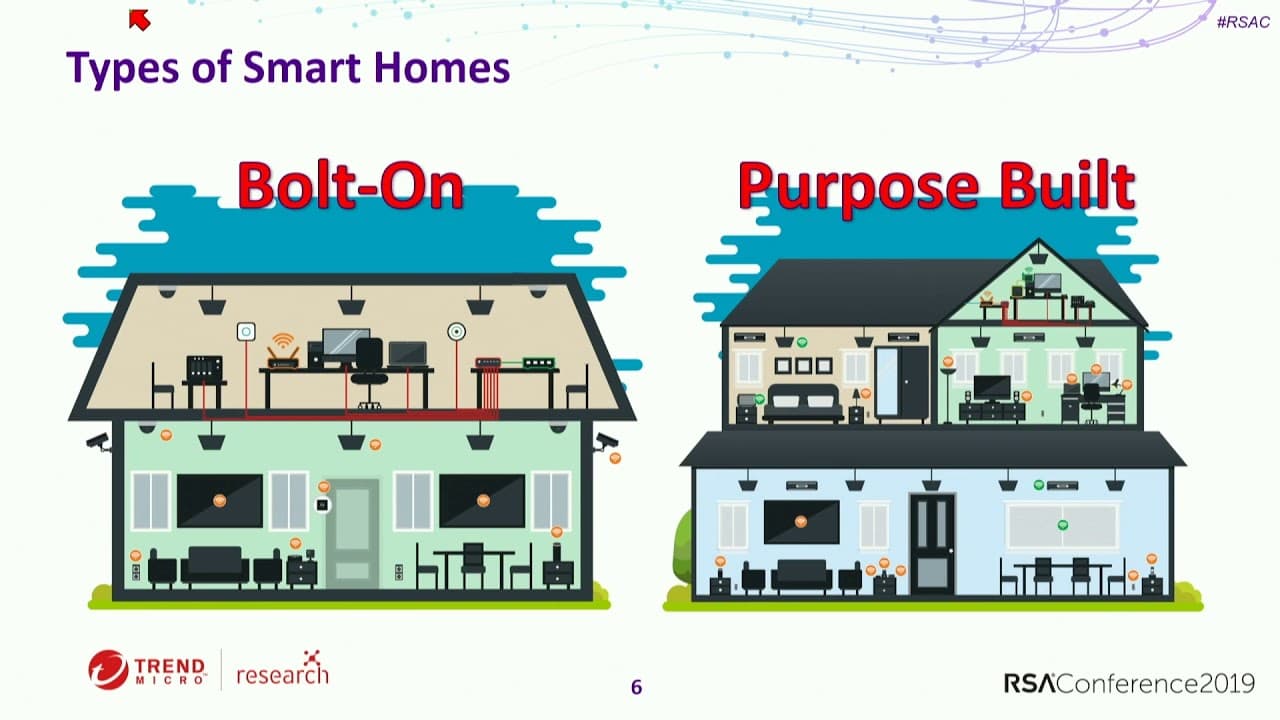
- Smart homes can follow a bolt-on model in which owners gradually add products from different vendors. This approach can produce a heterogeneous environment because devices such as Wemo and TP-Link products have separate applications and require an automation platform to operate as a coordinated system.
- Purpose-built smart homes integrate automation during construction rather than adding it afterward. The German example routed lights directly to controllers and used a home automation protocol instead of conventional light switches, allowing the homeowner to plan wiring and control arrangements around automated operation.
- Local automation servers can run on hardware such as Raspberry Pis, Arduino-class devices, Mac Minis, or virtual machines. They host automation logic within the environment and provide a foundation for coordinating connected devices without placing every rule on a cloud-based platform.
- Virtual automation services include voice-controlled systems such as Google Home, Alexa, and Siri. They can connect multiple devices and execute coordinated routines, including a good-night command that turns off most lights, leaves one illuminated, and starts music.
- Cloud-based automation services store and execute automation rules remotely. IFTTT is presented as a prominent example that can control connected devices and run prebuilt applications, including a rule designed to open a garage door when a particular vehicle enters the driveway.
- Home Assistant supports simple web-based rules and more granular YAML configuration. A basic rule can activate a Wemo device at 6:30 each morning, while configuration-file conditions can restrict that behavior to Monday through Friday instead of running during the weekend.
Install to Summarize YouTube Videos and Get Transcripts
Explore YouTube Video Summarizer or Get YouTube Transcript Extractor
Questions & Answers
Q: What is a complex IoT environment?
A complex IoT environment is defined by the researchers as a minimum of ten IoT devices integrated through an IoT automation platform and functionally chained together to create smart applications. Merely owning many connected devices does not satisfy the definition. The devices must interact through automation rules that combine their capabilities into coordinated household functions.
Q: Why can smart home automation create cybersecurity risk?
Smart home automation can create cybersecurity risk because many devices become interconnected through shared platforms, rules, controllers, bridges, and network services. The description characterizes the resulting exposure as enterprise-level risk within the home. The researchers examined that exposure by building two complete automation environments and launching smart attacks against the connected systems.
Q: What types of IoT automation servers are discussed?
The researchers identify three types of IoT automation servers: local, virtual, and cloud-based. Local servers can run on devices such as Raspberry Pis, Arduino-class hardware, Mac Minis, or virtual machines. Virtual systems include Google Home, Alexa, and Siri. Cloud-based platforms include IFTTT, where users place automation rules and run prebuilt applications.
Q: What is the difference between bolt-on and purpose-built smart homes?
A bolt-on smart home develops gradually as an owner buys products from different vendors and connects them through a common automation platform. A purpose-built smart home incorporates automation during construction. In the German example, lights connected directly to controllers and were operated through an automation protocol rather than traditional light switches, influencing the home’s wiring and layout.
Q: How does Home Assistant create automation rules?
Home Assistant provides a user-friendly interface for creating basic automation rules and also exposes YAML configuration files for more granular control. The researchers demonstrate a rule that turns on a Wemo device at 6:30 every morning. YAML conditions can refine the schedule so the action occurs only from Monday through Friday and not on weekends.
Q: What does HA Bridge do in a smart home?
HA Bridge is described as an open-source tool that emulates a Philips Hue bridge while communicating with other devices. Because Alexa supports Philips Hue, a command can be directed through HA Bridge and translated into an action for something other than a light bulb. It therefore functions as an intermediary between voice control and diverse device actions.
Q: How was presence detection used in the research environment?
The United States laboratory used a UniFi access point for presence detection. This allowed the researchers to trigger automation rules according to what was on or around the network. Presence information therefore became an input to the automation system, enabling rules and actions to respond to detected devices or nearby network activity.
Q: What devices and technologies were included in the test homes?
The research environments included smart plugs, thermostats, security cameras, voice-control devices, speakers, Philips Hue equipment using Zigbee, and a UniFi access point for presence detection. They also used Raspberry Pis, virtual machines, network switches, patch panels, network-attached storage, FHEM, HA Bridge, Echo Dots, and EnOcean automation controllers in the German environment.
Summary & Key Takeaways
-
IoT automation platforms act as the brains of connected environments by linking otherwise separate devices through rules. These rules can combine monitoring systems, access controls, speakers, garden sprinklers, smart plugs, thermostats, cameras, lights, and presence detection into applications that streamline daily activities, such as alarms or coordinated nighttime routines.
-
The researchers define a complex IoT environment as at least ten IoT devices integrated through an automation platform and functionally chained into smart applications. Their audience survey suggested that owning ten or more connected devices was common, while combining that many devices into integrated applications was still uncommon but moving toward mainstream adoption.
-
Two test environments represented different approaches to smart homes. The United States lab used bolt-on products and Home Assistant, while the German purpose-built home used infrastructure designed for automation from the ground up. Raspberry Pis, virtual machines, FHEM, HA Bridge, EnOcean controllers, voice assistants, speakers, switches, storage, and wireless systems supported the research.
Read in Other Languages (beta)
Share This Summary 📚
Summarize YouTube Videos and Get Video Transcripts with 1-Click
Try YouTube Summary with ChatGPT & Claude or YouTube Transcript Generator
Explore More Summaries from RSAC Cybersecurity 📚


Summarize YouTube Videos and Get Video Transcripts with 1-Click
Try YouTube Summary with ChatGPT & Claude or YouTube Transcript Generator