How to Find Profitable SaaS Ideas From Real Founders
TL;DR
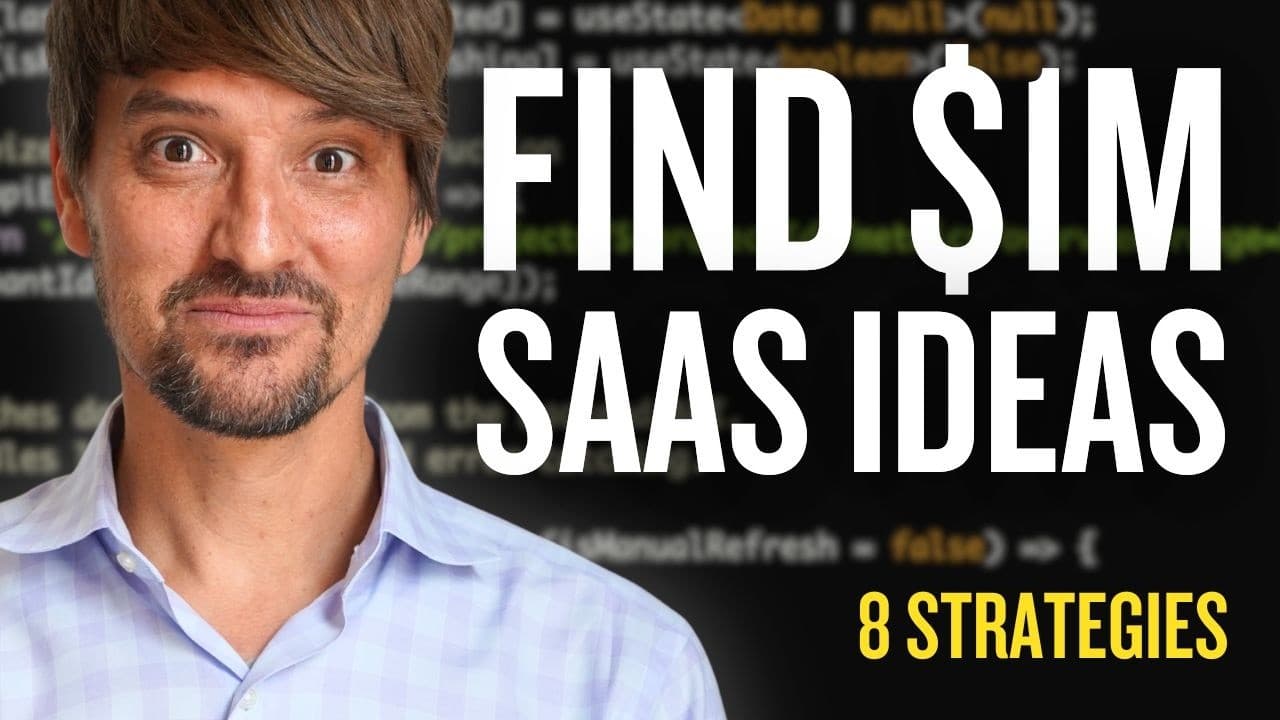
Most successful founders found ideas by solving problems at their day jobs. A survey of 200+ SaaS founders shows nearly half found ideas at work, while others copied existing products or entered proven categories. The video breaks down eight vetted methods with real examples.
Transcript
Choosing the right SAS idea can be the difference between making 10,000, a h 100,000, or even a million dollars a month and making nothing at all. But I'm not here to give you another list of hypothetical SAS ideas. Cuz that's not what you need. What you really need is to know how successful founders actually found their idea and how you can steal ... Read More
Key Insights
- About 48% of founders found their idea by solving a problem at their day job.
- Founders gain deep context, built-in testers, and knowledge of the buying process when they source ideas at work.
- Validation can be done without leaving current employment, reducing risk while exploring a new product.
- Three idea-generating questions help trigger insights: daily tools, manual processes to automate, and industry tools that are outdated.
- Copying or adapting an existing successful product provides market clarity and faster validation, often easier than building from scratch.
- Entering an existing category can leverage established paradigms, easing marketing and sales messaging.
- Examples cited include Jetbit, Drip, and TY is shortener, illustrating practical execution in real markets.
- There is a free resource mentioned (robwalling.com/ideas) to help locate a SaaS idea and a broader marketplace reference is provided.
Install to Summarize YouTube Videos and Get Transcripts
Explore YouTube Video Summarizer or Get YouTube Transcript Extractor
Questions & Answers
Q: A real search query question about the video (e.g. 'How to...', 'What is...', 'Why does...', 'When should...'). Question 1
The video argues that the most reliable way to identify a profitable SaaS idea is to observe problems at your day job or in your current work environment. Founders often recognize barriers, repetitive tasks, and bottlenecks they personally experience, which signals a viable target for software. This approach helps you understand the problem deeply, access potential customers early, and anticipate budgeting and approval processes. Validation can occur while still employed, reducing risk if you maintain professional boundaries and respect IP agreements.
Q: Question 2
Another consistent path is copying an existing product or entering a proven category. Founders discover demand by recognizing what customers already use and value, then offering a better or cheaper alternative. This route simplifies positioning because prospective buyers already understand the category, enabling faster marketing, clearer messaging, and reduced sales friction. In some cases, this approach accelerates growth when incumbents are overpriced or clunky.
Q: Question 3
The eight methods include practical tactics beyond day job problems and copying existing products. The video outlines how to identify opportunities through field observations, industry experience, and leveraging collective insights from a broad founder network. Real-world examples illustrate each method, including conversion to a standalone product and positioning that aligns with established customer expectations.
Q: Question 4
What cautions should be observed when sourcing ideas from the day job? You should validate the problem outside your employer, check for IP clauses in employment agreements, and avoid using proprietary data or hardware. These precautions protect you legally, ethically, and financially while you test and refine your idea in a low-risk environment.
Q: Question 5
How can you use the three guiding questions to generate SaaS ideas? Assess: what tools you use daily that frustrate you, what manual tasks could be automated, and whether incumbents are slow to adapt or outdated. Answering these prompts helps surface concrete problems, potential feature gaps, and fair comparisons to existing solutions, enabling faster ideation and validation.
Q: Question 6
Why is copying an existing category effective for SaaS ideation? It provides a familiar framework for customers, reducing the cognitive load of understanding a new product. This familiarity allows quicker marketing wins, clearer value propositions, and faster onboarding, particularly when the new offering targets a known pain point or process that users already recognize.
Q: Question 7
What role do real examples play in the video’s guidance? The speaker cites founders like Jetbit, Drip, and TY is shortener to illustrate how each method translates into concrete actions and market impact. These case studies demonstrate how solving real problems, applying a proven category, or leveraging existing demand can lead to scalable SaaS ventures.
Q: Question 8
What resources does the video offer to help viewers start finding their own SaaS idea? A free resource is available at robwalling.com/ideas for a 9-5 audit to uncover ideas, plus references to marketplaces and early access to related content. These materials are designed to help initiate ideation quickly and with data-driven framing.
Summary & Key Takeaways
-
The video distills eight proven methods founders use to discover profitable SaaS opportunities, backed by data from a survey of over 200 founders earning at least $1,000 a month. It emphasizes practical, real-world sourcing over theoretical lists, with examples from multiple industries. A downloadable resource and community examples augment the guidance.
-
A key takeaway is the emphasis on finding problems you already encounter in your day job, which provides context, potential beta testers, and insight into purchasing processes, reducing risk while validating the idea during employment.
-
The content also covers alternative paths such as copying existing ideas or entering established categories, and how these strategies can ease market entry through familiar paradigms and pricing expectations.
Read in Other Languages (beta)
Share This Summary 📚
Summarize YouTube Videos and Get Video Transcripts with 1-Click
Try YouTube Summary with ChatGPT & Claude or YouTube Transcript Generator
Explore More Summaries from Rob Walling 📚




Summarize YouTube Videos and Get Video Transcripts with 1-Click
Try YouTube Summary with ChatGPT & Claude or YouTube Transcript Generator