How to Draw Orbital Diagrams for Electron Configurations
TL;DR
To draw orbital diagrams, first identify the electron configuration of the element, such as nitrogen's which is 1s² 2s² 2p³. Fill the orbitals from lowest to highest energy, ensuring that degenerate orbitals receive one electron each with parallel spins before pairing. This method helps visualize whether an atom is paramagnetic or diamagnetic based on its unpaired electrons.
Transcript
in this video i'm going to talk about orbital diagrams and how to draw them and how to place the electrons within each orbital so let's start with nitrogen so nitrogen has an atomic number of 7 and an average atomic mass of 14.01 now in order to write the orbital diagram or to draw it first you need to identify the electron configuration of nitroge... Read More
Key Insights
- 🫀 Orbital diagrams are a visual representation of how electrons are distributed within different energy levels and sublevels of an atom.
- 🪈 The electron configuration of an element determines the order in which orbitals are filled in the orbital diagram.
- 💄 Nitrogen, with an electron configuration of 1s2 2s2 2p3, has three unpaired electrons, making it paramagnetic.
- 😑 Transition metals and their ions require specific considerations when drawing orbital diagrams, as electrons are removed from the highest energy level for ions.
Install to Summarize YouTube Videos and Get Transcripts
Explore YouTube Video Summarizer or Get YouTube Transcript Extractor
Questions & Answers
Q: How do you draw the orbital diagram for nitrogen?
To draw the orbital diagram for nitrogen, start by identifying the electron configuration (1s2 2s2 2p3). Then, fill the orbitals from the 1s level to the 2p level, following the rules of filling orbitals.
Q: What is the difference between paramagnetic and diamagnetic substances?
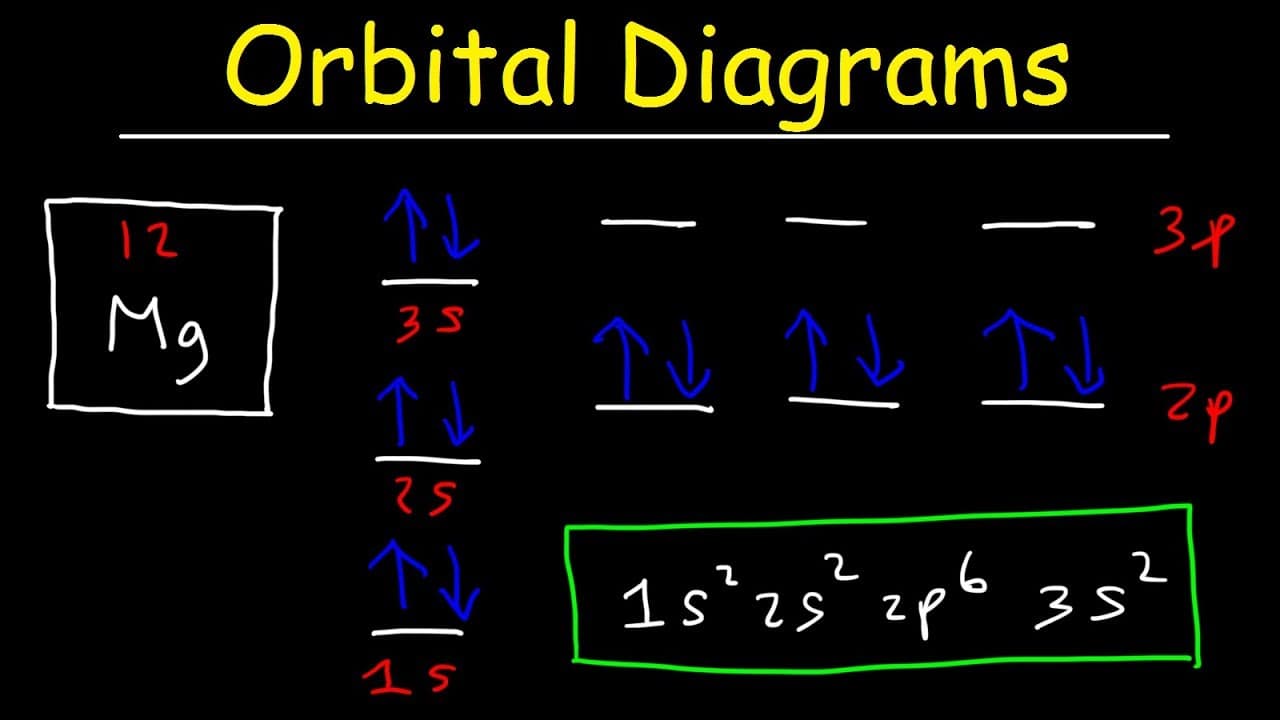
A paramagnetic substance, like nitrogen, has unpaired electrons and is weakly attracted to an external magnetic field. In contrast, a diamagnetic substance, like magnesium, has only paired electrons and is weakly repelled by an external magnetic field.
Q: Can you draw the orbital diagram for an ion, like phosphorus?
Yes, to draw the orbital diagram for an ion, you need to determine the number of electrons in the ion. For phosphorus, with 15 electrons, fill the orbitals until you reach a total of 15 electrons.
Q: How do you draw the orbital diagram for a cation?
For a cation like aluminum plus three, subtract the number of electrons equal to the positive charge from the electrons of the neutral atom. For aluminum, which has 13 electrons, the orbital diagram for aluminum plus three would have 10 electrons.
Summary & Key Takeaways
-
The video discusses how to draw orbital diagrams, specifically using nitrogen as an example. It emphasizes the importance of identifying the electron configuration before drawing the diagram.
-
The electron configuration of nitrogen is 1s2 2s2 2p3, and this information is used to fill the orbital diagram from the bottom up, with each orbital accommodating a specific number of electrons.
-
Nitrogen has three unpaired electrons, making it paramagnetic, while a substance with only paired electrons, like magnesium, is diamagnetic.
Read in Other Languages (beta)
Share This Summary 📚
Summarize YouTube Videos and Get Video Transcripts with 1-Click
Try YouTube Summary with ChatGPT & Claude or YouTube Transcript Generator
Explore More Summaries from The Organic Chemistry Tutor 📚



Summarize YouTube Videos and Get Video Transcripts with 1-Click
Try YouTube Summary with ChatGPT & Claude or YouTube Transcript Generator