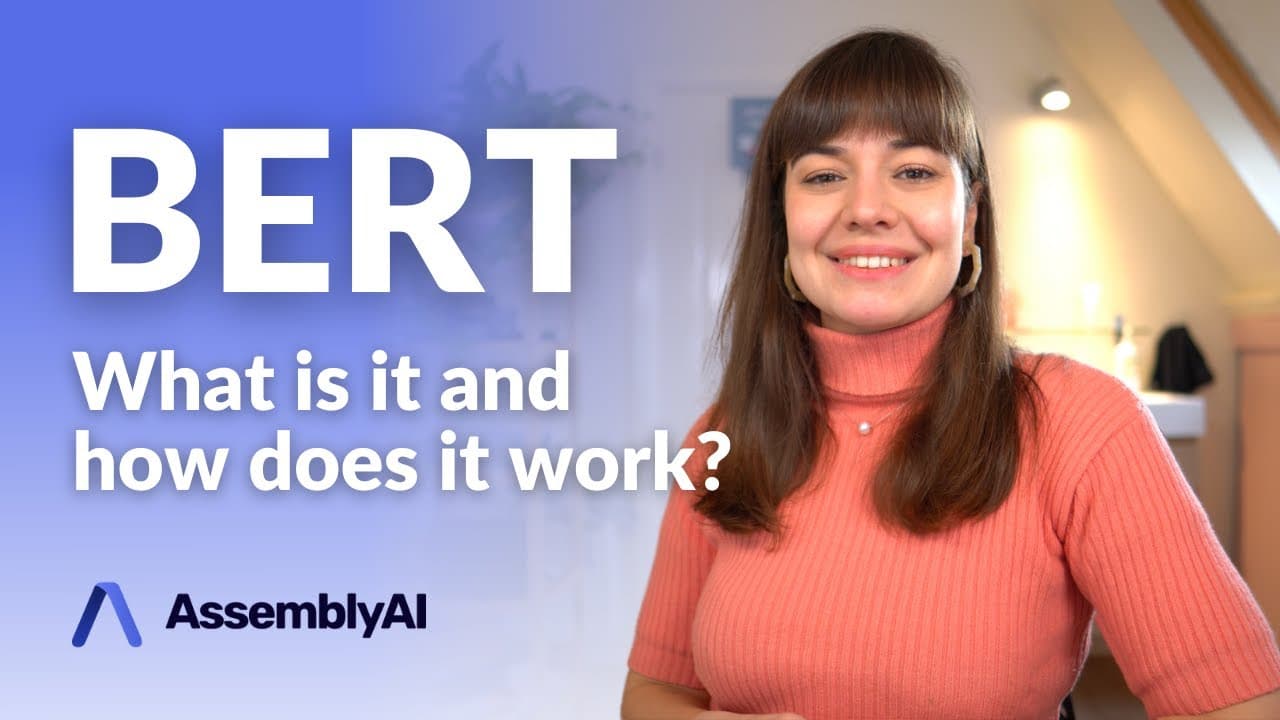
What Is BERT and How Does It Work for NLP Tasks?
TL;DR
BERT is a language model that uses stacked encoders to understand the context of language, enabling it to perform tasks like question answering and sentiment analysis. It is trained with masked language modeling and next sentence prediction, allowing users to fine-tune it for specific applications by adding a task-specific output layer.
Transcript
bert is one of those models that were based on the famous transformers architecture and had a gigantic impact in the world of ai when they were first published so in this video let's see what birth is how it works and how you can use it too this video is brought to you by assembly ai assembly ai is a company that is making a state of the art speech... Read More
Key Insights
- 🥠 BERT is a language model that understands language by learning the context of words and can be fine-tuned for various tasks.
- 😷 It is trained using masked language modeling and next sentence prediction tasks.
- 😒 BERT's architecture consists of stacked encoders, without the use of decoders.
- 🪜 Fine-tuning BERT requires adding a task-specific output layer and using a dataset specific to the task.
- 🍧 BERT models come in different sizes and languages, with large models having more parameters.
- 😑 BERT's pre-trained parameters are available for use without the need for training from scratch.
- 👨💻 Researchers at Google have generously shared the source code for BERT.
Install to Summarize YouTube Videos and Get Transcripts
Explore YouTube Video Summarizer or Get YouTube Transcript Extractor
Questions & Answers
Q: What is BERT and how does it work?
BERT is a language model that understands language by learning the context of words. It uses stacked encoders instead of encoders and decoders like the transformer architecture. BERT can be fine-tuned for specific language tasks.
Q: How is BERT trained?
BERT is trained using two tasks: masked language modeling and next sentence prediction. In masked language modeling, some words in a sentence are masked, and BERT's goal is to predict the missing words. In next sentence prediction, BERT determines if two sentences are related or not.
Q: What is the architecture of BERT?
BERT consists of stacked encoders that learn the context of language. It also includes input layers for positional encoding, segment embeddings, and token embeddings to handle the location and different sentences within input data.
Q: How can BERT be fine-tuned for specific tasks?
To fine-tune BERT, a new output layer specific to the task is added after BERT's encoders. This output layer is trained using a dataset specific to the task, such as sentiment analysis or named entity recognition.
Summary & Key Takeaways
-
BERT is a language model that can learn and perform specific language tasks, such as question answering, sentiment analysis, and text classification.
-
It consists of stacked encoders that learn the context of language, with no decoders.
-
BERT is trained using two tasks: masked language modeling and next sentence prediction.
Read in Other Languages (beta)
Share This Summary 📚
Summarize YouTube Videos and Get Video Transcripts with 1-Click
Try YouTube Summary with ChatGPT & Claude or YouTube Transcript Generator
Explore More Summaries from AssemblyAI 📚




Summarize YouTube Videos and Get Video Transcripts with 1-Click
Try YouTube Summary with ChatGPT & Claude or YouTube Transcript Generator